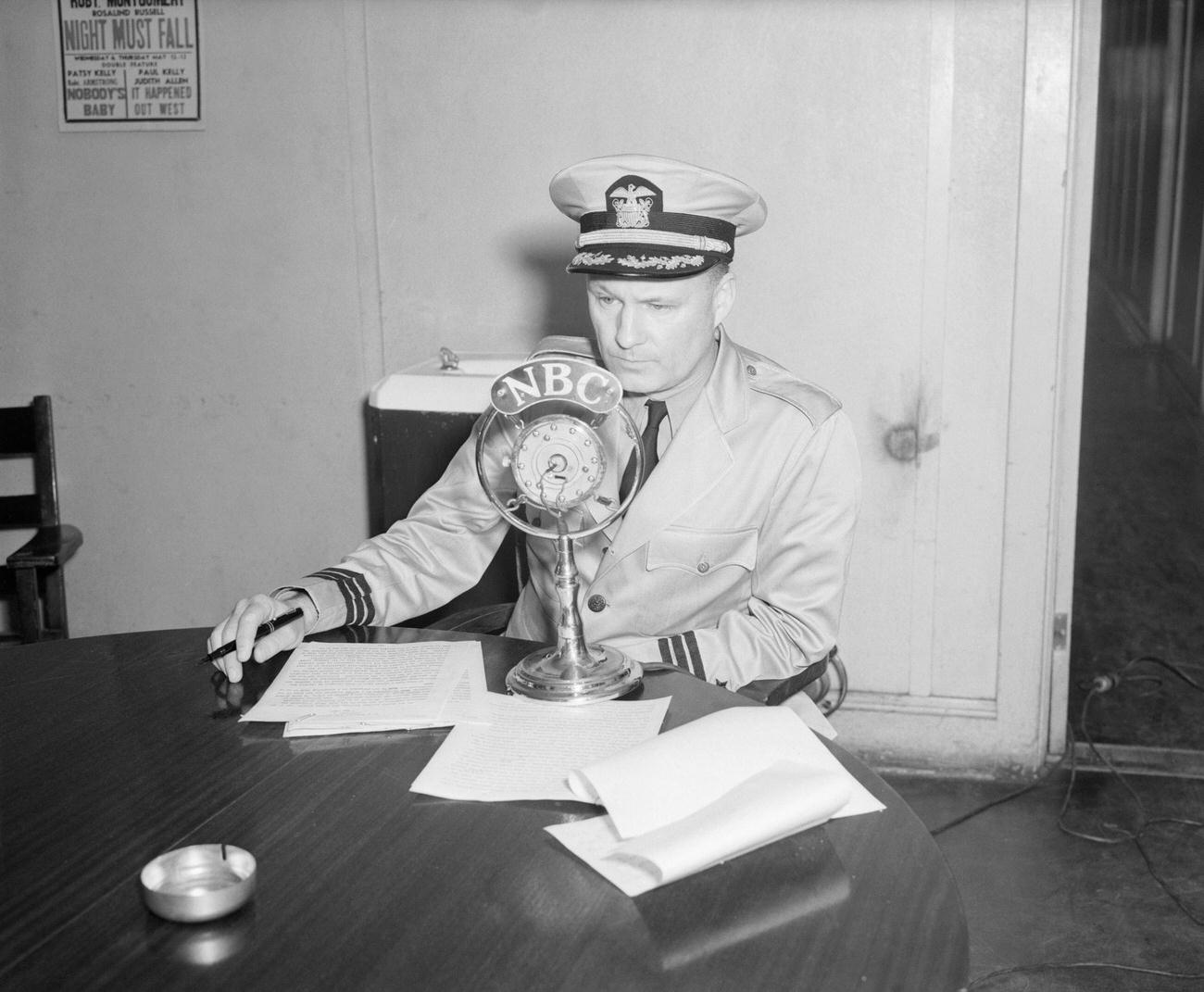
Under the crisp glare of indoor lighting, Charles E. Rosendahl sits at a plain table, uniform pressed and cap brim low, speaking into a prominent NBC microphone as papers lie spread beneath his hand. The setting is spare—bare walls, a chair pushed to the side, a tangle of cable near the floor—yet the equipment in the foreground signals a modern marvel for 1937: radio powerful enough to carry urgent news far beyond Lakehurst, New Jersey. His focused expression and the scripted pages suggest the careful balance between authority, accuracy, and speed demanded in the aftermath of the Hindenburg disaster.
Radio broadcasting during crises didn’t just report events; it shaped how the public experienced them in real time, turning a distant catastrophe into a shared national moment. The microphone’s circular grille and bold network lettering remind viewers that the story traveled through technology as much as through words, linking an airfield disaster site to living rooms and storefronts across the country. For anyone researching the Hindenburg, Lakehurst, or the evolution of breaking news, this photograph places a human figure—calm, controlled, and official—at the center of a rapidly changing media landscape.
Small details quietly deepen the scene: typed sheets prepared for transmission, a pen poised for last-minute edits, and a wall poster in the background that hints at the everyday world continuing just outside the broadcast room. Framed by these ordinary objects, Rosendahl’s broadcast becomes more than a historical footnote—it becomes a window into how inventions in communication and aviation collided in the 1930s, producing both awe and tragedy. As a piece of vintage news and radio history, the image captures the moment when technology, leadership, and public memory met at Lakehurst in 1937.