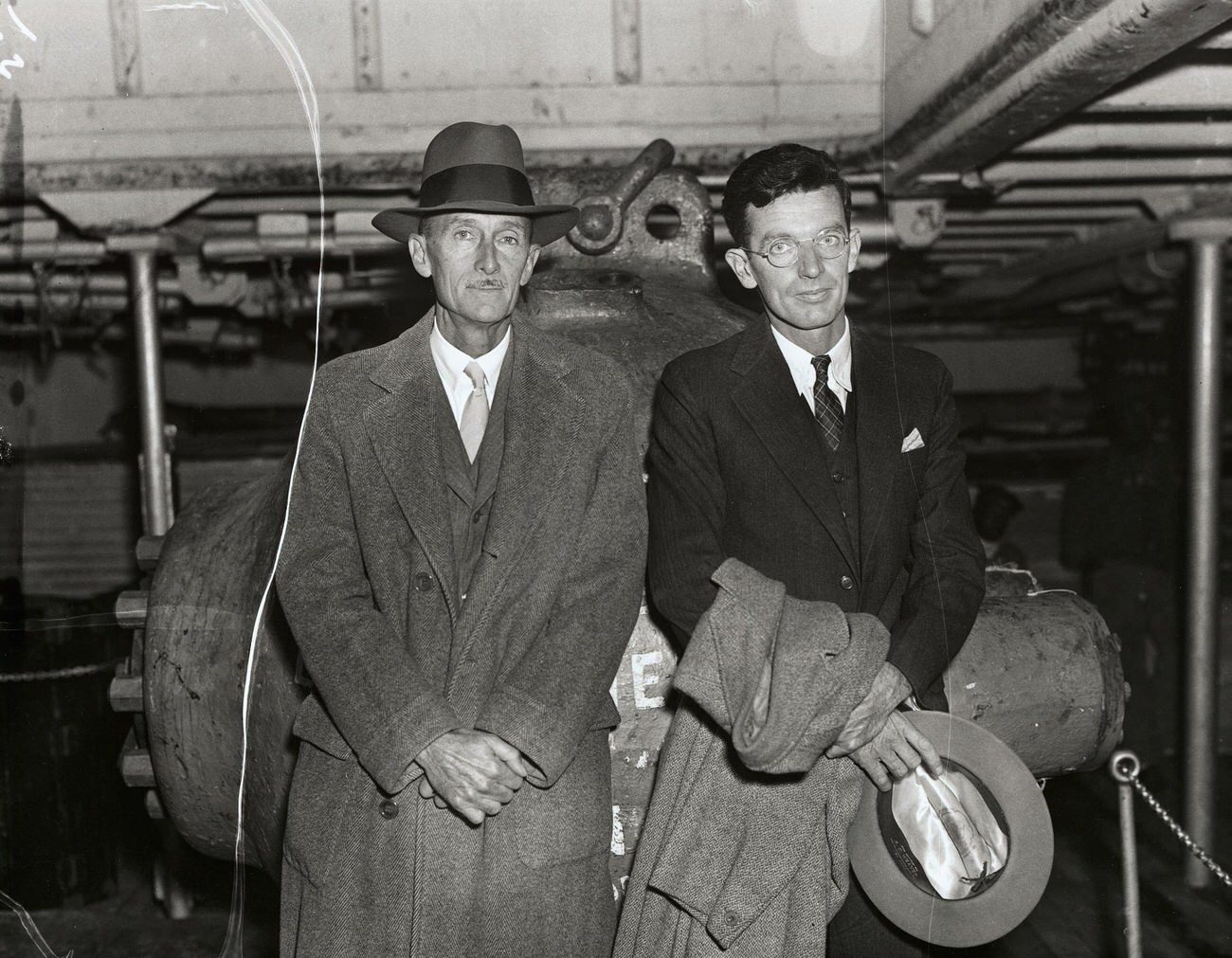
Fresh from their record-setting descent off Bermuda, William Beebe and J. Tee-Van stand with the calm poise of men who have just tested the ocean’s limits and returned to tell the story. Dressed in suits and hats rather than diving gear, they pose in an industrial shipboard setting where pipes, beams, and heavy metal fittings frame the moment. The contrast between everyday attire and extraordinary achievement gives this scene its quiet drama, emphasizing how exploration often depends on discipline and engineering as much as daring.
Behind them looms the bulky apparatus that hints at the technology that made such deep-sea work possible, a reminder that “Inventions” can be as vital to discovery as curiosity itself. The photo’s tight, enclosed background suggests the cramped practicality of life aboard a working vessel, where scientific ambition meets steel, chains, and machinery. Even without fanfare, their expressions read as focused and composed—less a victory lap than a brief pause before the next question.
Returning to New York after the dive, Beebe and Tee-Van embody an era when ocean exploration was becoming modern, mediated by pressure-resistant equipment and careful planning. For readers interested in the history of diving, marine science, and early twentieth-century innovation, this image offers a vivid touchstone: two explorers, a formidable piece of technology, and the promise of what lies beneath. It’s a compelling snapshot of how record dives captured public imagination while pushing the boundaries of what humans could safely observe in the deep.