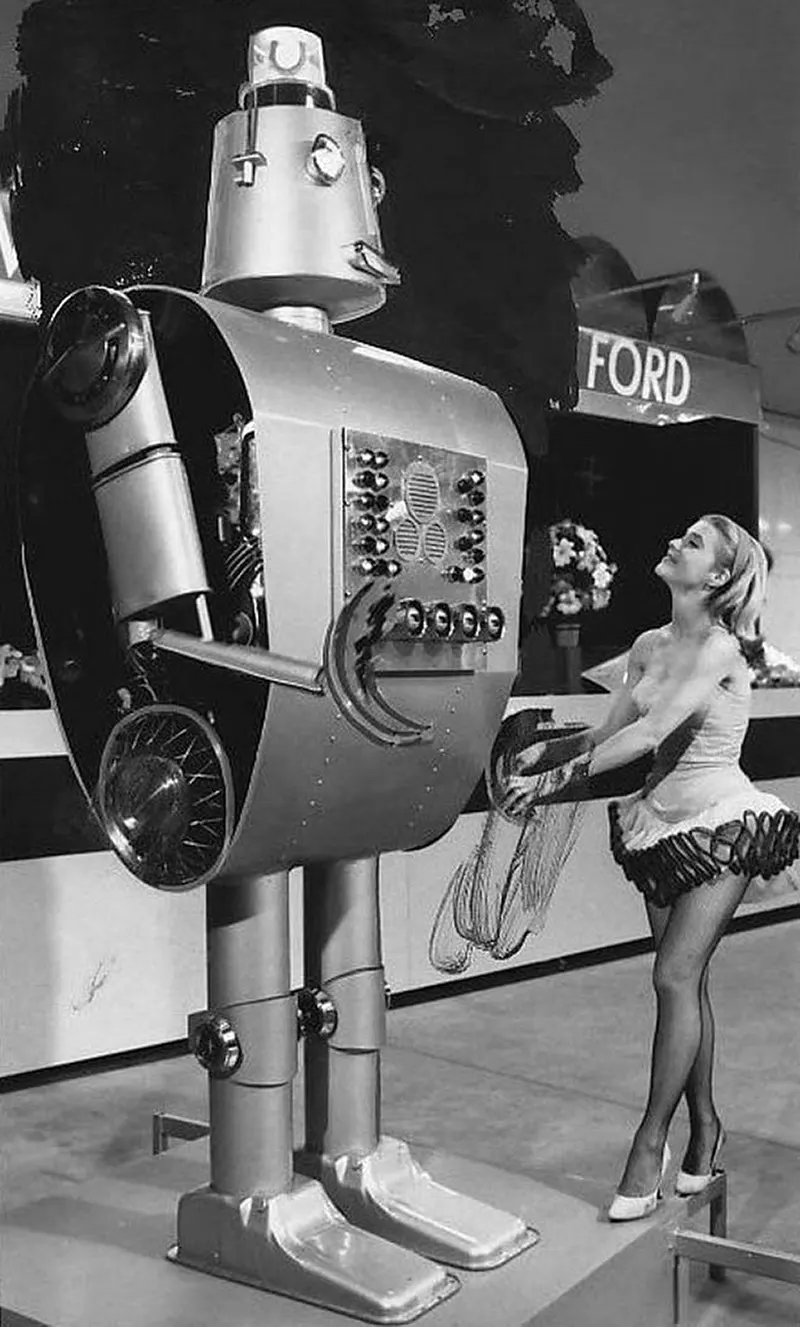
Freddie Ford, 1960 places us squarely in the era when “inventions” meant gleaming metal, push-button control panels, and robots that looked ready to step off a showroom floor. The towering figure at the center is an oversized mechanical man, all rounded shoulders and riveted plates, with a face shaped like a helmet and a chest packed with dials and switches—hardware meant to signal intelligence in the mid-century imagination. Even in black and white, the polished surfaces and bold, simplified geometry sell the promise of modernity.
To the right, a young woman in a short, ruffled outfit leans in with a theatrical sense of curiosity, holding what appears to be a coiled cable or rope, as if she’s about to “connect” the machine to power or coax it into action. Her pose and the robot’s calm, fixed stare create a staged, promotional energy typical of technology exhibitions and public demonstrations. Behind them, a sign with the word “FORD” anchors the scene in an industrial, corporate setting without spelling out the exact venue.
What makes this historical photo compelling is how clearly it reflects 1960’s optimism about automation and the future of work and leisure. The robot is less a practical device than a symbol—part invention, part entertainment, and part advertisement for a world where machines would stand beside people in everyday life. For readers interested in retro technology, mid-century design, and the cultural history of robots, Freddie Ford offers a vivid snapshot of the moment when tomorrow felt close enough to pose for.