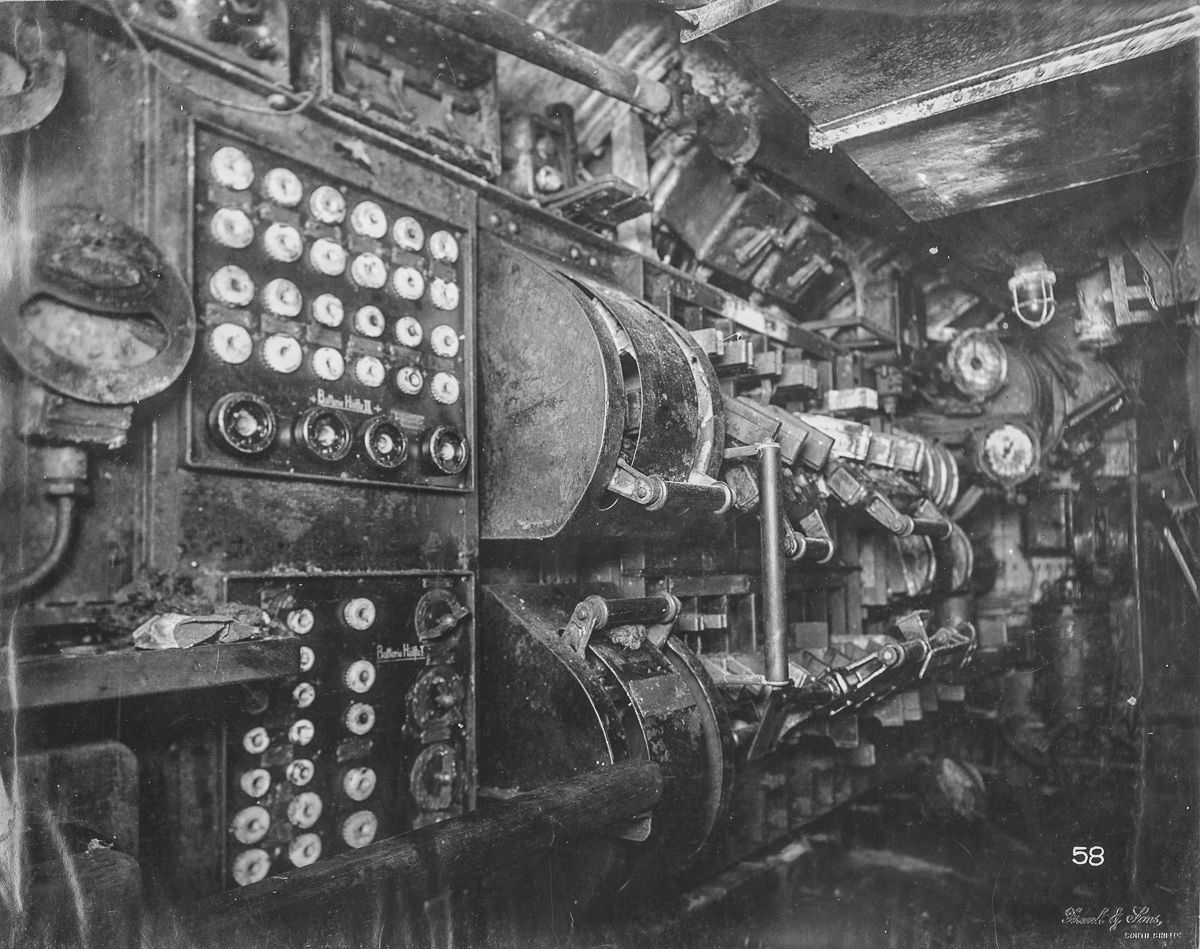
Deep inside the “Electric control room,” the camera lingers on a dense wall of switches, dials, and meter faces—an instrument panel built for constant attention. Heavy housings, thick cabling, and tightly packed components suggest an era when electrical power was managed through tactile hardware rather than screens, with every reading and adjustment made by hand. The scene feels more like the inside of a machine than an office, where engineering decisions were measured in needle movements and the click of contacts.
Along the left side, clustered gauges and labeled controls create a visual map of the system’s pulse, while the long mechanical assembly stretching into the background hints at the equipment being governed—perhaps motors, generators, or related industrial apparatus. The overhead piping and rugged construction point to a working environment shaped by heat, vibration, and noise, the kind of place where reliability mattered more than comfort. Even without people present, the room reads as occupied: instruments set at the ready, built to be watched.
Inventions often become “invisible” once they’re commonplace, but a historical photo like this makes the infrastructure of electrification visible again. For readers searching for early electrical engineering, industrial control panels, or the history of power distribution, this image offers a striking reminder of how complex systems were once tamed through analog controls and disciplined routine. It’s a portrait of technology in its working clothes—practical, imposing, and quietly transformative.