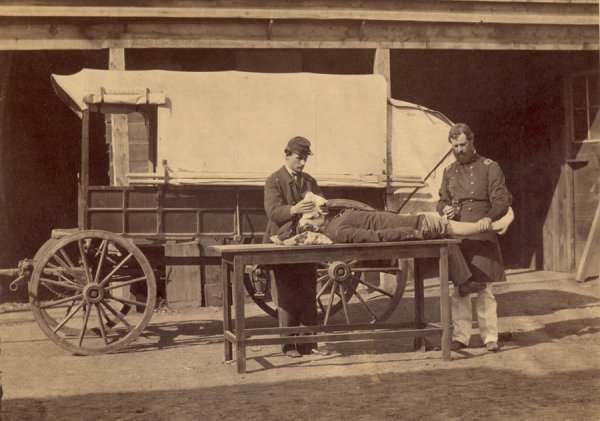
Set in front of a canvas-topped army medical wagon, a stark field demonstration unfolds with a patient stretched across a simple table, boots still on and body laid out as if for surgery. Two uniformed figures flank him—one at the head, hands busy with a cloth and small apparatus, the other standing watch near the feet—turning a utilitarian courtyard into an improvised operating area. The wagon’s large wooden wheels and tidy compartments emphasize how military medicine had to be mobile, ready to roll wherever casualties demanded attention.
The title points to anesthesia, and the scene aligns with that practice: the caregiver at the patient’s face appears to administer an inhaled agent, a method increasingly used to dull pain during amputations in wartime. Amputation was often the grim solution to shattered limbs, but the growing use of anesthetics marked a crucial shift in surgical care, even when conditions were rough and resources limited. Here, the focus is not dramatic heroism but procedure—controlled, instructive, and designed to be repeated under pressure.
For readers exploring Civil War medical history, this photograph offers a grounded look at the tools, posture, and proximity that defined battlefield treatment and emergency surgery. It also highlights the tension between innovation and necessity: modern ideas about pain relief practiced in the shadow of mass injury, on a table that could be assembled almost anywhere. As a historical photo, it’s an unvarnished window into army medical logistics, surgical training, and the early realities of anesthesia in wartime care.