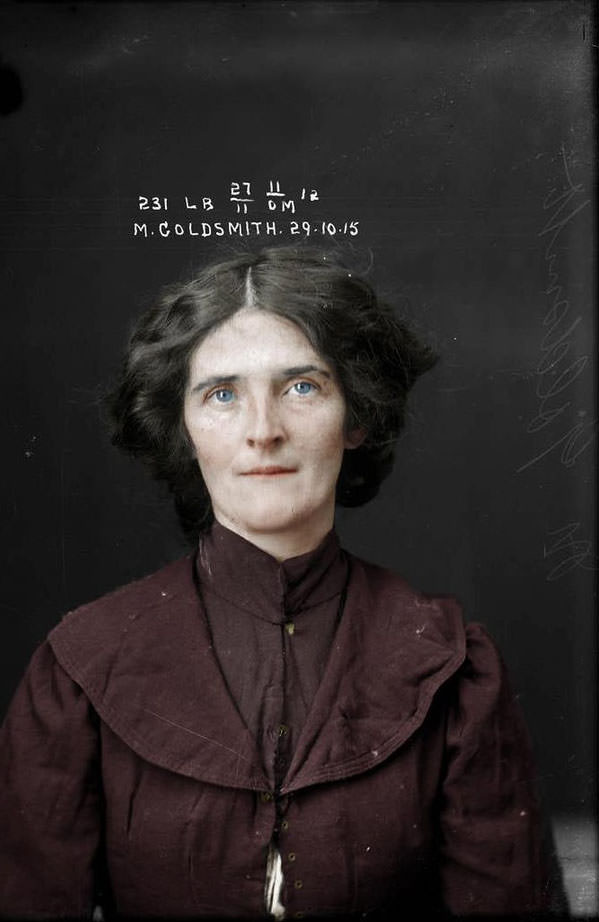
Muriel Goldsmith faces the camera with an unguarded steadiness, her pale blue eyes made strikingly immediate through modern colorization. The dark studio backdrop and tight framing pull attention to her features and clothing rather than any sense of place, a visual choice common to institutional portraiture. Above her head, the chalked identifiers—“231 L.B” and “M. Goldsmith 29.10.15”—anchor the image to paperwork and procedure, turning a person into a record.
In the title’s details—“Thief,” a criminal record number, and the State Reformatory for Women at Long Bay, NSW—lies the machinery of early 20th‑century justice as it applied to women. The dress, buttoned high at the collar, reads as practical and restrained, while her carefully parted hair suggests the small acts of order that survived even under custody. Fine scratches and marks across the plate hint at the photo’s age and handling, reminders that this portrait was an administrative tool long before it became a historical artifact.
Colorization changes how we meet her gaze, shifting the document from distant monochrome to something closer to lived reality. Yet the blunt label in the title remains, prompting questions about what “thief” meant in 1915 New South Wales—poverty, opportunity, circumstance, or choice—and how little of that complexity fits on a single line of text. For researchers and family historians alike, this Long Bay reformatory record is a stark entry point into prison history, women’s lives, and the archival traces left behind by the state’s need to catalogue and control.