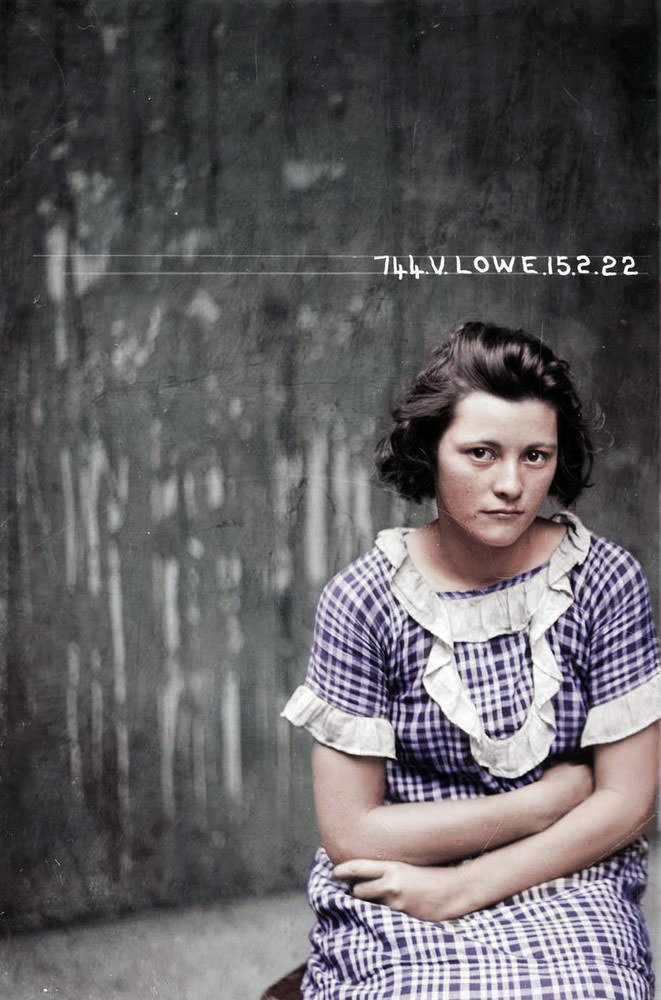
Valerie Lowe’s gaze meets the camera with a steady, unsoftened honesty, the sort of look that turns a police-station record into a lingering human story. Set against a worn, streaked wall at Sydney’s Central Police Station, she sits with her arms folded in a guarded posture, wearing a checked dress trimmed with a pale ruffle that reads as carefully chosen even in a formal, controlled setting. Chalked across the upper background, the notation “LOWE 15.2.22” anchors the moment to the date named in the title, a quiet reminder of how routinely lives were reduced to a line of text.
Colorization shifts the emotional temperature of the scene, pulling Valerie forward from the grey anonymity typical of early twentieth-century documentation. The muted purples and creams of her clothing, the natural tones of skin and hair, and the soft fall of light across her face make the photograph feel less like an archive and more like an encounter. Details that might otherwise blur—fabric texture, the edge of the collar, the tension in her hands—become part of the narrative, encouraging the viewer to linger.
Police photography from this era often aimed for clarity and control, yet the result can be unexpectedly intimate, especially when the subject’s expression refuses to become mere evidence. The Central Police Station, Sydney setting matters here, not as a backdrop for sensationalism but as a symbol of the institutions that catalogued ordinary people alongside extraordinary events. For readers searching family history, Australian archives, or early Sydney police records, this restored portrait offers both a valuable reference point and a respectful prompt to consider the person behind the paperwork.