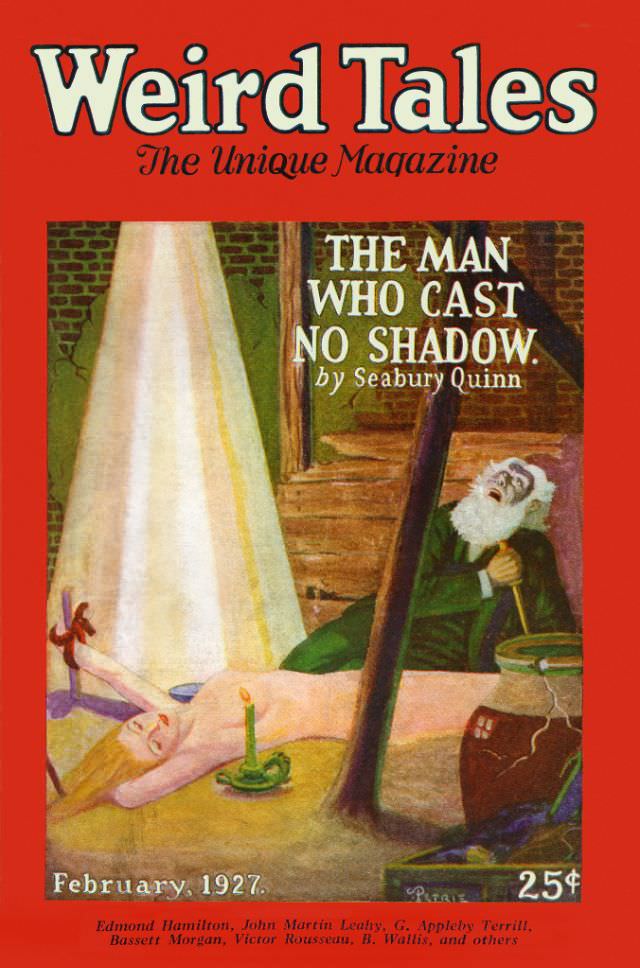
Bold red borders and oversized lettering announce **Weird Tales** with the proud tagline “The Unique Magazine,” pulling the eye straight into the lurid drama that made pulp fiction unforgettable. The February 1927 cover promises chills with the featured story title, “The Man Who Cast No Shadow,” credited to Seabury Quinn, a name closely associated with the magazine’s eerie, fast-paced brand of horror and mystery. Even before a reader turns a page, the design sells suspense: high-contrast typography, theatrical staging, and a color palette meant to pop on a crowded newsstand.
Inside the illustration, a tense tableau unfolds on rough wooden floorboards against a dark brick backdrop, lit by a sharp beam that feels like a spotlight from another world. A pale figure lies sprawled across the foreground, while a small candle and scattered objects suggest a ritual-like atmosphere—part crime scene, part séance, all melodrama. Off to the right, an older bearded man recoils in alarm, his posture and expression amplifying the sense that something unnatural has just occurred.
Details at the bottom root the artwork in its original marketplace, from the clear “February, 1927” dating to the prominently printed “25¢” price, reminders of an era when pulp magazines were cheap thrills with vivid cover art doing most of the advertising. For collectors, researchers, and fans of classic weird fiction, this cover is a compact lesson in how 1920s horror imagery blended theatrical fear, suggestive symbolism, and sensational storytelling hooks. As a historical artifact, it also highlights the visual language that helped define Weird Tales and the broader pulp magazine tradition.