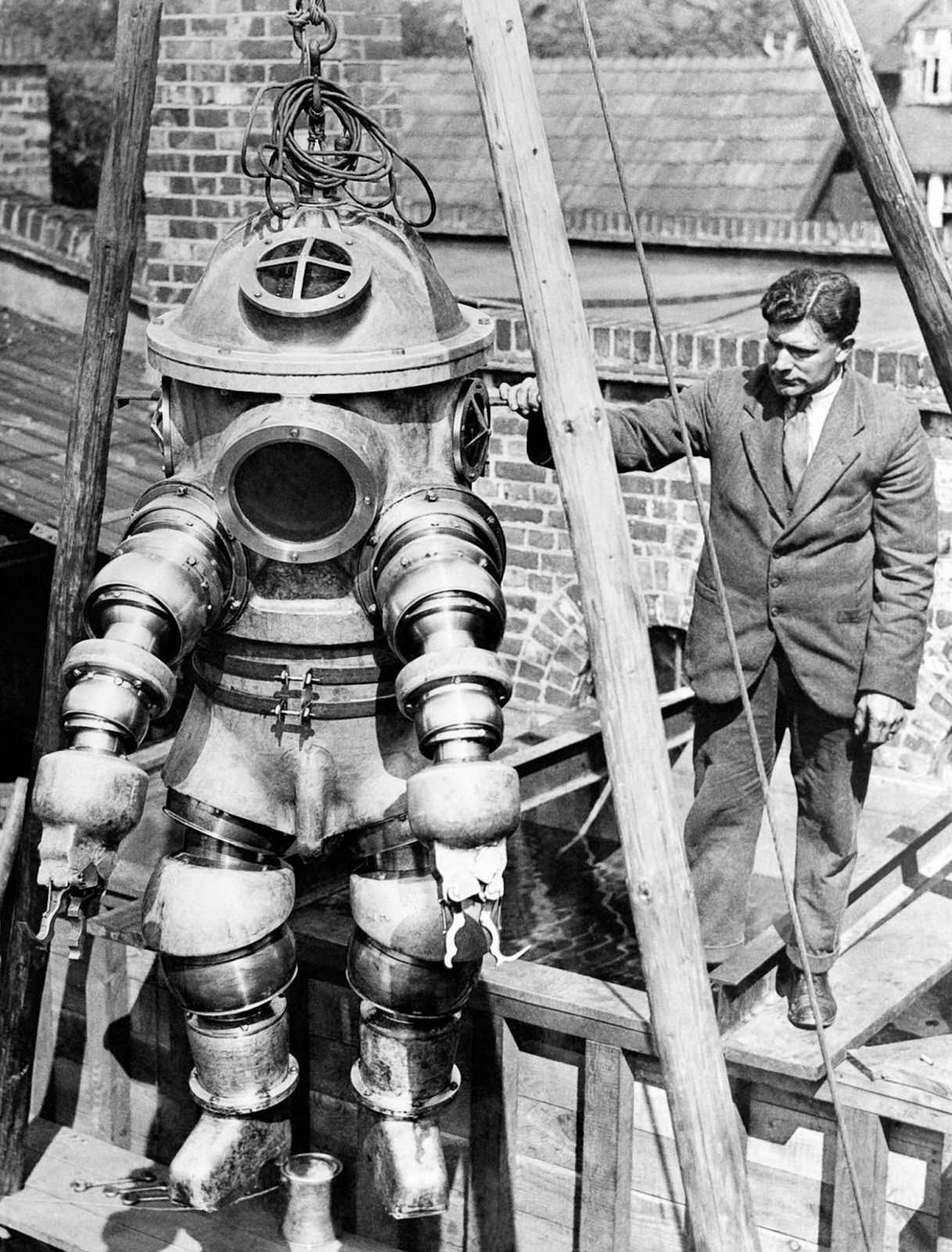
Steel, rivets, and thick glass dominate the frame, where an early diving suit hangs from a hoist like a mechanical body awaiting its wearer. The helmet’s round viewing ports and heavy joints hint at the engineering challenges of working underwater in the early 20th century, when every seal, bolt, and hose connection mattered. Behind it, brickwork and rooftop lines place this “Suit, 1930.” moment firmly in the built environment of its era, where industry and everyday architecture met.
A man in a tailored suit stands close by, his posture suggesting inspection or demonstration rather than labor, an intriguing contrast to the hulking apparatus beside him. That juxtaposition—street clothing next to specialized survival gear—captures the spirit of “Inventions” as much as any blueprint: ideas moving from workshop to real-world use. Details like the suspended cables and the staged setup imply testing, display, or preparation, emphasizing the careful handling these pioneering systems required.
Browsing this historical photo today offers a tactile sense of how underwater technology once looked and felt, long before sleek modern scuba equipment became common. The design reads as both protective armor and precision instrument, built to extend human reach into an alien environment. For readers interested in vintage diving equipment, early industrial innovation, or 1930s engineering, the image provides a vivid, SEO-friendly window into the era’s practical ingenuity.