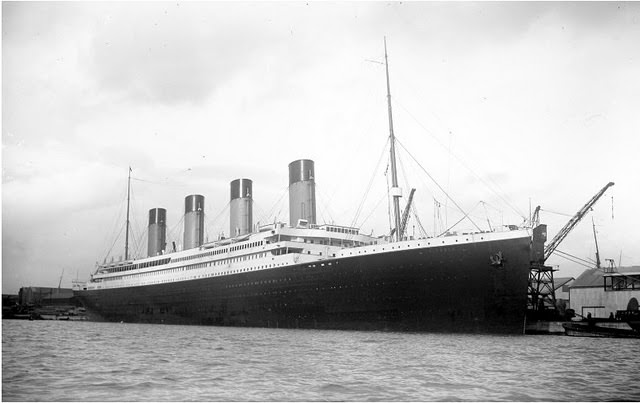
Dominating the waterfront with four towering funnels and a hull that seems to stretch beyond the frame, the Titanic appears here as a finished statement of industrial confidence. The low angle from the waterline emphasizes scale, turning steel plates, portholes, and railings into a repeating pattern that hints at the ship’s layered decks and sprawling interior. Nearby dockside structures and equipment look small by comparison, underscoring why contemporary observers spoke of the liner in near-mythic terms.
Behind that imposing silhouette lies a story of construction that blended brute-force labor with cutting-edge inventions for the era. Shipyard cranes, riveting crews, and precise fitting of massive sections transformed raw materials into a transatlantic passenger liner engineered for speed, comfort, and perceived safety. Details visible in the superstructure—clean deck lines, orderly lifeboat arrangement, and the symmetry of the funnels—suggest the careful planning that made the Titanic a symbol of modern maritime design long before it became a legend.
Reading the image today, it’s easy to understand how the ship’s rise to fame began even before any maiden voyage: the Titanic was marketed as a triumph of technology, luxury, and engineering ambition. That reputation—“unsinkable” in popular language—was built as much in the shipyard as it was in newspapers, advertisements, and public imagination. For historians and enthusiasts searching for Titanic construction history, early 20th-century shipbuilding, and the inventions that shaped ocean travel, this photograph offers a sober, compelling window into the moment when possibility seemed as vast as the ship itself.