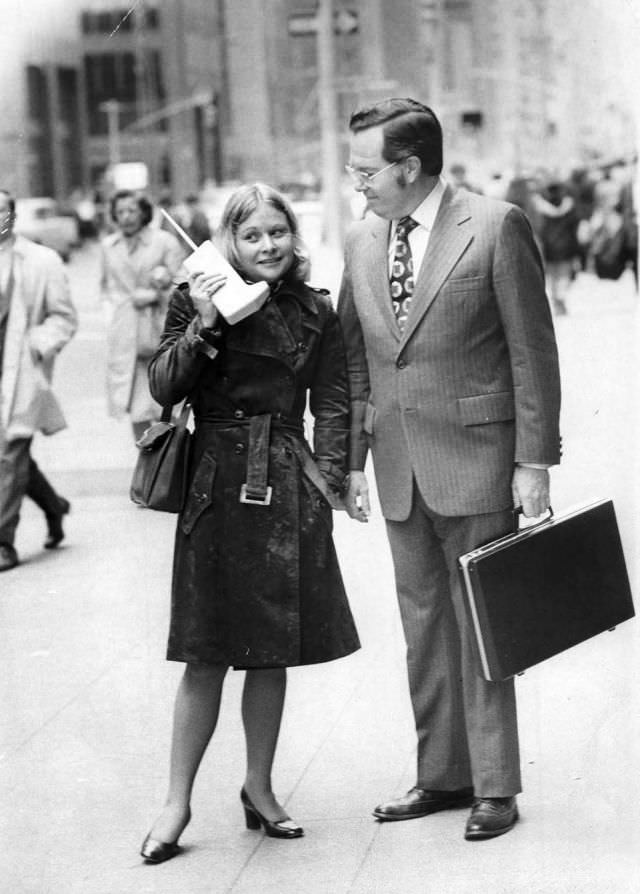
On 6th Avenue in New York, Jeanne Bauer moves through the Midtown sidewalk crowd with a bulky Motorola DynaTAC pressed to her ear, its long antenna and brick-like body announcing a future that hasn’t quite arrived yet. The contrast is the point: everyday coats, handbags, and hurried pedestrians surround a device that looks more like lab equipment than a consumer product. Even without sound, the scene suggests curiosity and disruption, the moment when “phone call” begins to detach from a wall, a desk, and a fixed address.
Beside her walks John Mitchell, the Motorola engineer credited in the title as the mind behind the phone, dressed for business with a briefcase in hand and an attentive glance toward the handset. Their pairing reads like a live demonstration staged in the open air—technology tested not in a showroom but in the real flow of the city. The DynaTAC becomes the star prop, a portable communications invention large enough to be unmistakable, inviting stares and questions from anyone passing by.
For readers interested in the history of the mobile phone, this 1973 street photograph offers an immediate sense of scale, ambition, and public performance at the dawn of cellular-era ideas. New York’s busy avenue provides the perfect backdrop: a place where speed and connectivity feel necessary, and where innovations are judged instantly by whether they can keep up. As a WordPress post image, it anchors discussions of Motorola, early handheld devices, and the origins of modern wireless communication in a single, memorable walk down the sidewalk.