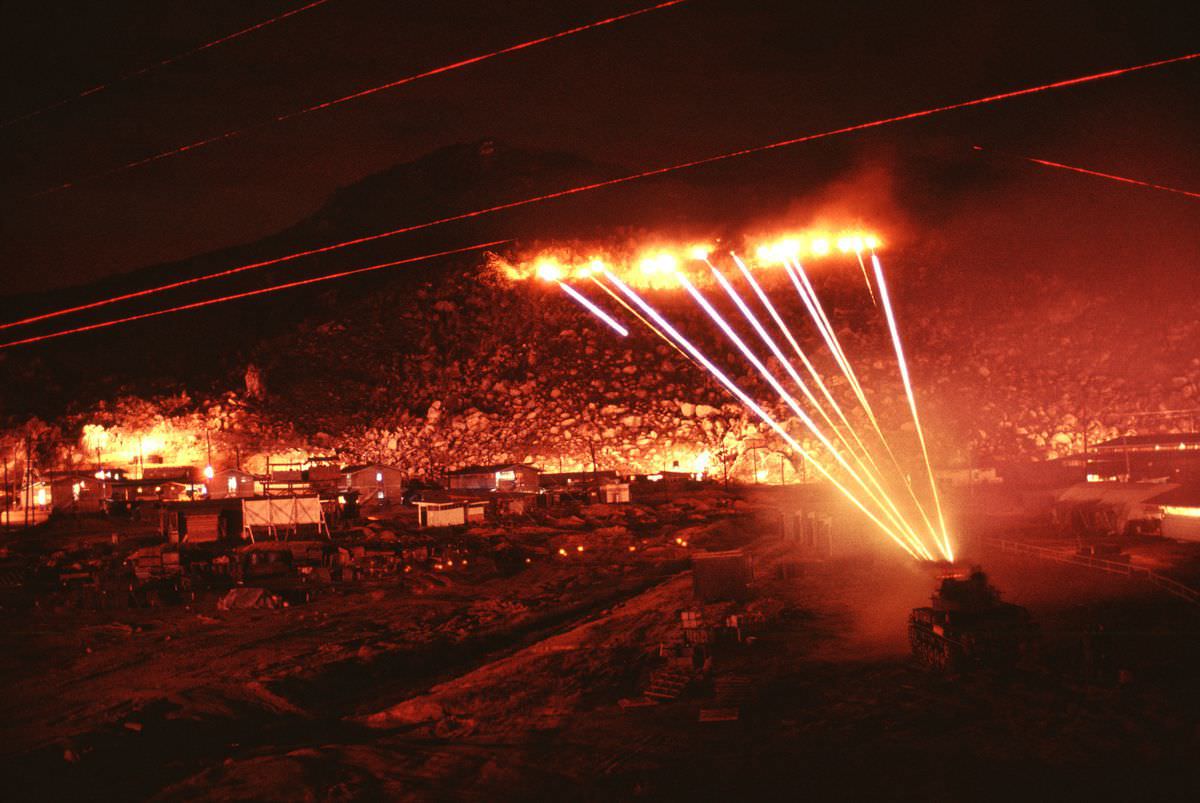
Streaks of tracer fire carve bright, straight lines across a night sky as an M42 “Duster” unleashes a sustained burst toward a rocky hillside. The long exposure turns muzzle flashes into a glowing band along the slope, while the vehicle’s position in the foreground anchors the scene like a spotlighted stage of modern war. Below the ridge, low buildings and scattered structures sit in harsh orange light, emphasizing how close the fighting could press against inhabited ground.
Built as an anti-aircraft platform, the M42’s twin .50-caliber machine guns were frequently turned on targets on the ground during the Vietnam War, where visibility, terrain, and sudden contact demanded immediate firepower. The title’s mention of high explosive .50-caliber fire points to the specialized ammunition that could add blast and incendiary effect to the already punishing volume of tracers. In one frame, the photograph communicates the weapon’s purpose on a battlefield defined by darkness—lighting the landscape, marking aim, and saturating a suspected position.
Night combat photography like this is as much about atmosphere as documentation, capturing the sensory reality soldiers described: heat, noise, and the unsettling beauty of ballistic arcs. The hillside becomes a canvas of light and smoke, and the base-like sprawl beneath it hints at the logistical footprint that followed the front line. For readers searching Vietnam War photos, M42 Duster history, or .50-caliber tracer fire, this image offers a stark, unforgettable glimpse of how firepower transformed the night into daylight.