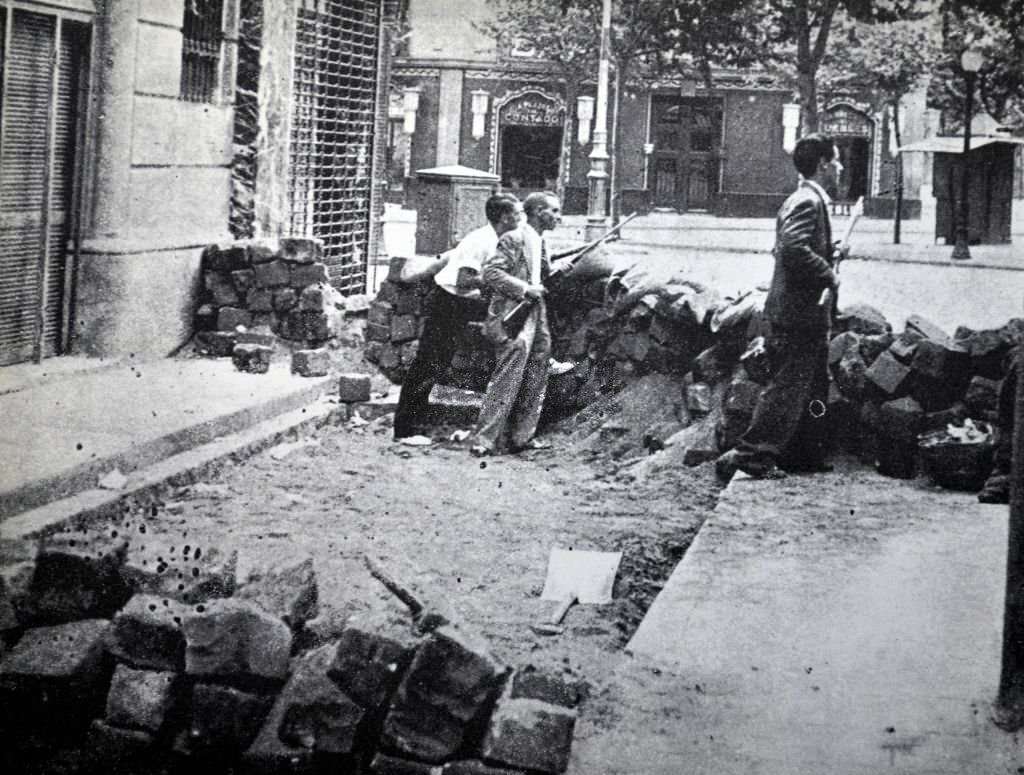
Barricades of rough stone and torn-up pavement cut across a Barcelona street, turning an ordinary thoroughfare into an improvised fortress during the Spanish Civil War in 1937. The trench-like gap in the roadway and the stacked rubble speak to a city reshaped in haste, where construction materials and street cobbles became tools of survival. Even the surrounding façades—shuttered windows, heavy doorways, and a quiet corner storefront—feel suddenly exposed in the open air of conflict.
At the edge of the makeshift wall, armed men crouch and lean forward, using the barricade as cover while they watch the street beyond. Their posture suggests both vigilance and uncertainty, a reminder that urban warfare often unfolded at close range, with danger arriving from the next intersection rather than a distant front. The scene carries the tense rhythm of civil wars: moments of waiting, quick decisions, and neighborhoods pulled into the struggle.
Barcelona’s wartime barricades have become one of the most enduring symbols of the conflict’s street-level reality, where politics, fear, and community defense collided in public spaces. For readers exploring Spanish Civil War history, this photograph offers a stark, ground-level view of how cities adapted—blocking roads, digging trenches, and redefining everyday architecture as battlefield terrain. It’s a fragment of 1937 that captures the vulnerability of the urban home front and the heavy cost of a war fought among streets and doorsteps.