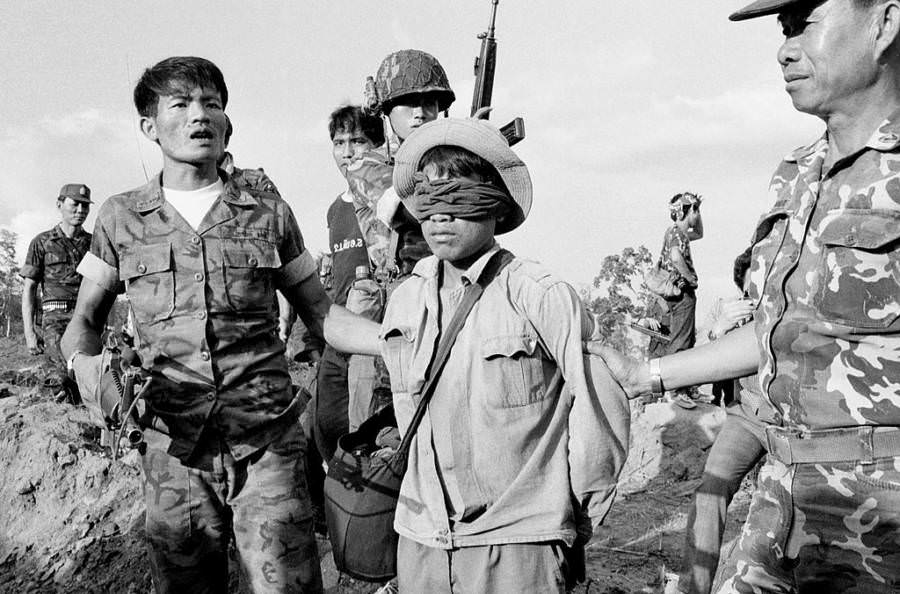
Along the Cambodian–Thai border in Aranyaprathet, this 1985 scene freezes a tense moment from the civil wars that spilled across frontiers and into refugee corridors. A blindfolded Cambodian soldier stands at the center of the frame, held by armed men in camouflage, his posture rigid beneath a brimmed hat and travel-worn clothing. The stark contrast and close proximity of bodies convey how quickly a combatant could become a captive in the confusion of shifting lines and uncertain allegiances.
Details in the photograph pull the viewer into the mechanics of conflict: rifles carried at the ready, watchful faces half-turned toward something outside the frame, and the uneven ground that suggests a makeshift position rather than a formal barracks. The prisoner’s bag and strap hint at movement—perhaps a patrol, a retreat, or an attempted crossing—while the blindfold speaks to fear, control, and the fragile boundary between military procedure and raw coercion. In the background, more figures and weapons create a layered tableau of authority, anxiety, and improvisation.
For readers searching for Khmer Rouge-era history, Cambodia civil war photography, or Aranyaprathet Thailand 1985, this image offers a grounded entry point into a wider story of displacement and borderland warfare. It underscores how Thailand’s frontier became a stage where Cambodian factions, local forces, and civilians collided in the aftermath of revolution and genocide. Seen today, the photograph functions as both evidence and warning: war is not only fought in jungles and capitals, but also in the liminal spaces where people are captured, processed, and forgotten.