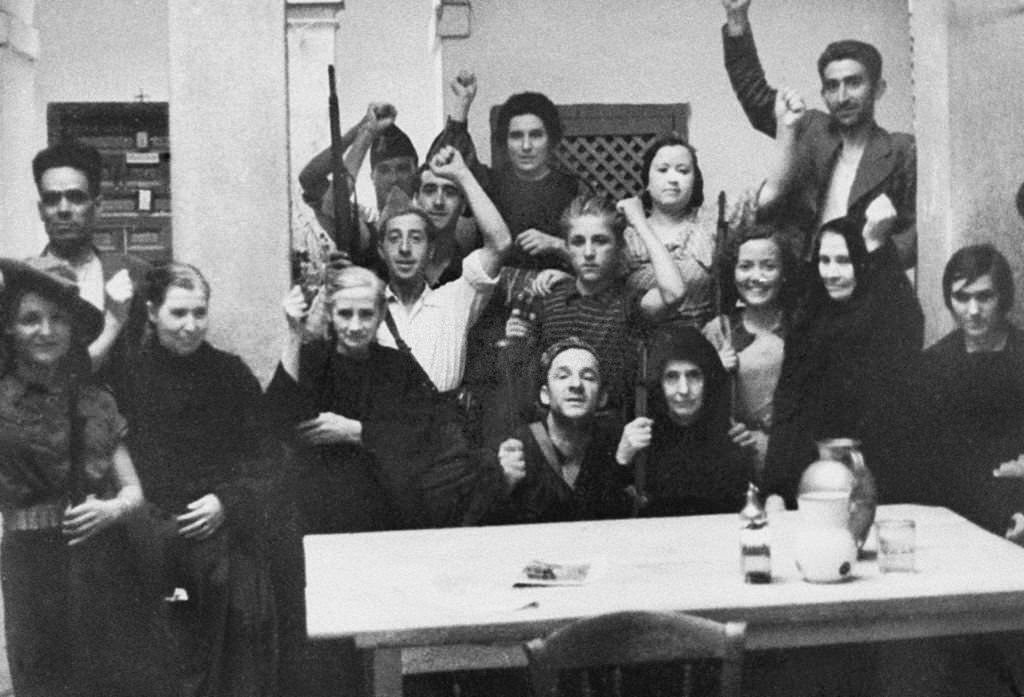
Inside a Toledo convent during the Spanish Civil War, a tense, crowded scene unfolds around a plain table, where religious women sit shoulder to shoulder with armed government militiamen. Several figures lift clenched fists in a gesture that reads as political theater, solidarity, or defiance depending on the viewer’s eye, while others keep their faces guarded and still. Civilian clothing and improvised postures suggest a moment when normal identities were being rewritten in real time.
Uniforms are absent, yet weapons and raised arms make the wartime context unmistakable; the camera catches the uneasy mix of protection and pressure that could surround nuns in Republican-held areas. The women’s dark dresses and head coverings contrast with the militiamen’s workwear, turning the group portrait into a study of divided symbols sharing the same room. On the tabletop, everyday objects sit in sharp relief—small domestic details that underline how conflict moved into kitchens, cloisters, and common spaces.
Such photographs from Spain’s civil wars era are rarely simple documents; they are evidence of power, fear, propaganda, and survival layered into a single frame. The title’s claim—nuns in civilian clothes, guarded by governmental militiamen—points to the precarious strategies used to keep people alive when faith and politics collided. For readers searching the history of Toledo, convent life, and the Spanish Civil War, this image offers a stark reminder of how quickly sanctuary could become a frontline.