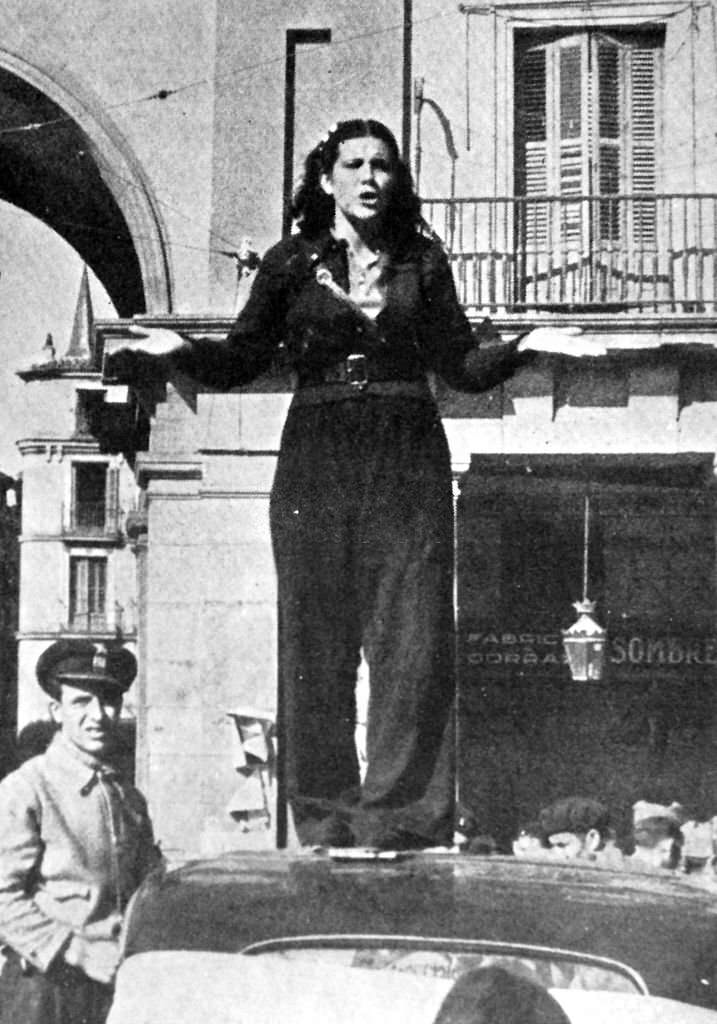
In the middle of Madrid’s tense 1936 streetscape, a Republican militia woman stands elevated above the crowd, arms opened in a forceful appeal. Her dark uniform and belted waist read as practical, disciplined, and unmistakably militant, while her expression suggests urgency rather than ceremony. Behind her, balconies, shutters, and stone façades frame the scene like a public stage, turning an ordinary urban corner into a moment of wartime politics.
The composition is crowded with small clues: a man in a cap near the foreground glances toward the camera, and the top of a vehicle anchors the speaker’s impromptu platform. Light catches the architectural details and the speaker’s face, emphasizing the drama of public address during the Spanish Civil War. Even without hearing the words, the posture and setting convey a rallying speech—part warning, part encouragement—aimed at civilians caught in a rapidly shifting conflict.
Women in Republican militias became powerful symbols in early war imagery, and photographs like this helped circulate ideas about resistance, participation, and the redefinition of public roles. For readers searching Spanish Civil War history, Republican Madrid, or female militia guards in 1936, the picture offers a vivid entry point: propaganda and spontaneity intertwined on a city street. It preserves not only a person addressing a crowd, but the charged atmosphere of a capital learning to live—and speak—through crisis.