Category: Civil Wars
Explore the human side of civil wars through authentic historical photographs. Witness the struggles, courage, and consequences of divided nations.
These images document key events and personal moments that shaped political and social transformations around the world.
-
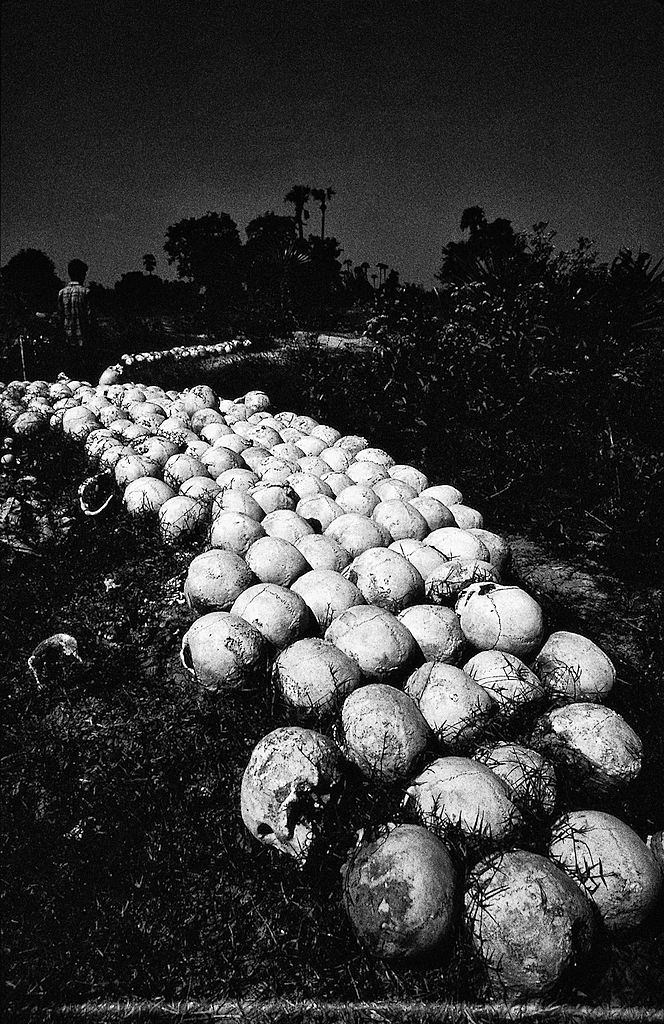
#49 The Killing Fields at Choeung Ek just a few kilometers south of Phnom Penh
Rows of human skulls lie in the grass at Choeung Ek, the Cambodian “Killing Fields” located just a few kilometers south of Phnom Penh. The stark contrast of pale bone against dark earth makes the scene feel both forensic and intimate, turning the landscape itself into a witness. In the distance, small figures and tree…
-
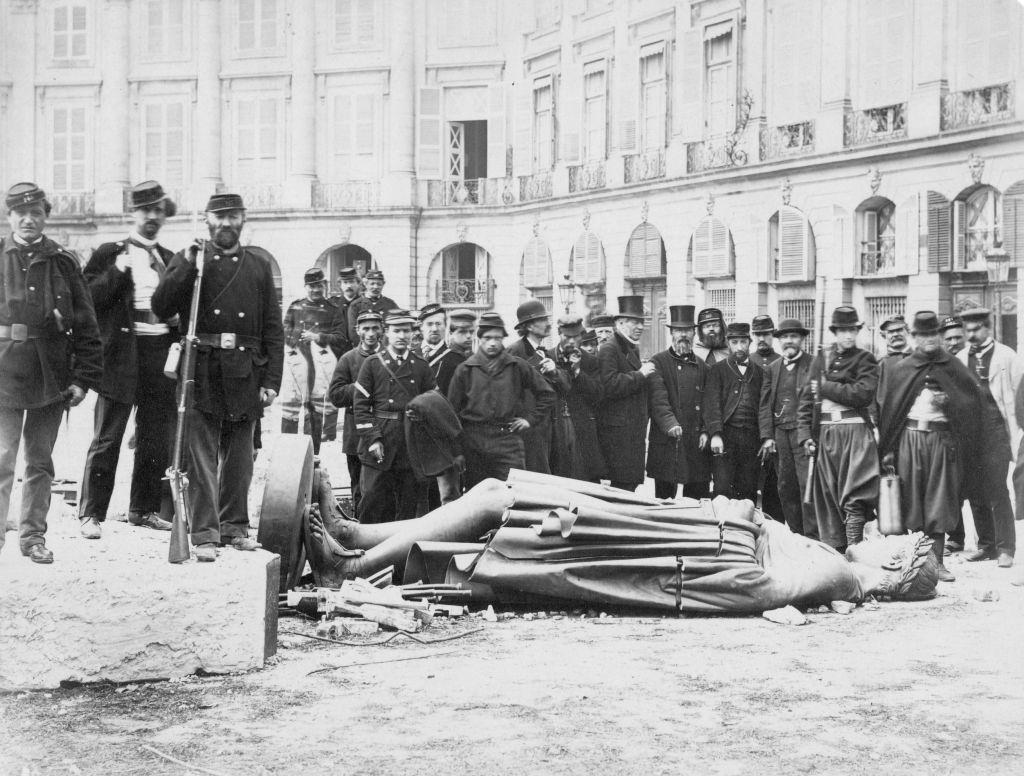
#12 The overthrow of the statue of Napoleon I which was on top of the Colomne Vendome, 1871.
Stretched across the ground, the fallen figure of Napoleon I lies amid dust and broken masonry, its laurel-crowned head turned toward a tight ring of onlookers. Uniformed men with rifles stand nearest, while civilians in dark coats and brimmed hats gather behind them, their faces fixed on the toppled bronze as if taking stock of…
-
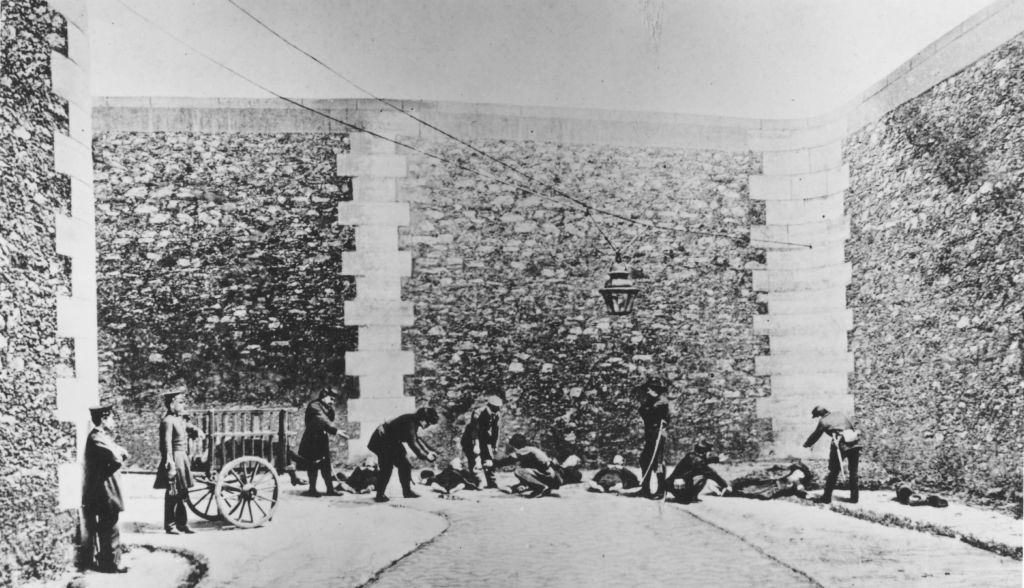
#28 Troops collecting bodies after the Paris Commune, at the end of the Franco-Prussian War.
Under a high stone archway, soldiers and laborers move with grim purpose along a bare roadway, bending to lift the dead and gather them into a rough line. A small cart with wooden wheels waits nearby, while scattered hats and dark bundles on the ground suggest how sudden and chaotic the violence was. The harsh…
-
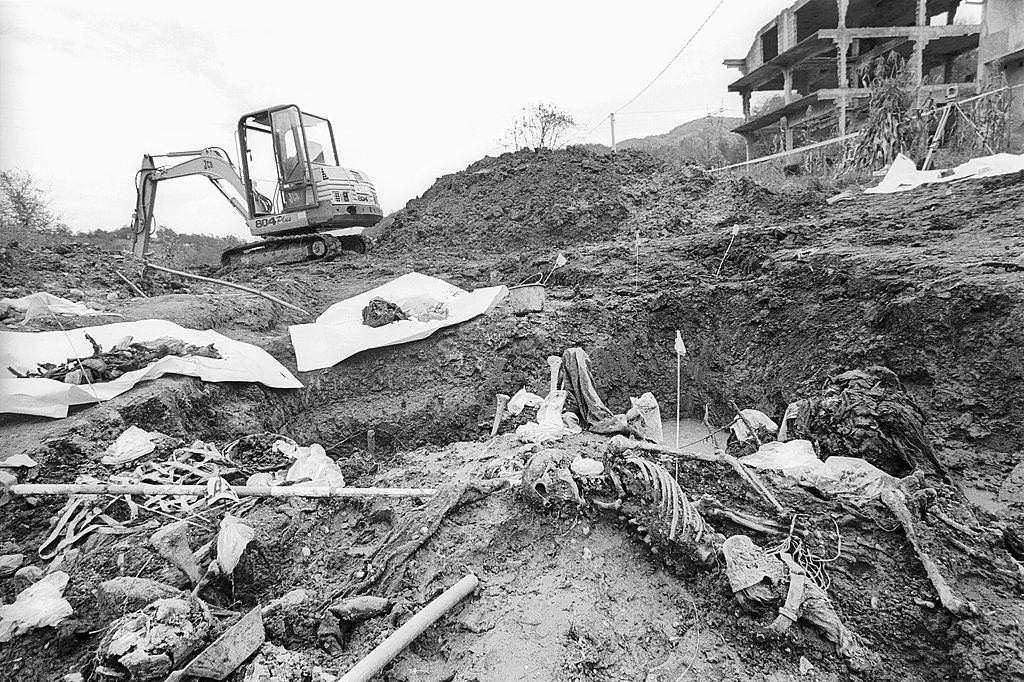
#2 A mass grave containing the bodies of men massacred in Srebrenica in July 1995.
Mud, torn fabric, and exposed bones lie in the foreground as a mechanical excavator sits on the ridge above, turning the earth where a mass grave has been opened. The stark contrast between human remains and heavy equipment underscores the grim work of recovery after atrocity. Taken in the context of Srebrenica in July 1995,…
-
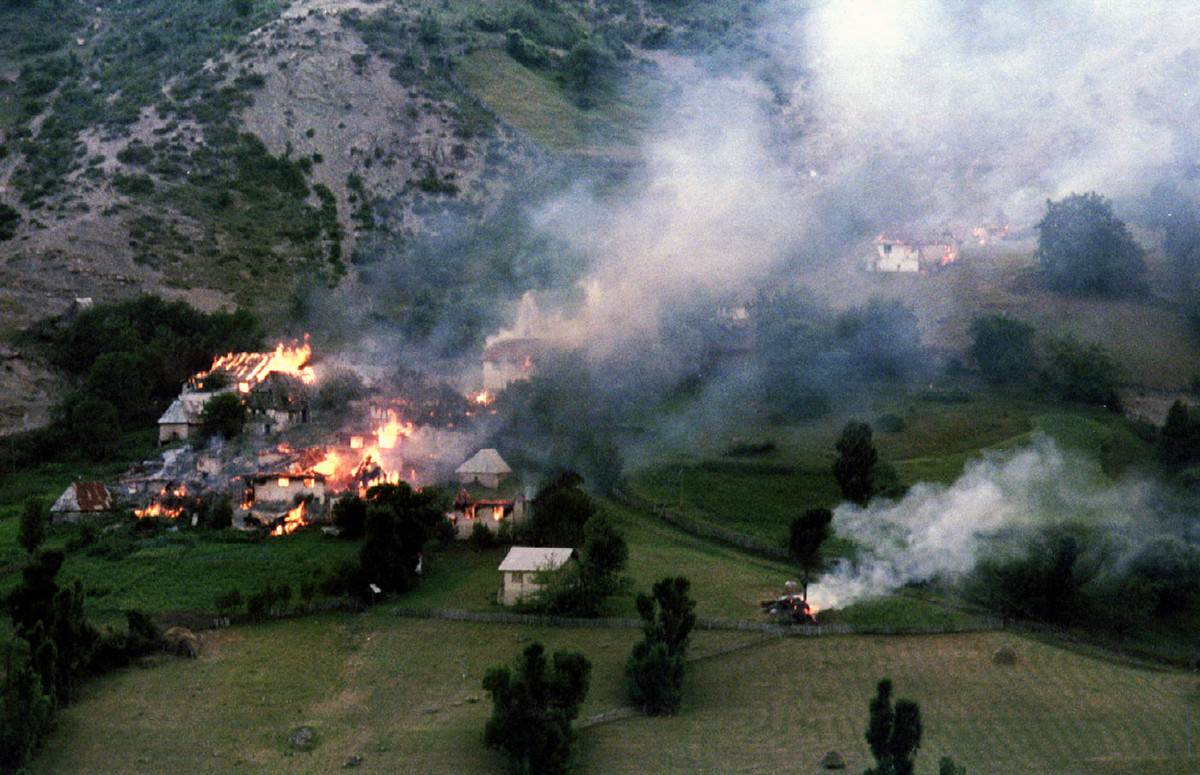
#18 Smoke and flames rise from houses set on fire by heavy fighting between Bosnian Serbs and Muslims in the village of Ljuta on Mount Igman some 40km southwest from the besieged Bosnian capital of Sarajevo, on July 22, 1993.
Smoke billows across the green slopes of Mount Igman as flames chew through a cluster of village houses in Ljuta, turning a quiet rural landscape into a battlefield scar. From a distance the blaze reads like a jagged line of orange against dark roofs and trees, while gray plumes drift over fields and orchards that…
-
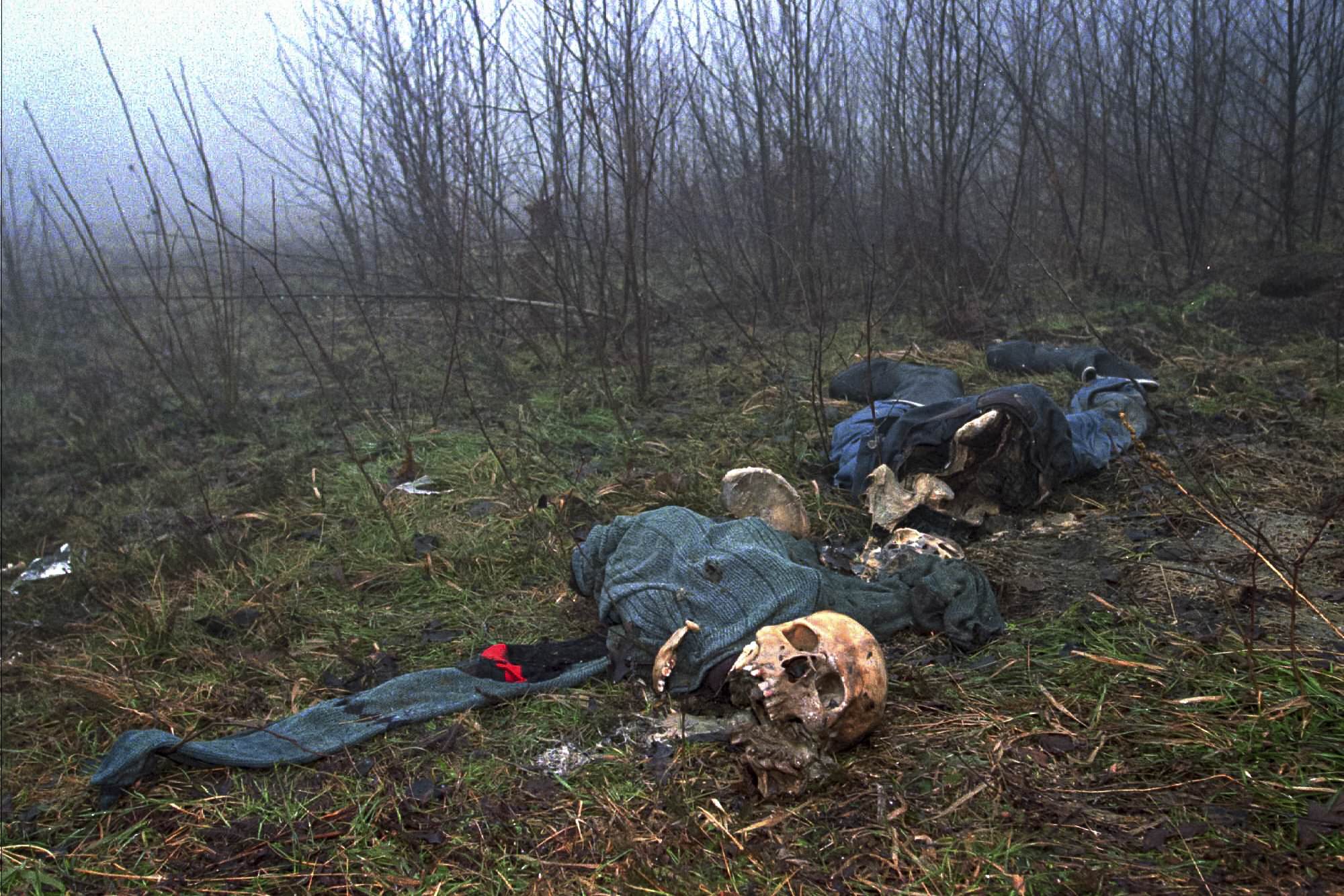
#34 One of four clothed skeletons examined by U.N. investigator Elizabeth Rehn.
Mist hangs low over a scrubby, leafless landscape where four bodies lie in a rough line, their clothing still draped over exposed bones. The foreground draws the eye to a skull turned toward the camera, surrounded by damp grass, mud, and scattered debris, while darker garments recede into the background. The scene’s quiet, wintry palette…
-
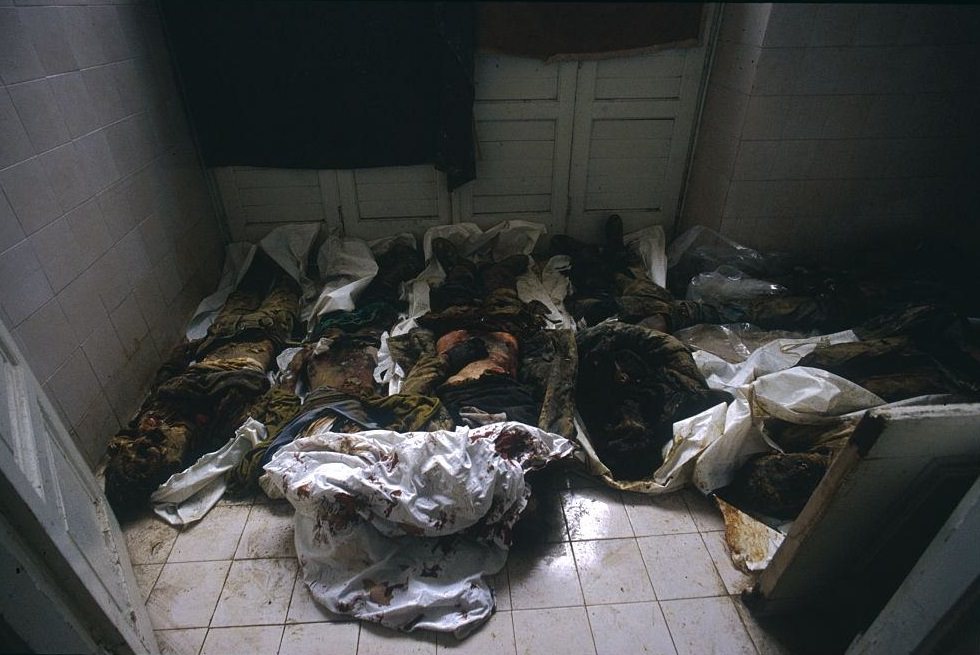
#50 The corpses of civilians killed during the siege of Sarajevo lie on the floor of a morgue in Sarajevo. Some bodies are still in their clothes while others are wrapped in sheets.
In a cramped, tiled morgue room in Sarajevo, the floor has become a makeshift holding place for civilians killed during the siege. Bodies are laid side by side in a grim row, some still wearing everyday clothes, others covered with bloodstained sheets and plastic. The stark lighting and hard surfaces strip away any sense of…
-
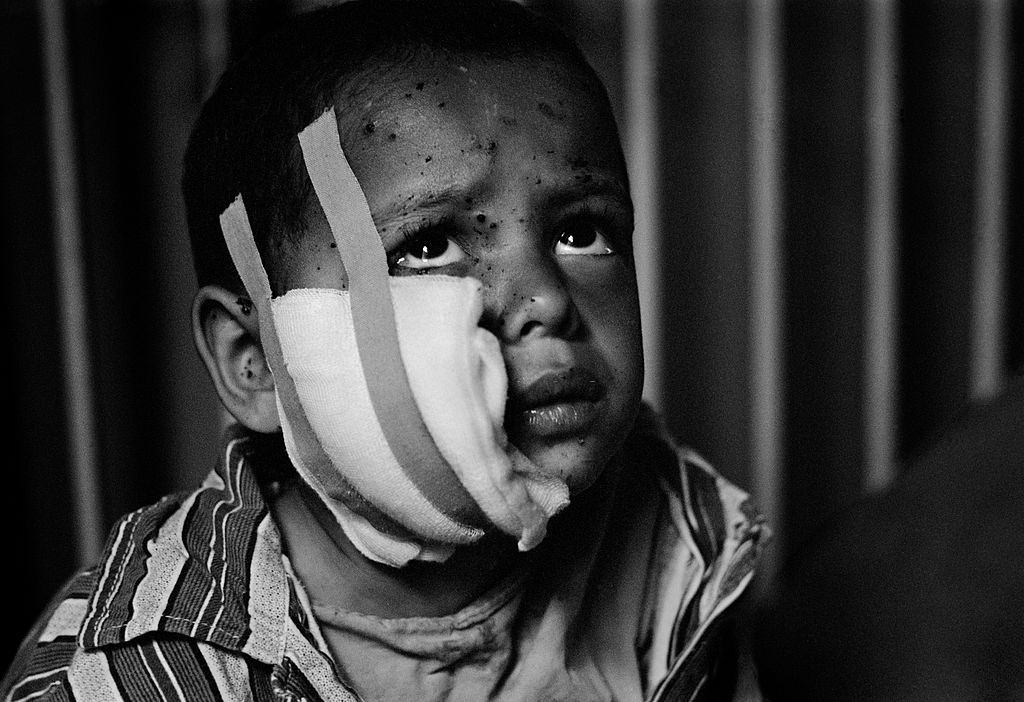
#13 Shrapnel wounds on the face of a frightened boy in a ward at Sarajevo hospital during the siege in 1992.
A child’s face, dotted with shrapnel wounds and held in place by broad strips of medical tape, turns slightly upward in a Sarajevo hospital ward during the siege in 1992. The tight crop leaves little room to look away: bruising, grit, and bandaging dominate the frame, while the boy’s wide eyes carry the kind of…
-
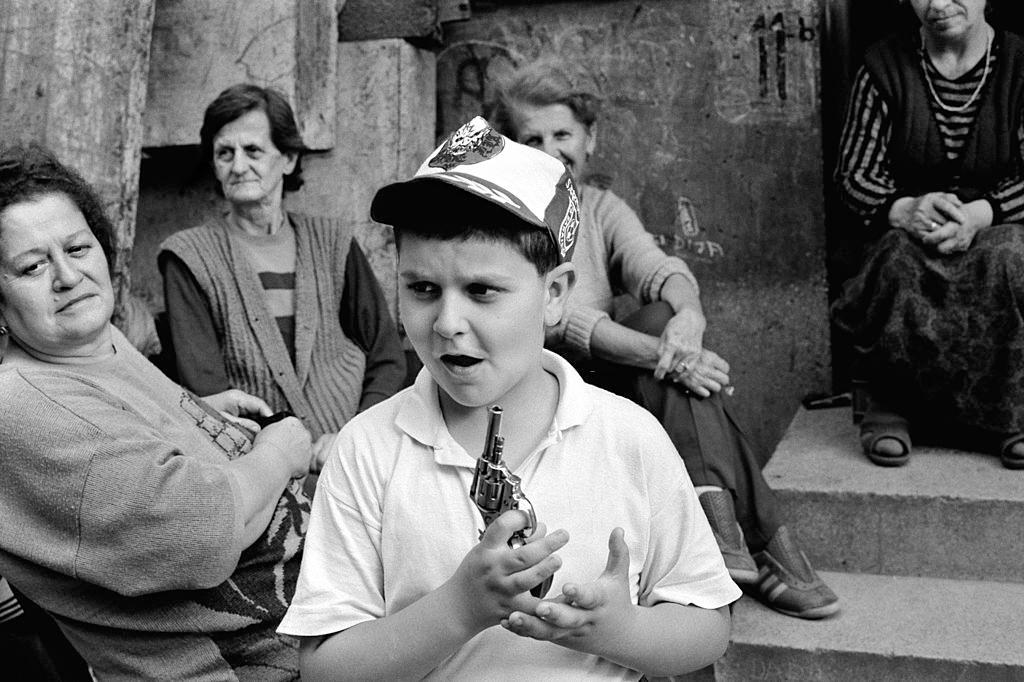
#29 Mothers sit talking outside an apartment block during a break in shelling as a child holds a toy gun nearby.
On a worn stairwell outside a battered apartment block, a small group of mothers settles into a brief, precious pause. Their postures suggest familiarity with this threshold—half shelter, half meeting place—where conversation can resume the moment the shelling stops. Behind them, scuffed walls and rough doors carry the quiet evidence of hardship, turning an ordinary…
-
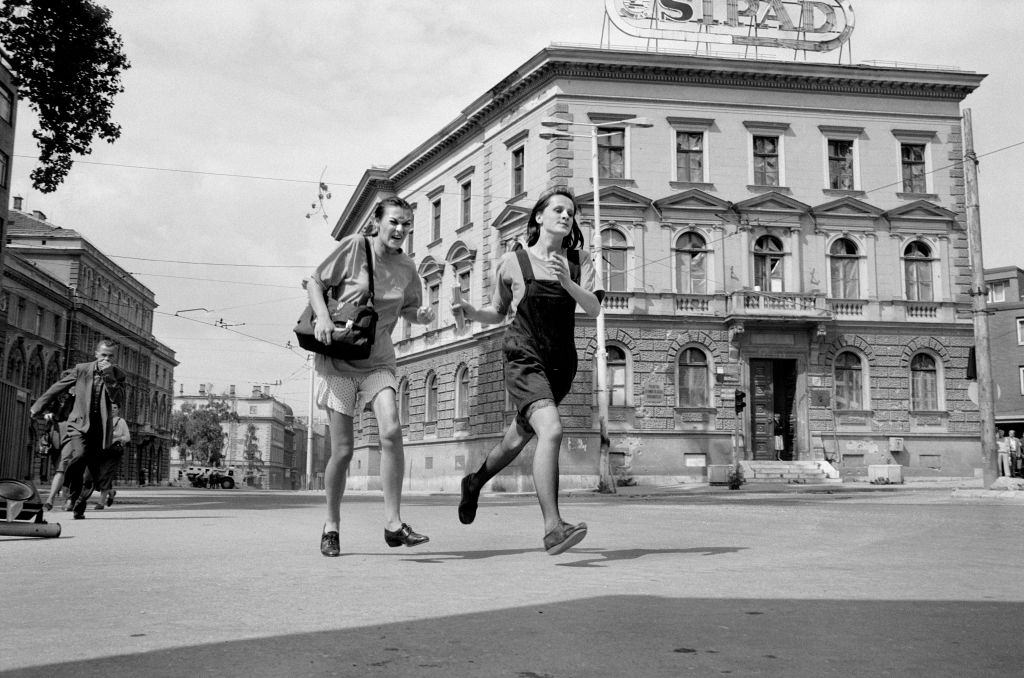
#45 Two teenage girls grimace with fear as they sprint across an intersection on Sniper Alley, July 1992.
Fear is written across two teenage faces as they bolt through an exposed intersection on the route long nicknamed “Sniper Alley,” the kind of place where a few open metres could feel like a battlefield. One girl clutches her bag while her stride breaks into a frantic leap; the other drives forward with her arms…