Category: Civil Wars
Explore the human side of civil wars through authentic historical photographs. Witness the struggles, courage, and consequences of divided nations.
These images document key events and personal moments that shaped political and social transformations around the world.
-

#51 Republican parade in Madrid attended by the Soviet Russian delegation to celebrate the supply of arms from Russia during the Spanish Civil War.
Mounted columns and tightly packed ranks of uniformed men press through a broad Madrid street, their movement framed by shopfronts and sidewalks crowded with onlookers. Automobiles roll alongside the riders, suggesting an official procession with security and dignitaries close at hand. From this elevated viewpoint, the parade’s scale becomes clear: a city momentarily reorganized around…
-
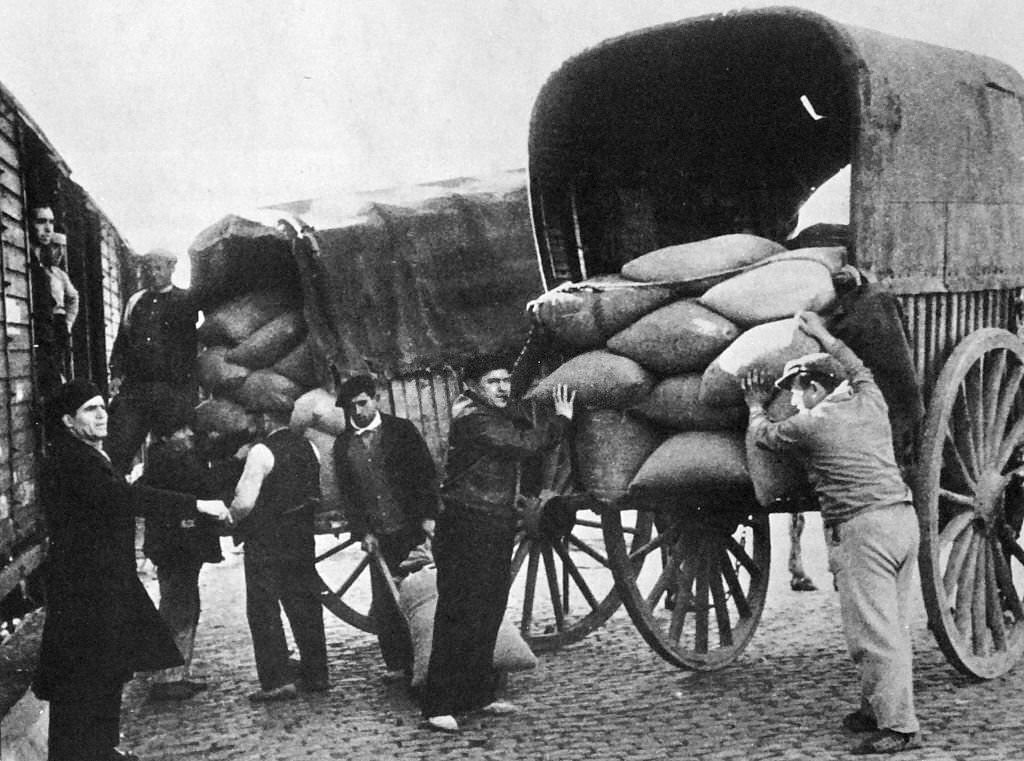
#67 Grain supplies are transferred from carts to rail trucks for distribution during the Spanish Civil War 1936.
At the edge of a rail line, men cluster around a high-sided cart piled with bulging sacks of grain, working shoulder to shoulder as a rail truck waits to take the load onward. The cobbled ground, the heavy wooden wheels, and the covered wagon frame a scene of urgency and routine at once—an everyday transfer…
-

#83 Spanish Civil War Propaganda banner at a ruined building after the capture of the city by the Nationalists on 7 February 1937,
Amid a jagged slope of broken brick and collapsed beams, a bold propaganda banner stretches across the wreckage, turning destruction into a political stage. The Spanish text proclaims the promise of “La Nueva España” and the slogan “¡Arriba España!”, a visual declaration meant to dominate the scene as much as the rubble beneath it. What…
-
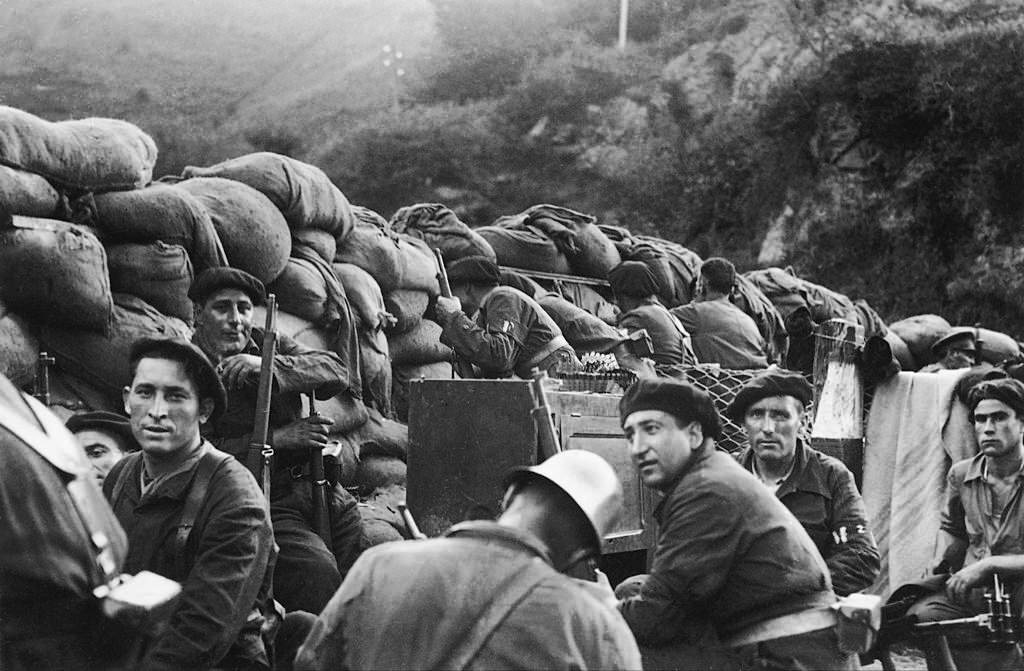
#99 Spanish Militiamen awaiting the Enemy on the Slopes of Irun, In Basque Country, On September 4, 1936.
Huddled behind a high wall of sandbags on the slopes above Irun, a group of Spanish militiamen wait in the tense lull that so often precedes a clash. Faces turn toward the camera with a mix of fatigue and wary alertness, while rifles and helmets crowd the foreground, making the position feel cramped and improvised.…
-

#115 The July military uprising in Seville, Spain on 18 July 1936, which contributed to the start of the Spanish Civil War.
Dust hangs over a narrow street as armed soldiers move forward and residents line the walls with their hands raised, turning an everyday façade of whitewashed buildings into a stage for coercion. The posture of the crowd—pressed close to doorways, faces half-turned, arms held high—conveys the sudden reversal of power that accompanies a military takeover.…
-
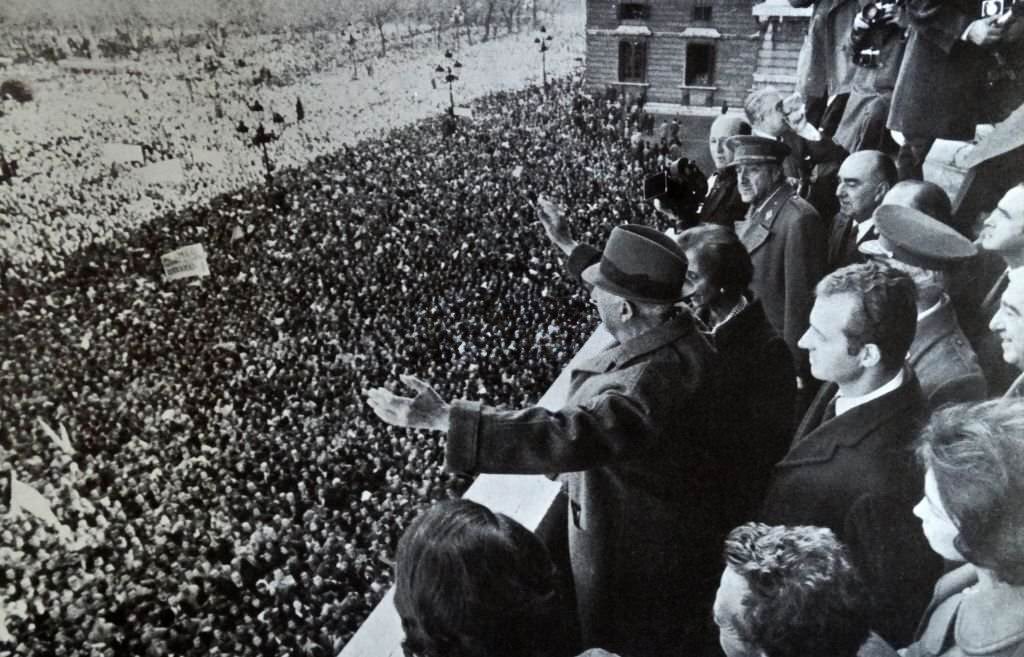
#131 Spanish leader with his wife Carmen Polo and Juan Carlos later King of Spain, 1969.
From a packed balcony above an immense sea of faces, Spain’s ruling circle appears in a carefully staged public moment: the Spanish leader stands forward with arms extended, acknowledging a crowd that stretches to the edge of the frame. Beside him are his wife, Carmen Polo, and a young Juan Carlos—later King of Spain—whose presence…
-

#147 A machine-gun nest, manned by rebels in steel helmets in the Guadarrama Mountains north of Madrid, Spain, July 30th, 1936.
High on the scrubby slopes of the Guadarrama Mountains north of Madrid, a small rebel crew in steel helmets works a machine-gun position with practiced urgency. One man feeds a belt of ammunition while another steadies the weapon on its mount, their bodies angled toward an unseen front beyond the frame. Behind them, the landscape…
-

#163 Damage caused in the town of Oviedo, Spain during the Siege of Oviedo, in the Spanish Civil War.
Shattered plaster and pockmarked walls turn an ordinary street in Oviedo into a record of the Siege of Oviedo during the Spanish Civil War. The house at the center bears the unmistakable scars of shelling—broken windows, chipped masonry, and a roofline that looks bruised by repeated blasts. In the foreground, the road is churned and…
-

#8 A Soviet army tank rolls over a barricade made from trucks and buses in front of the Czechoslovak Radio building on August 21, 1968.
Steel and shattered glass collide in a single, claustrophobic frame as a Soviet army tank forces its way over a barricade of trucks and buses outside the Czechoslovak Radio building on August 21, 1968. The turret and gun barrel dominate the foreground, pressing into the crushed bodies of civilian vehicles; bent metal rails and splintered…
-

#24 Czechoslovakians gather to listen to a transistor radio for news of the Soviet invasion and occupation on August 29, 1968.
Faces press inward as a small transistor radio becomes the center of gravity, pulling a tight circle of Czechoslovakians into shared attention. The crowd’s closeness suggests a public space briefly turned into a listening post, where every syllable matters and no one wants to miss a detail. Rain-speckled clothing and intent expressions add to the…