Category: Civil Wars
Explore the human side of civil wars through authentic historical photographs. Witness the struggles, courage, and consequences of divided nations.
These images document key events and personal moments that shaped political and social transformations around the world.
-
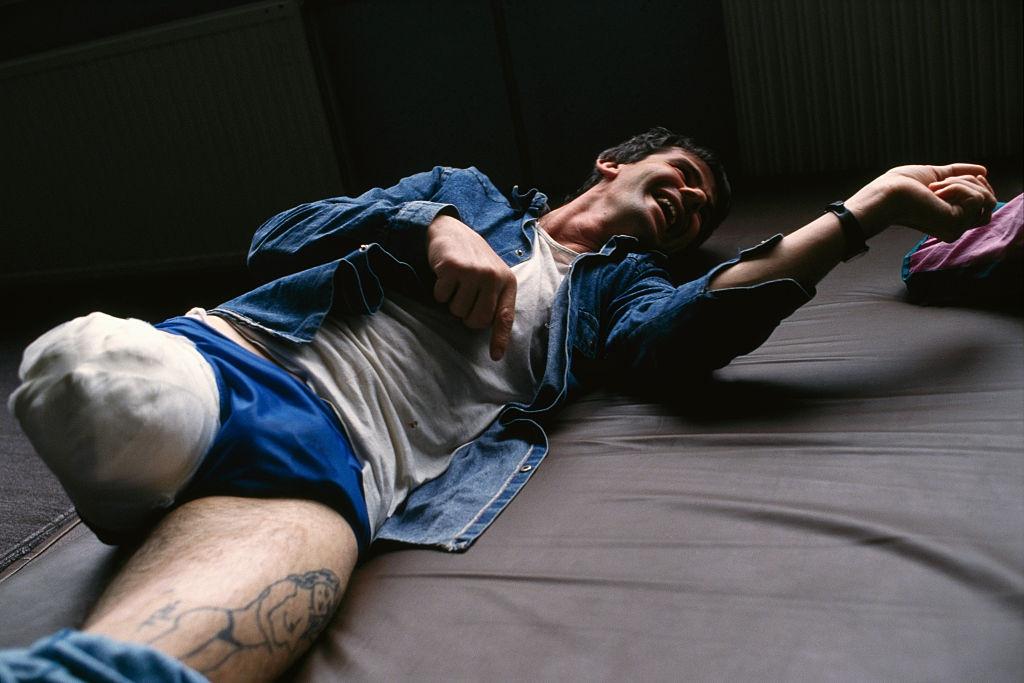
#49 A civilian lies in a hospital while recovering from an amputated leg, received during the siege of Sarajevo in the Yugoslavian Civil War.
A man sprawls across a hospital mattress, one leg ending in a thick white bandage where an amputation has recently been performed. His denim shirt hangs open over a T‑shirt, and the angle of his body—one arm flung outward, the other drawn in tight—suggests both exhaustion and the strain of pain managed moment by moment.…
-
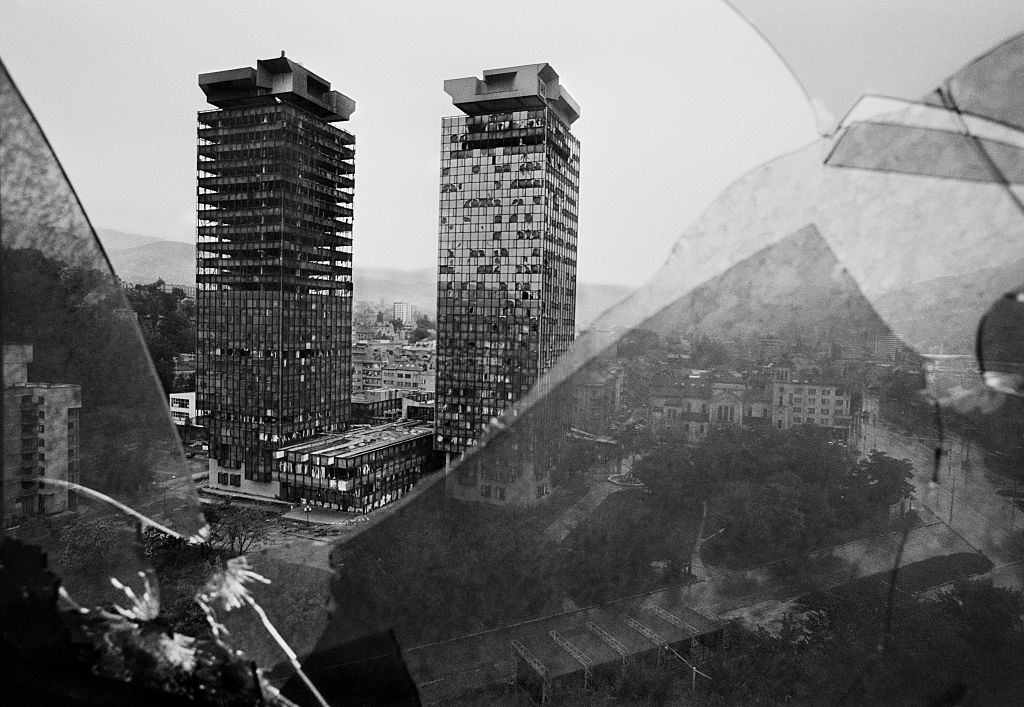
#12 The burnt out tower blocks of Sarajevo’s financial district seen through the shattered windows of the Holiday Inn Hotel.
Jagged shards of glass dominate the foreground, turning the Holiday Inn’s broken window into both frame and witness as Sarajevo’s financial district rises beyond it. Two tower blocks stand scarred and hollowed, their darkened façades and missing panes forming a grid of damage against a pale sky. In the distance, low hills and tightly packed…
-
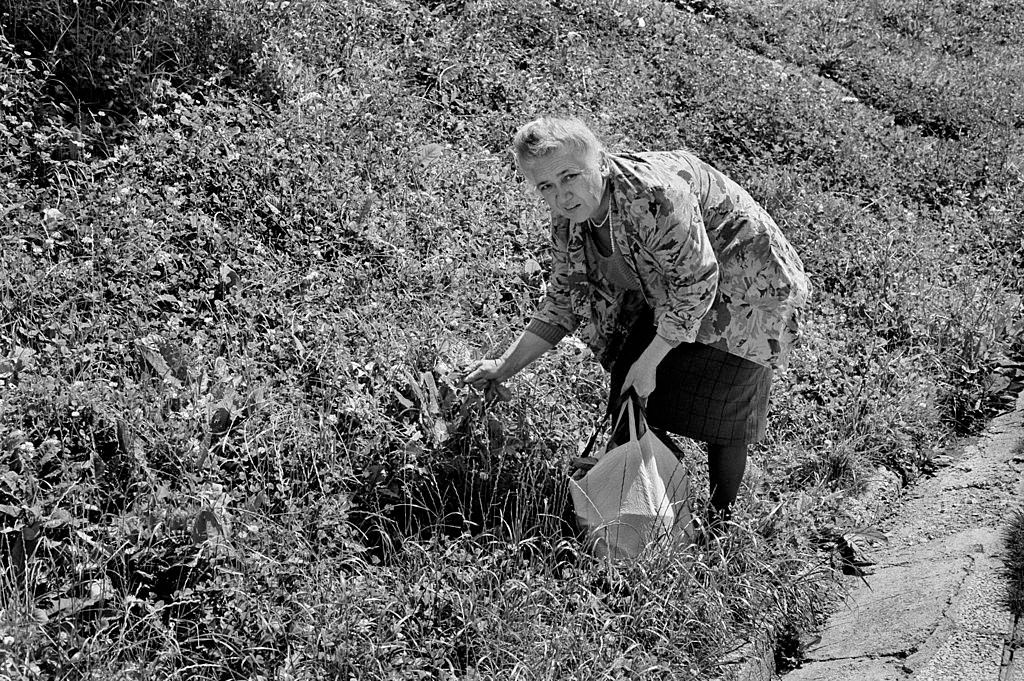
#28 A well dressed woman wearing pearls gathers wild plants and leaves to cook as food becomes scarce in Sarajevo.
Pearls at the throat and a patterned jacket on her shoulders, a well dressed woman bends into the roadside growth, pulling tender stems and leaves with practiced care. She holds a shopping bag open at her feet, turning an ordinary accessory of city life into a tool for survival. Her glance toward the camera is…
-
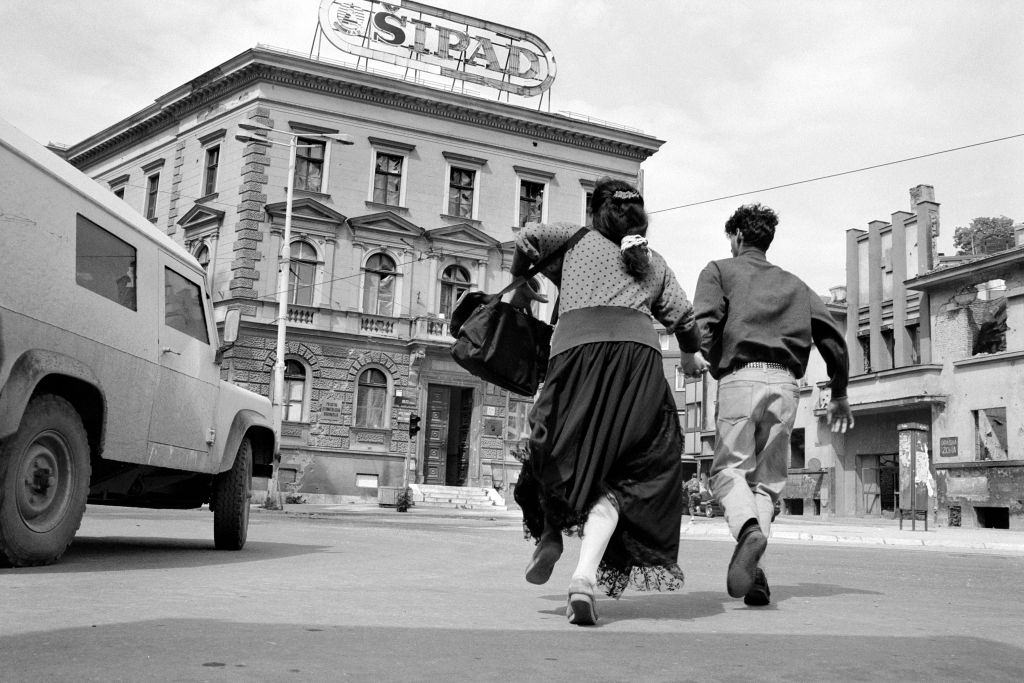
#44 A couple hold hands and shelter behind an armoured press vehicle as they run across an intersection in Sarajevo, 1992.
Mid-stride and hand-in-hand, a couple breaks into a run across a Sarajevo intersection in 1992, using the bulk of an armoured press vehicle as a moving shield. The camera catches them from behind—coat tails lifted by motion, shoes skimming the pavement—while the city’s elegant façades loom ahead with a quiet, battered gravity. Above it all,…
-
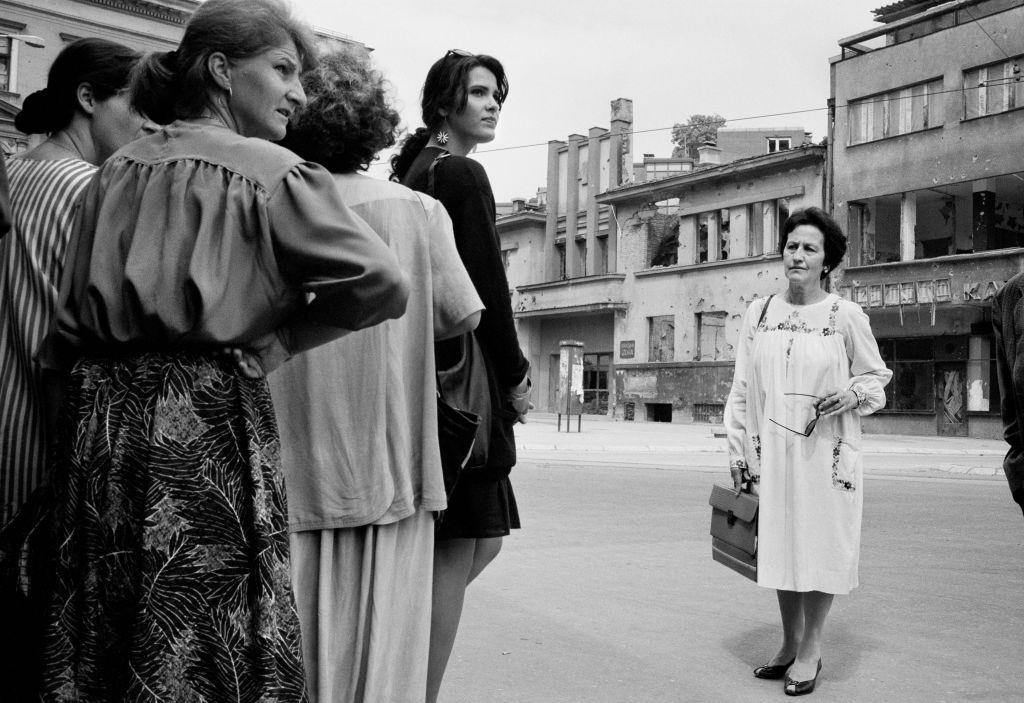
#60 Women wait for the shooting to stop before running across ‘Sniper Alley’ during the siege of Sarajevo in 1995.
A cluster of women stands tight to the curb, bodies angled toward an open stretch of road that offers no cover, each face reading the street as if it were a weather report. Across the way, another woman waits alone with a handbag and glasses in hand, caught between the ordinary habits of city life…
-
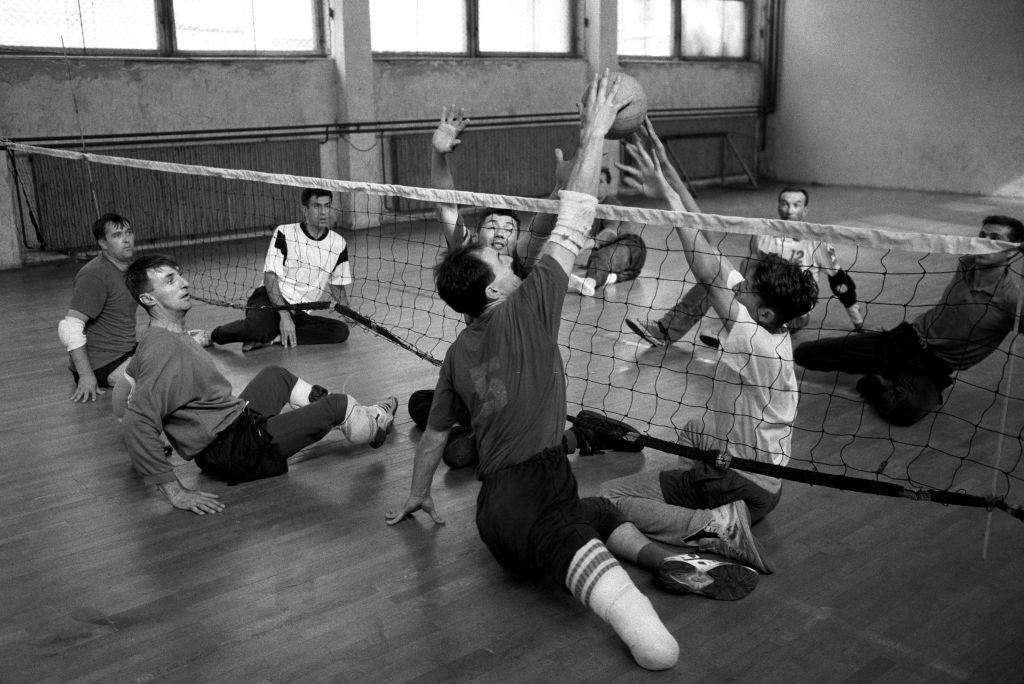
#76 Men who lost limbs through shells and landmines play floor volley ball at a sports club for amputees set up in Sarajevo during the war, 1995.
On a polished wooden gym floor, a volleyball net cuts the room in two as men lean, brace, and reach upward from seated positions, eyes trained on the ball at the top of the frame. Athletic jerseys and improvised knee pads share space with the stark markers of injury—missing limbs, bandaged stumps, and the careful…
-
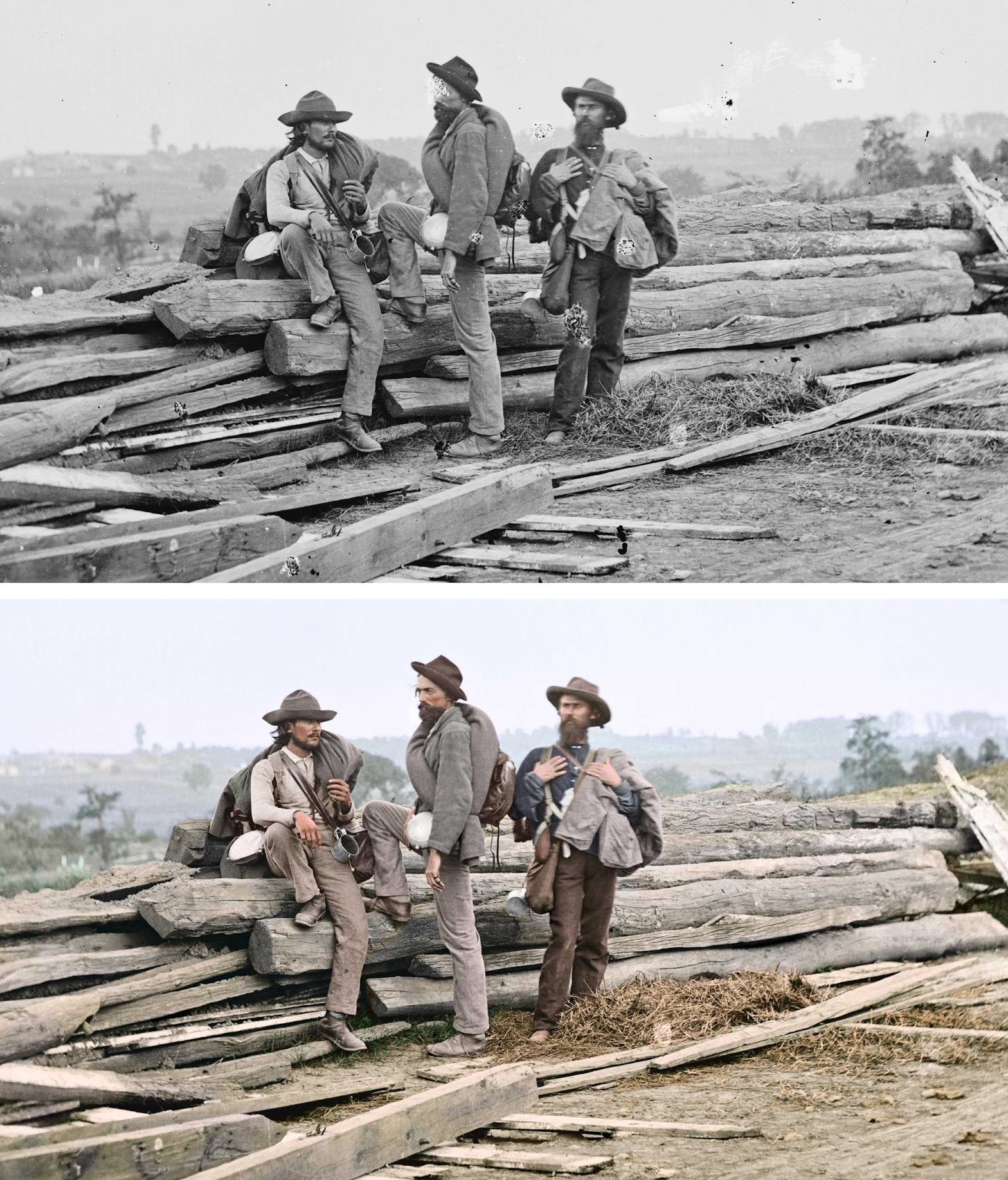
#15 Three Confederate prisoners in Gettysburg, Penn., June-July, 1863.
Along a rough split‑rail fence on the Gettysburg landscape, three Confederate prisoners pause as if caught between exhaustion and wary attention. Their civilian-style hats, rumpled jackets, and slung blankets read like a soldier’s life reduced to what can be carried, while tin canteens and small personal gear hang at their sides. One sits on the…
-
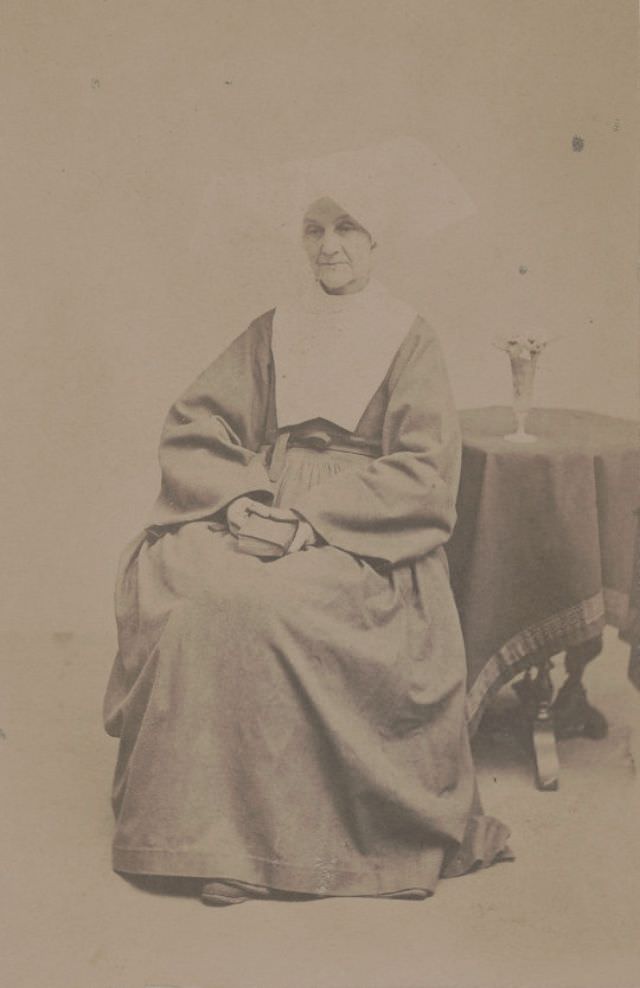
#3 Catholic nun and nurse Sister Ann Alexis Shorb of the Daughters of Charity of St. Vincent de Paul, also known as Henrietta “Harriet” Shorb.
Seated in a plain studio setting, Sister Ann Alexis Shorb—also known as Henrietta “Harriet” Shorb—meets the camera with a steady, unembellished calm. Her habit and wide sleeves fall in heavy folds, while her hands rest together in her lap, a small detail that suggests discipline and practiced composure. A draped side table and simple vase…
-

#19 Eleanor C. Ransom, also known as “Mother,” Civil War nurse, who worked in a Union hospital in Tennessee and aboard the transport ship “North America”, with Union soldier who is showing her a bugle
Quietly staged in a studio setting, Eleanor C. Ransom—remembered by many as “Mother”—sits in a full, dark dress while a Union soldier stands beside her, angling a bugle so she can see it clearly. The soft focus and pale tones typical of Civil War-era portrait photography give the moment an intimate, almost hushed quality. Rather…
-
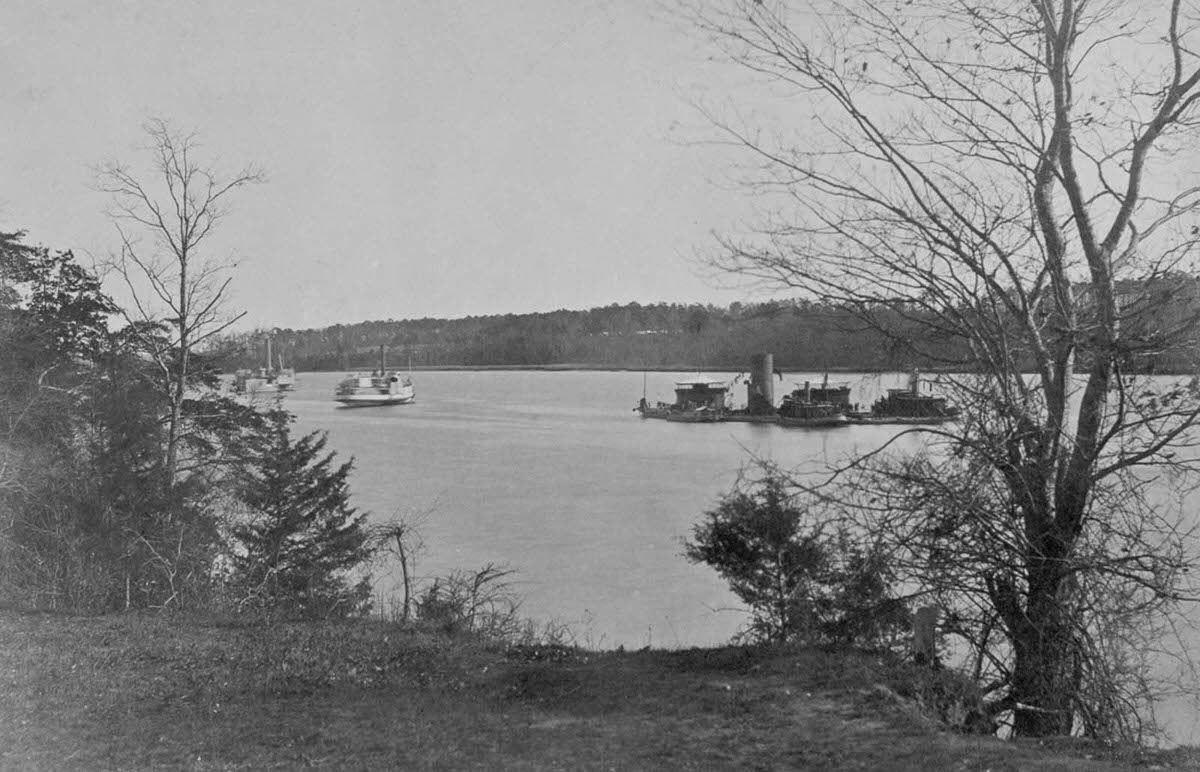
#4 The double-turreted ironclad gunboat Onondaga in the James River in Virginia, 1863.
Across the quiet sweep of the James River, low iron silhouettes sit on the water like floating fortresses, their smokestacks and squat profiles breaking the horizon line. The double-turreted ironclad gunboat Onondaga appears as a dark, armored presence among other vessels, while bare trees in the foreground frame the scene and remind us of the…