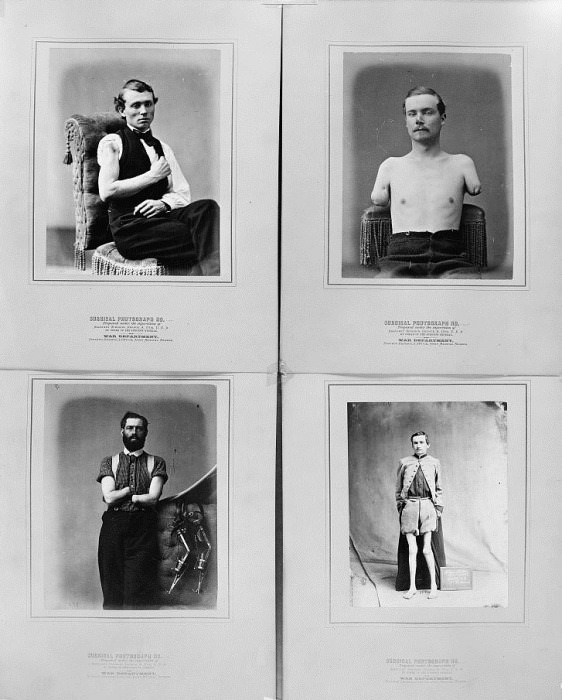
Arranged like a medical plate, these four portraits—compiled by the U.S. Surgeon General’s Office—present starkly different outcomes of arm amputation, each man posed in a studio setting with the calm formality of the era. The subjects sit or stand against plain backdrops, their injuries clearly framed so the level of removal can be studied, compared, and recorded. Even without battlefield noise or hospital clutter, the photographs carry the unmistakable weight of Civil War medicine and the long aftermath carried on surviving bodies.
Across the series, posture becomes part of the story: one figure rests in a chair with his sleeve pinned and torso angled to reveal what remains, while another sits bare-chested so the shoulder line and stump are unmistakable. In a separate view, a man stands with an apparatus nearby, suggesting the period’s developing interest in prosthetics and rehabilitation, where mechanical ingenuity tried to answer irreversible loss. The plain studio props and rigid compositions were not meant to comfort; they were meant to instruct, turning individual suffering into a visual reference for surgeons and administrators.
Beneath each portrait, printed captions and the orderly layout hint at a larger archive—case-by-case documentation that fed reports, lectures, and the evolving standards of wartime surgery. For readers searching Civil War photographs, amputation history, or the records of the Surgeon General’s Office, this set offers an unvarnished look at how medicine learned through systematic observation. Seen today, the images ask for more than clinical attention, reminding us that every “type” in a classification once belonged to a person navigating survival, stigma, and adaptation.