Category: Colorization
See history come to life with colorized photographs of the past. From wars to daily life, these restored images bridge time with emotion and realism.
Each colorized photo revives forgotten stories and gives a fresh perspective on iconic historical moments.
-
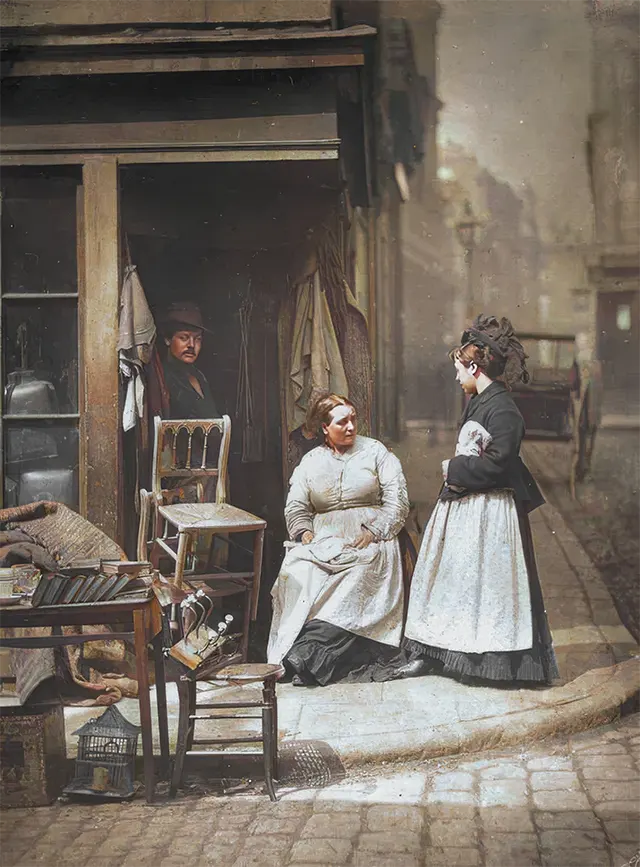
#24 Women talk outside a secondhand shop in London, 1890s.
Just beyond the shopfront, two women pause in conversation on a worn doorstep, their aprons and dark jackets suggesting working lives shaped by long days and practical needs. The colorization brings out small, intimate details—soft fabric tones, the scuffed threshold, and the muted grime of the street—making the London of the 1890s feel less remote…
-
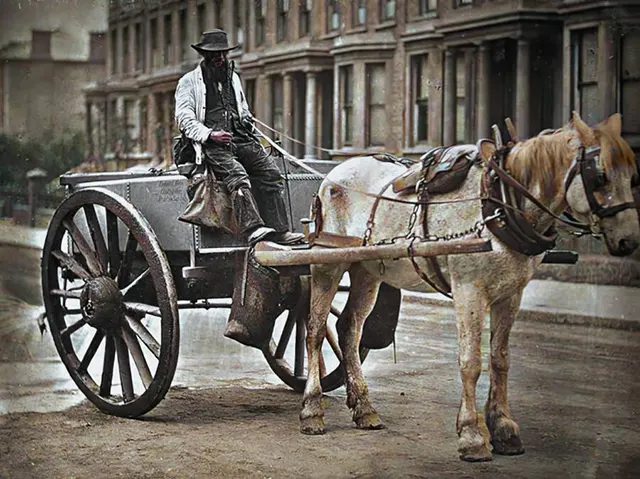
#40 Water carts roam the streets on hot days, 1890s.
Late-19th-century city streets could turn punishingly hot and dusty, and water carts like the one seen here were part of the everyday answer. A sturdy horse stands patiently in harness while the driver sits high on the tank wagon, ready to make another pass along the roadway. The wet sheen on the street hints at…
-

#15 Weegee photographs a human head at the scene of a murder. Circa 1945.
Under the harsh angle of a streetlamp, Arthur “Weegee” Fellig leans into his press camera, the familiar cloth hood pulled over his head as he frames a scene most people would instinctively avoid. Suited onlookers and officials ring the cobbled edge of the sidewalk, their polished shoes and overcoats forming a tight perimeter around the…
-

#31 The naked corpse of American aspiring actress and murder victim Elizabeth Short, known as the “Black Dahlia,” lying in a vacant lot in Los Angeles, 1947.
A vacant lot in Los Angeles becomes the stage for one of the most infamous crime stories in American history, as the title’s subject—Elizabeth Short, later dubbed the “Black Dahlia”—lies exposed in the grass. The colorization lends an unsettling immediacy: pale skin against dark weeds, a strip of sidewalk at the edge, and a stillness…
-
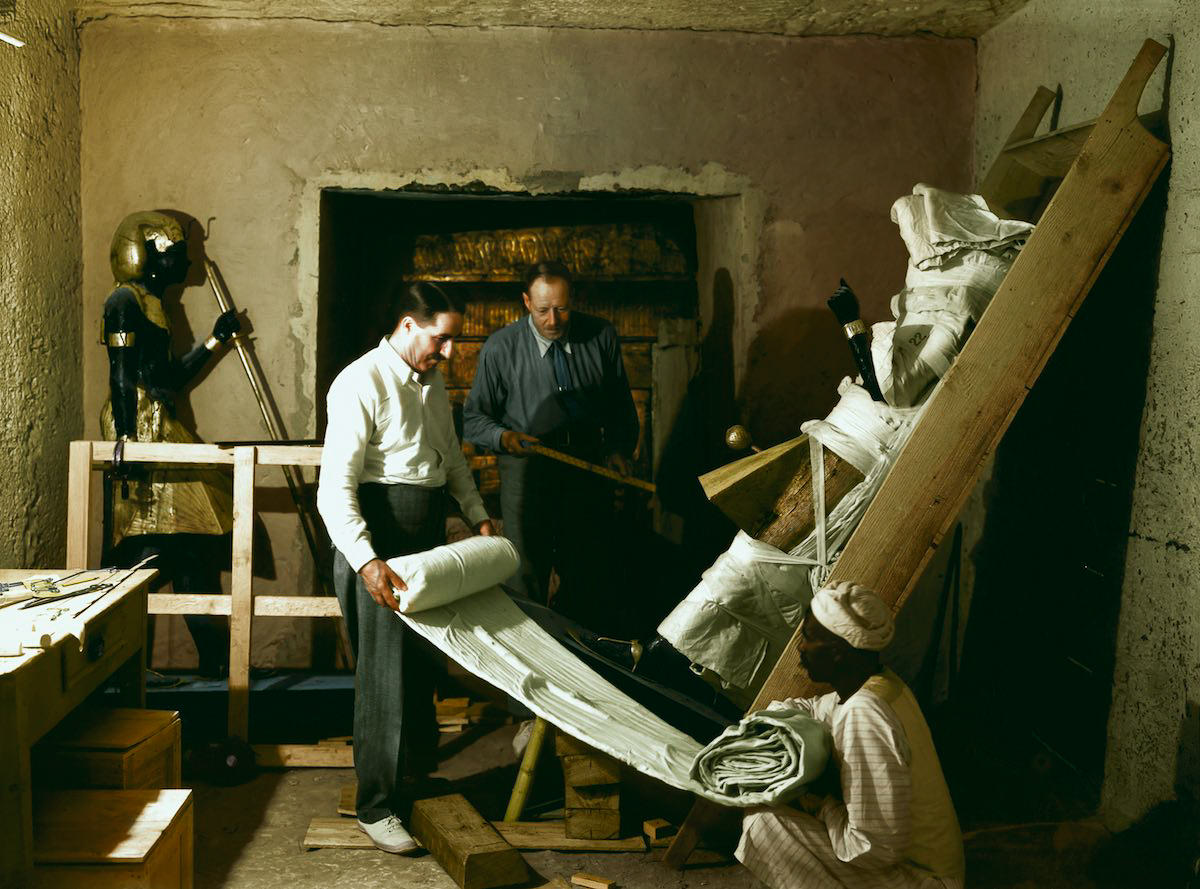
#6 Howard Carter (on the left) working with his friend and colleague Arthur Callender on wrapping one of two sentinel statues of Tutankhamun (Carter no. 22) found in the Antechamber. Tutankhamun’s Tomb, December 1925
In the cramped, dust-toned antechamber of Tutankhamun’s tomb, Howard Carter stands at left with a long roll of protective cloth, focused on the careful work of safeguarding a royal guardian. Beside him, his friend and colleague Arthur Callender checks a measuring tape, while boards, crates, and makeshift supports crowd the floor—practical reminders that archaeology is…
-
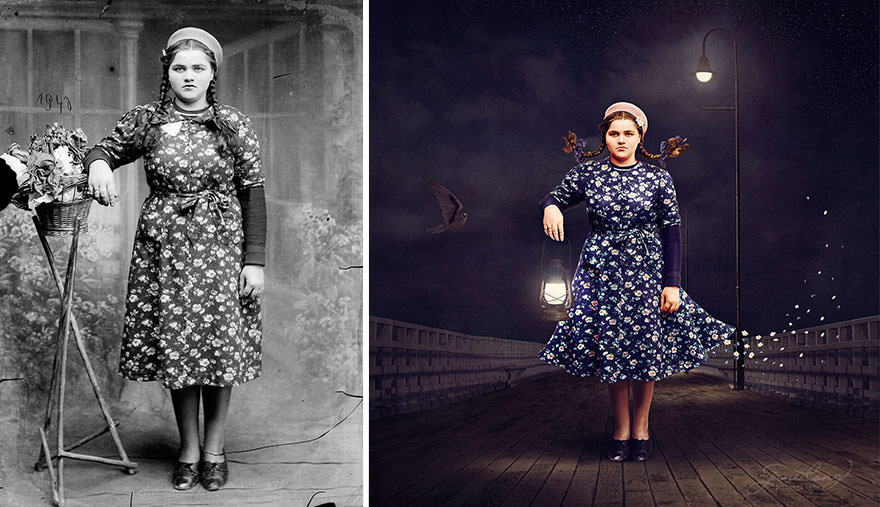
#1 Photographer Recolor Historic Glass-Plate Photos With His Conceptual And Artistic Imagination #1 Colori
A young woman stands front and center, her posture steady and her gaze unflinching, dressed in a patterned, floral dress with darker sleeves and a light head covering that frames her face. In the original glass-plate look, the studio setting feels plain and utilitarian, with props at the edge hinting at a staged portrait made…
-
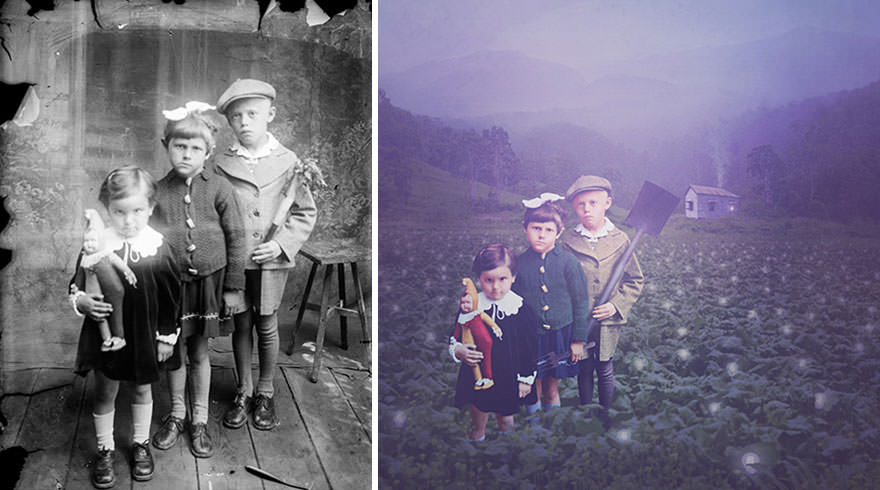
#17 Photographer Recolor Historic Glass-Plate Photos With His Conceptual And Artistic Imagination #17 Color
Three children stand close together in a formal studio pose, their serious expressions and carefully chosen clothes hinting at how expensive and momentous a glass-plate portrait could be. The youngest clutches a doll, while the older pair anchor the composition with stiff posture and heavy shoes, framed by a painted backdrop and the plain wooden…
-
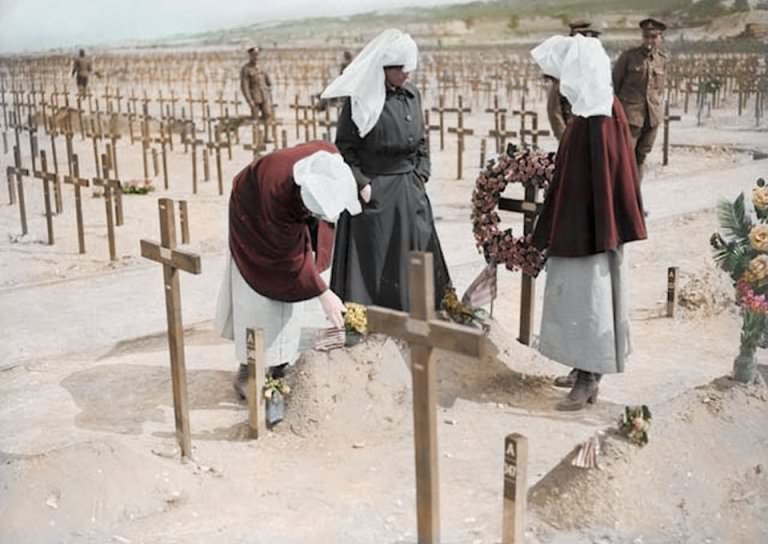
#13 Nuns laying wreaths in a field of mass graves. The total number of military and civilian casualties in World War I was around 40million.
Across a bleak cemetery landscape, nuns move quietly among long rows of simple wooden crosses, pausing to lay flowers and a wreath on freshly mounded earth. The colorized tones soften the scene without diminishing its weight: pale sand, muted habits, and small clusters of blooms that stand out against the emptiness. A few uniformed figures…
-

#8 Charlie Chaplin at the Age of 27, 1916
Youthful and unguarded, Charlie Chaplin appears here at 27, presented in a calm, direct portrait that feels worlds away from the familiar cane-and-bowler silhouette. His curly hair sits slightly tousled, his expression steady and thoughtful, and the plain backdrop keeps the focus firmly on the face—an intimate look at the man behind the screen persona.
-
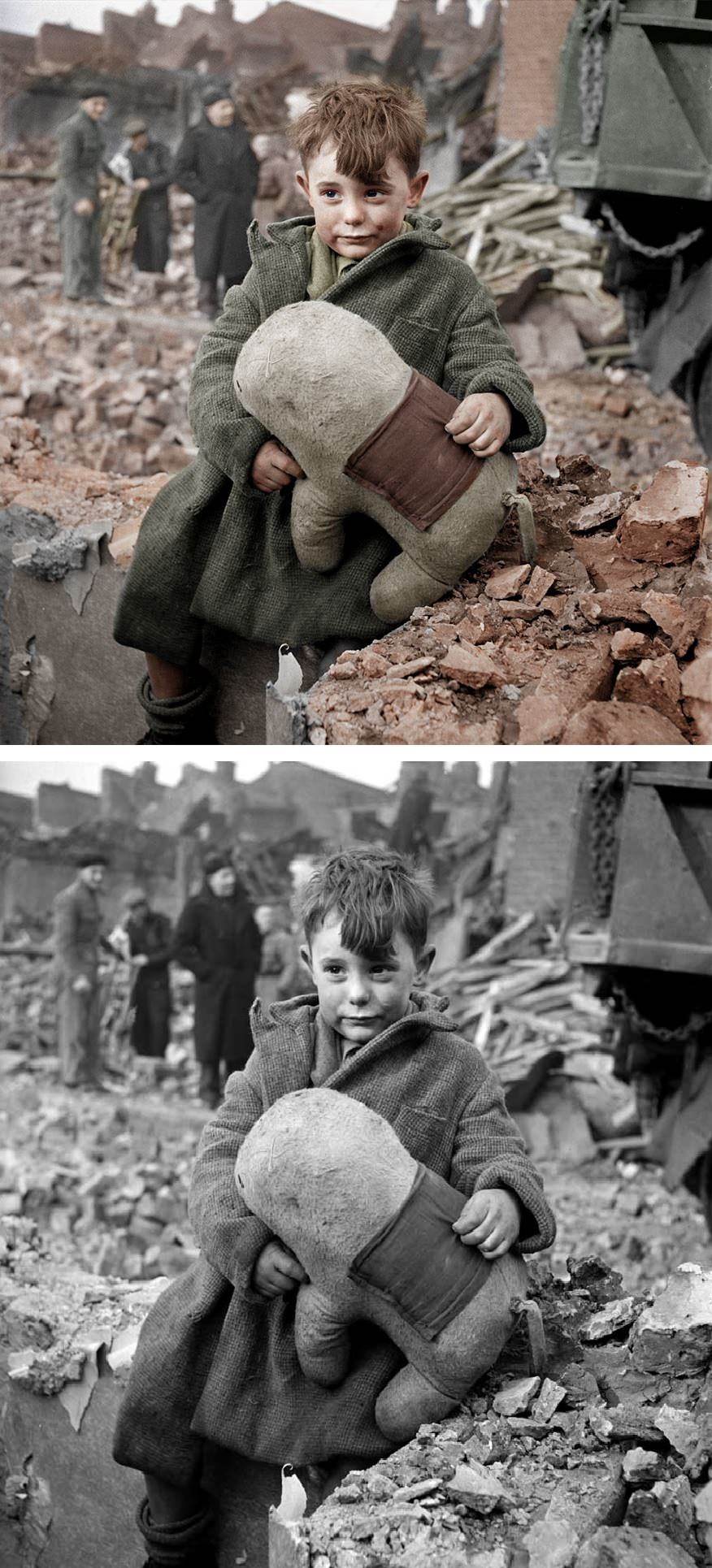
#24 Abandoned Boy Holding a Stuffed Toy Animal. London 1945
Caught between piles of broken brick and splintered timber, a small boy in an oversized coat clutches a well-worn stuffed toy animal as if it were the last steady thing in his world. His face is smudged, his hair unkempt, and his wary sideways glance suggests both fatigue and alertness—an expression many wartime London children…