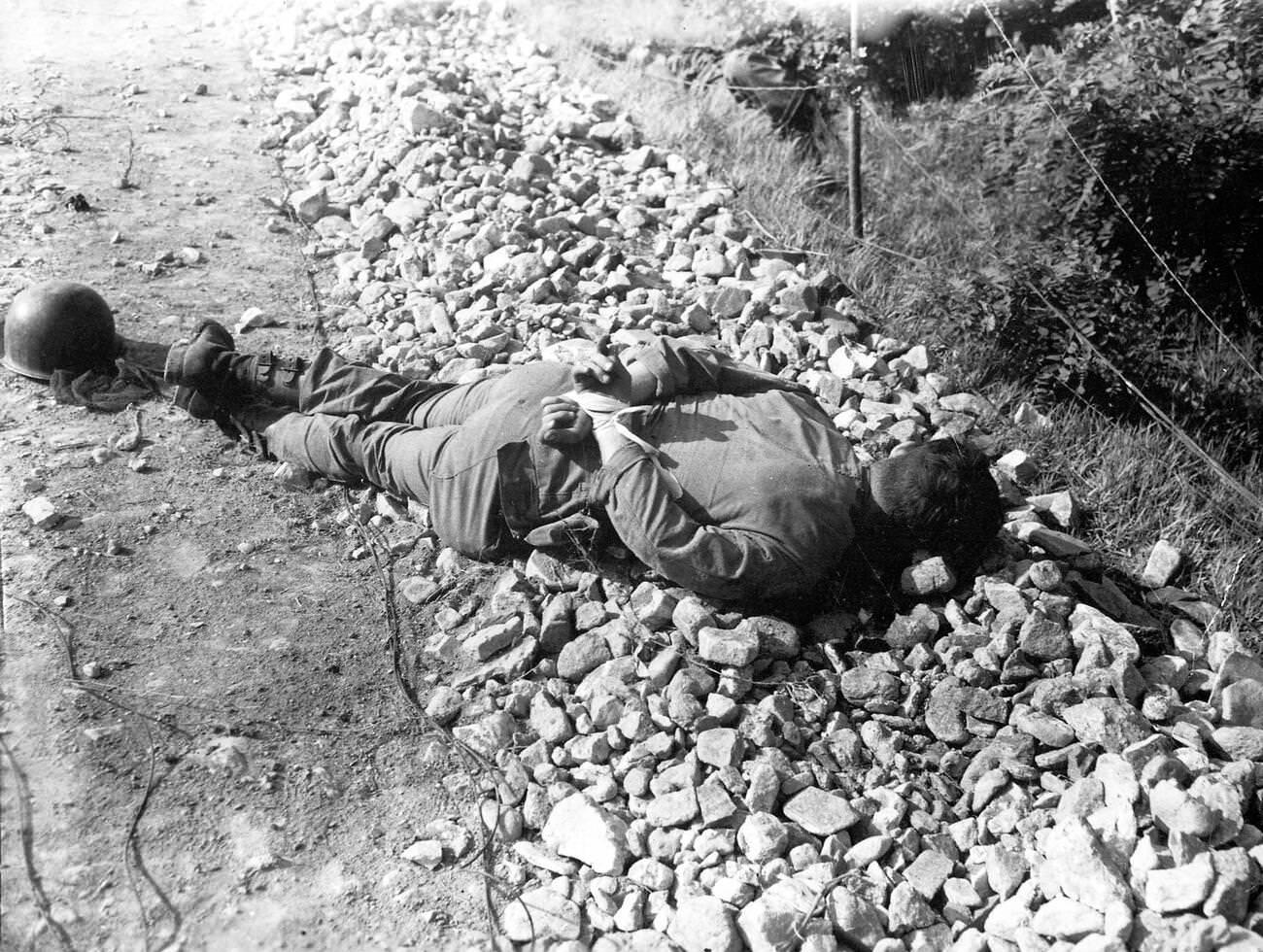
Along a rough railway embankment, a South Korean soldier lies motionless on a bed of broken stone, his hands bound behind his back. The stark angle of the scene—dirt road to one side, scrub and fencing to the other—turns ordinary infrastructure into a silent witness. Nearby, a helmet and scattered gear emphasize how abruptly a life was cut off, leaving only the hard textures of gravel and uniform to tell the story.
Such photographs from the Korean War in the 1950s confront viewers with the conflict’s intimate brutality, beyond maps and communiqués. The binding at the wrists signals captivity and execution rather than death in open combat, pointing toward the murky, retaliatory violence that can follow shifting fronts and collapsing authority. In this frame, the body’s stillness and the emptiness around it speak to fear, control, and the human cost hidden beneath military narratives.
For readers researching Korean War history, war crimes, and civil conflict on the peninsula, this image is a sobering primary visual record. It invites careful reflection on how quickly a civil war within a larger international war could reduce a soldier to an anonymous casualty by the roadside. Preserved and shared with context, scenes like this help anchor discussion in evidence, reminding us that the era’s “big events” were lived—and ended—one body at a time.