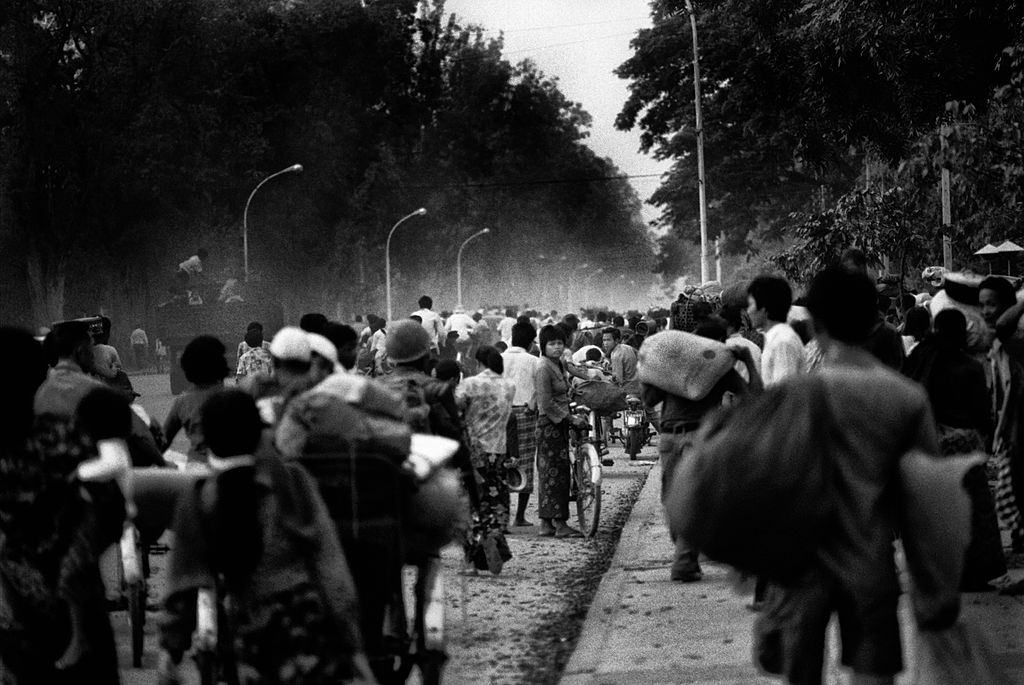
Dusk settles over Monivong Boulevard as the crowds thicken, the streetlights receding into a haze of dust and exhaust. Thousands move in the same direction, some on foot and others pushing bicycles or small motorbikes, with bundles slung over shoulders and arms wrapped around what can be carried. The perspective down the long roadway makes the flow feel endless, a human current filling the center of Phnom Penh on the evening described in the title.
Faces turn back toward the camera in brief, uncertain glances while most bodies keep pressing forward, compressed by urgency and confusion. Clothing ranges from patterned wraps to plain shirts, suggesting families and neighbors swept into the same movement rather than a single organized march. The dense tree line and curving lamp posts frame the scene like a corridor, emphasizing how a familiar urban avenue became a passageway in the final hours of a civil war turning point.
Set against the fall of Phnom Penh to the Khmer Rouge on April 16, 1975, the photograph reads as both a record of mass displacement and a portrait of ordinary life interrupted. It offers powerful historical context for anyone researching Cambodia’s civil wars, Phnom Penh history, and the lived experience of regime change as night falls. The dust in the air, the crowded roadway, and the improvised luggage all hint at a city being emptied and remade, moment by moment, under the weight of events.