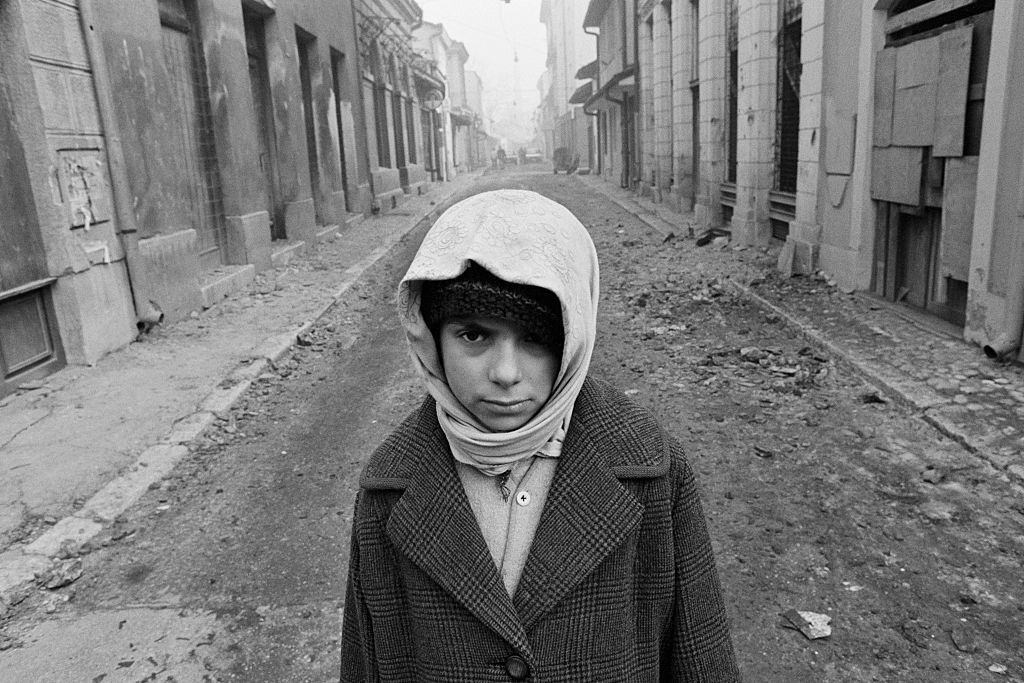
A narrow street in Sarajevo’s Old Town stretches behind Mirza Mangajic, its paving broken and scattered with debris, the shopfronts and doorways shuttered in uneasy silence. Wrapped in a headscarf and heavy coat, the 10-year-old stands at the center of the frame with a steady, guarded expression that feels far older than his years. The emptiness of the lane, framed by close walls and worn facades, speaks to a city where ordinary movement has become a calculation.
In 1993, during the Bosnian civil war and the siege of Sarajevo, survival often depended on family bonds and the small routines that could still be maintained amid shortages and danger. The title’s mention of Mirza living with his grandmother underscores how conflict rearranged households, leaving children and elders to navigate daily life together. Clothing becomes more than warmth here—layers and coverings hint at cold interiors, interrupted utilities, and a public space that no longer offers comfort or safety.
What lingers is the tension between youth and circumstance: a child’s face set against an urban corridor marked by damage and abandonment. As a historical photo, it offers an intimate entry point into Sarajevo’s wartime reality—less about military spectacle than about civilians enduring block by block, day by day. For readers searching the history of the Bosnian War, the Siege of Sarajevo, or civilian life in Sarajevo’s Old Town in 1993, this image anchors those terms in a single human presence.