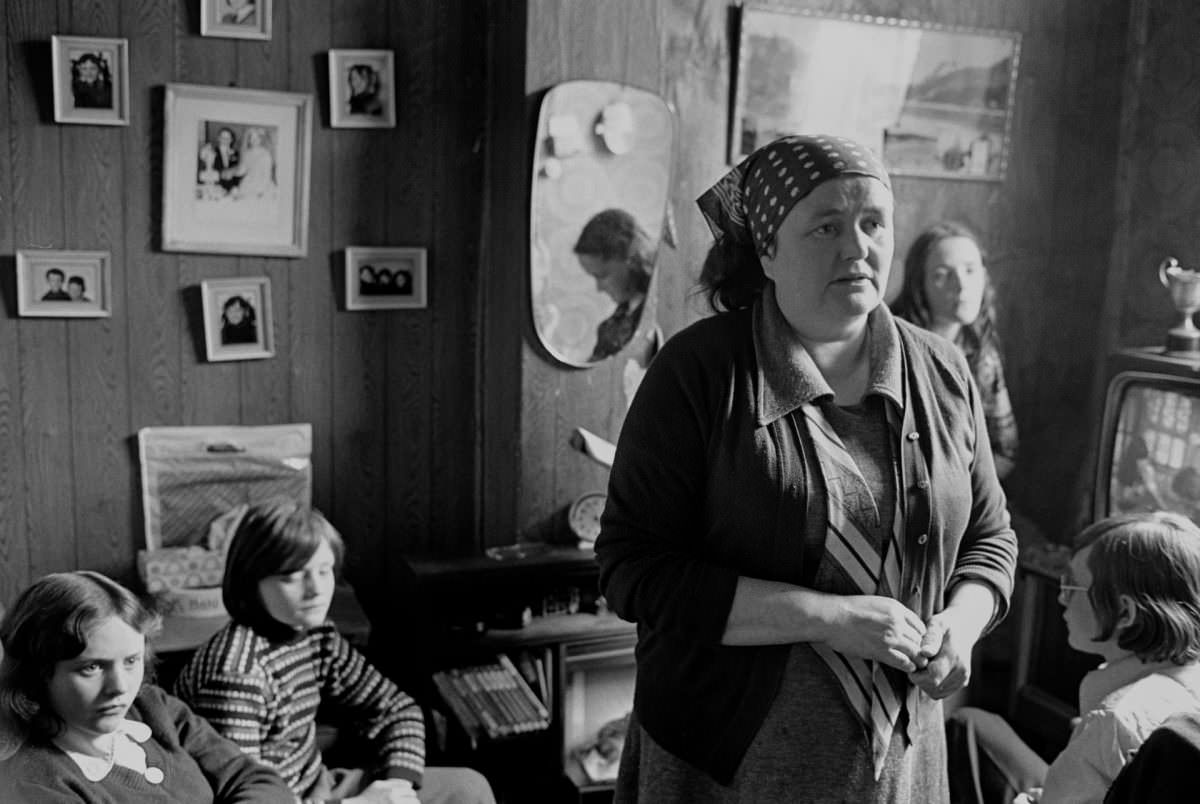
In a modest, wood‑paneled room, a woman stands at the center with a headscarf tied neatly in place, her hands caught mid‑gesture as if answering a question or holding a household together by sheer attention. Children gather around her—some seated, one half‑turned toward her—while the light from a window softens the edges of their faces and turns the everyday interior into something quietly dramatic. Family photographs line the wall, anchoring the scene in memory and routine even as expressions suggest strain, fatigue, or wary focus.
Northern Ireland in 1978 sits in the background of this moment, part of a period when politics and violence often pressed into private life, shaping conversations in kitchens and front rooms as much as streets and headlines. The domestic details—the small mirror, framed portraits, a television set pushed to the side—hint at ordinary aspirations and limited space, the kind of home where news and rumor could arrive daily and still be met with tea, chores, and the constant supervision of children. Without needing to show conflict directly, the photograph conveys how a society under pressure can be read in posture, in silence, and in the way a family holds close.
For readers searching for a historical photo of Northern Ireland during the late 1970s, this image offers a grounded, human view: not slogans or uniforms, but a mother figure and kids navigating another day indoors. It’s a reminder that “civil wars” and unrest are also lived through long stretches of waiting, listening, and trying to keep children calm when the outside world feels uncertain. The power here lies in the unspoken story—how resilience looks when it’s domestic, intimate, and photographed without spectacle.