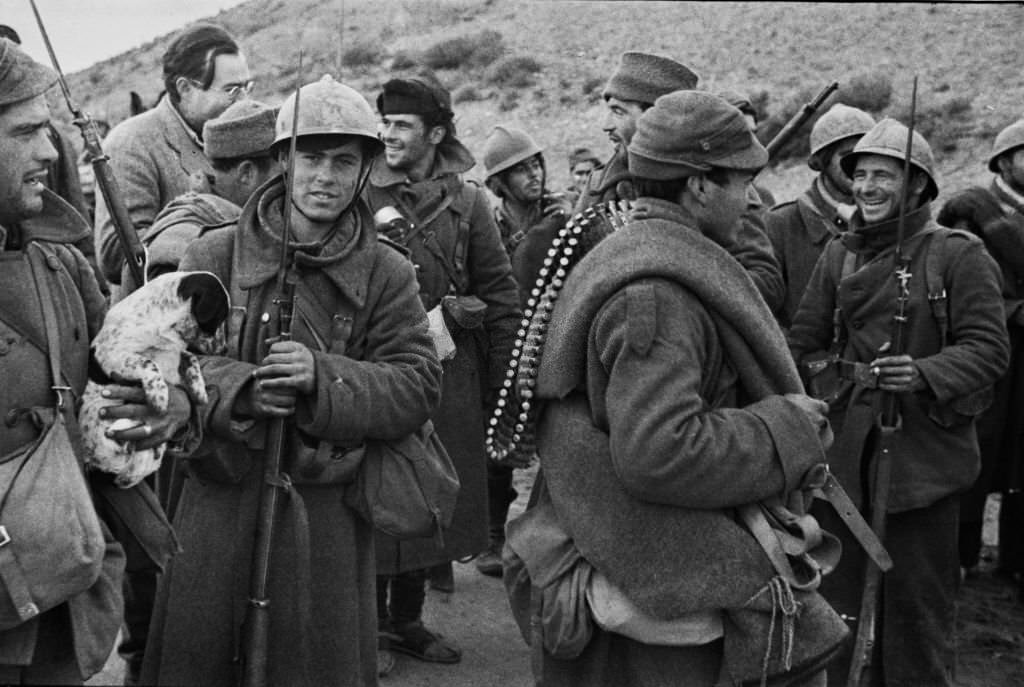
On the Aragon front near Teruel, a brief pause in the cold becomes a crowded, human scene: bundled Republican soldiers gather in heavy coats and mixed helmets, rifles close at hand, while a correspondent leans in to listen and speak. Ernest Hemingway—there as a writer and journalist—appears among them not as a distant observer but as part of the knot of bodies and voices, a figure in civilian clothing framed by men preparing to move. The terrain behind them is bare and sloping, offering little shelter, a stark backdrop for an encounter that feels both conversational and urgent.
Faces turn in different directions, some smiling, some focused, as ammunition belts and straps cut across shoulders and chests. One soldier cradles a small animal against the hardness of steel and canvas, a quiet reminder of ordinary life carried into extraordinary circumstances. The photograph’s closeness emphasizes texture—wool, leather, metal—and the practical improvisation of gear that defined so much of the Spanish Civil War at the front.
Dated in the title to 21 December 1937 during the Battle of Teruel, the moment sits at the intersection of reportage and combat, where words are gathered in the same air as orders and gunfire. Hemingway’s presence hints at how international attention and battlefield reality collided in Aragon, with journalists seeking truth amid propaganda, fear, and camaraderie. For readers searching Spanish Civil War history, Teruel, or Hemingway in Spain, this image offers an intimate glimpse of the republic’s soldiers on the edge of action—alive with talk, tension, and fleeting warmth before the next move.