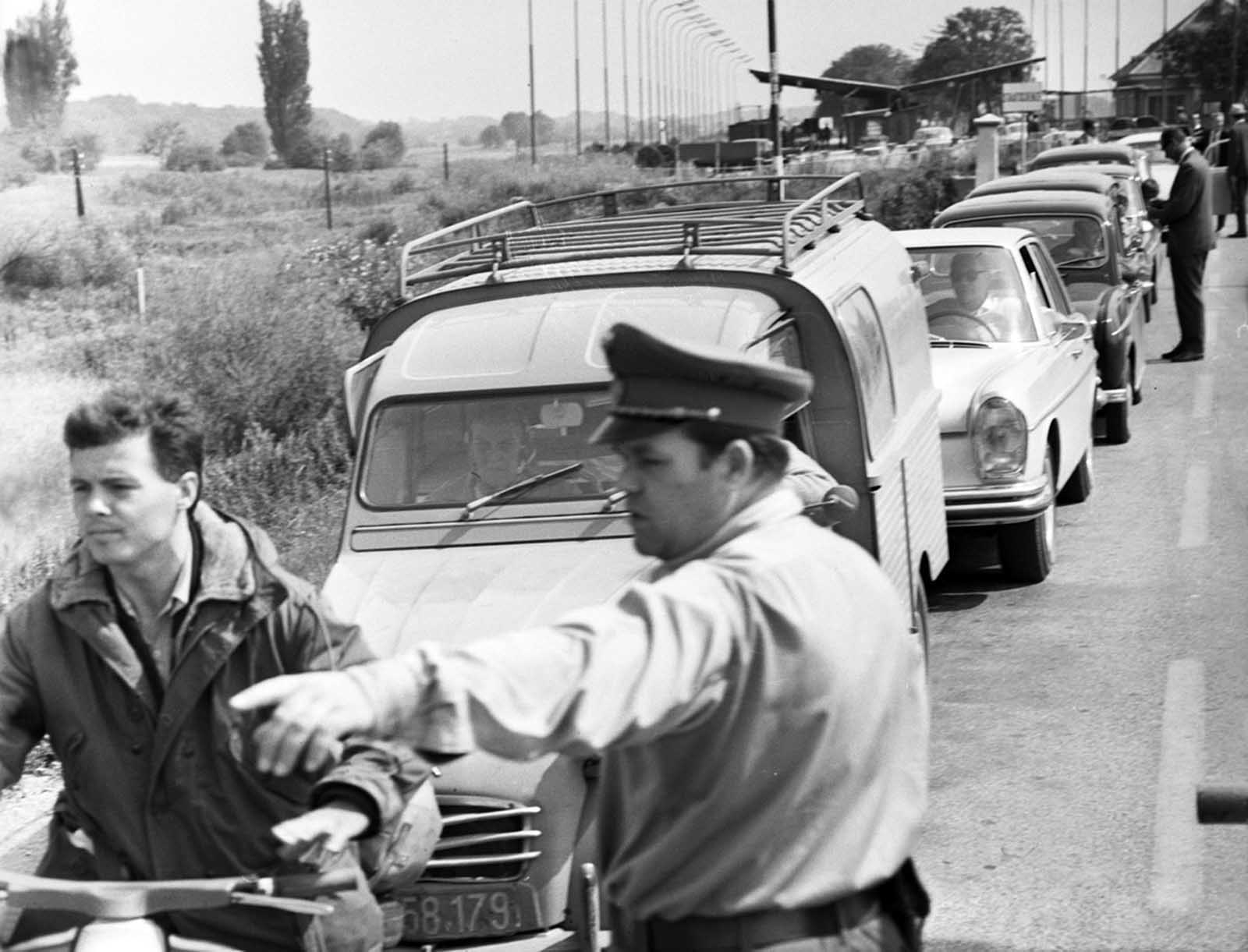
A line of vehicles inches forward on a border road, the kind of slow-moving procession that turns ordinary travel into a test of nerves. In the foreground, a uniformed officer gestures with an outstretched arm, directing traffic and people with brisk efficiency, while a young man on a motorbike waits nearby, half-turned as if listening for instructions. Beyond them, cars and small vans—some fitted with roof racks that hint at hurried packing—stack up toward the checkpoint buildings in the distance.
Autumn 1968 sits behind every detail in this scene, when Czechoslovakian refugees fled the country and the Austrian border became a threshold between the known and the uncertain. The photo’s tension comes not from overt chaos but from restraint: faces set, hands on steering wheels, and bodies poised for the next signal. Even the open landscape to the side, calm and expansive, contrasts with the compressed human story unfolding along the roadway.
For readers exploring Cold War history, refugee movements in Europe, or the aftermath of the Prague Spring, the photograph offers a grounded look at what “flight” often meant—paperwork, queues, and the uneasy choreography of checkpoints. It’s a reminder that political upheaval is recorded not only in speeches and tanks, but also in the quiet logistics of escape: what you can carry, how long you must wait, and which border guard decides when you may pass.