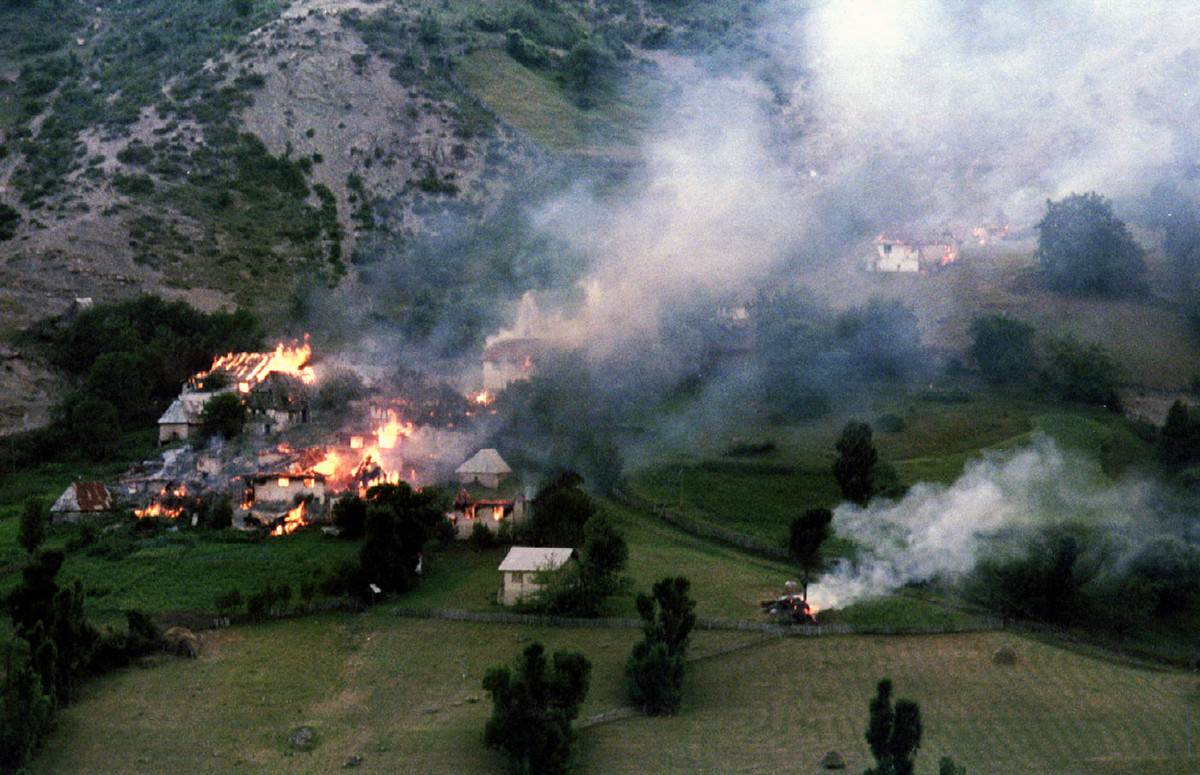
Smoke billows across the green slopes of Mount Igman as flames chew through a cluster of village houses in Ljuta, turning a quiet rural landscape into a battlefield scar. From a distance the blaze reads like a jagged line of orange against dark roofs and trees, while gray plumes drift over fields and orchards that only hint at the lives interrupted below. The contrast between summer countryside and sudden destruction makes the scene hard to look away from.
Set during heavy fighting between Bosnian Serbs and Muslims, the moment speaks to the wider Bosnian War and the pressure surrounding the besieged capital of Sarajevo, roughly 40 kilometers away. No soldiers are visible, yet the evidence of combat is everywhere: multiple ignition points, scattered smoke columns, and a settlement visibly unraveling. It’s a stark reminder of how civil wars push violence into the most domestic spaces—homes, barns, and the paths between them.
For readers searching the history of Sarajevo’s siege, Mount Igman’s strategic terrain, or the human cost of the Yugoslav conflicts, this photo anchors the story in a single, devastating vista. The firelight at the village edge and the haze hanging over the valley suggest not only immediate loss but also the long aftermath—displacement, rebuilding, and memory. Preserved as a historical record, it challenges us to remember that wartime headlines were lived out house by house.