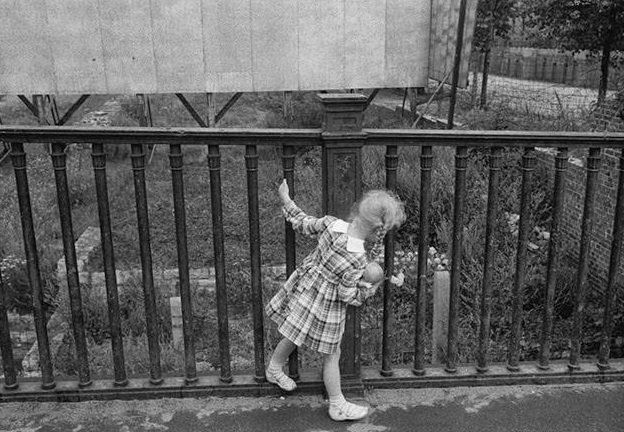
A small girl in a plaid dress stands on an overpass in West Berlin’s Wedding district, her hand pressed to the iron railing as she leans forward to look down. The tight vertical bars dominate the foreground, turning a simple viewpoint into something that feels guarded and constricted. Beyond the fence, a scrubby strip of ground and hard edges of infrastructure suggest the uneasy emptiness that so often framed everyday life near the Berlin Wall.
Childhood and division collide here in a quiet, unsettling way: a toy clutched in one arm, curiosity pulling her toward a space defined by barriers. The composition makes the railing feel less like ordinary street furniture and more like an extension of the border landscape—orderly, repetitive, and difficult to see through. In that tension, the photograph hints at how the Wall shaped not only movement and politics, but also the smallest gestures of looking, waiting, and wondering.
Set against the loaded backdrop implied by the title, the scene reads as a fragment of Cold War Berlin where domestic normalcy persisted beside a frontier. For readers searching for Berlin Wall history, West-Berlin Wedding, or candid street photography from the era, this image offers a vivid reminder that great conflicts were experienced in ordinary places. It’s an intimate perspective on a divided city, told not through soldiers or slogans, but through a child’s posture at the edge of a boundary.