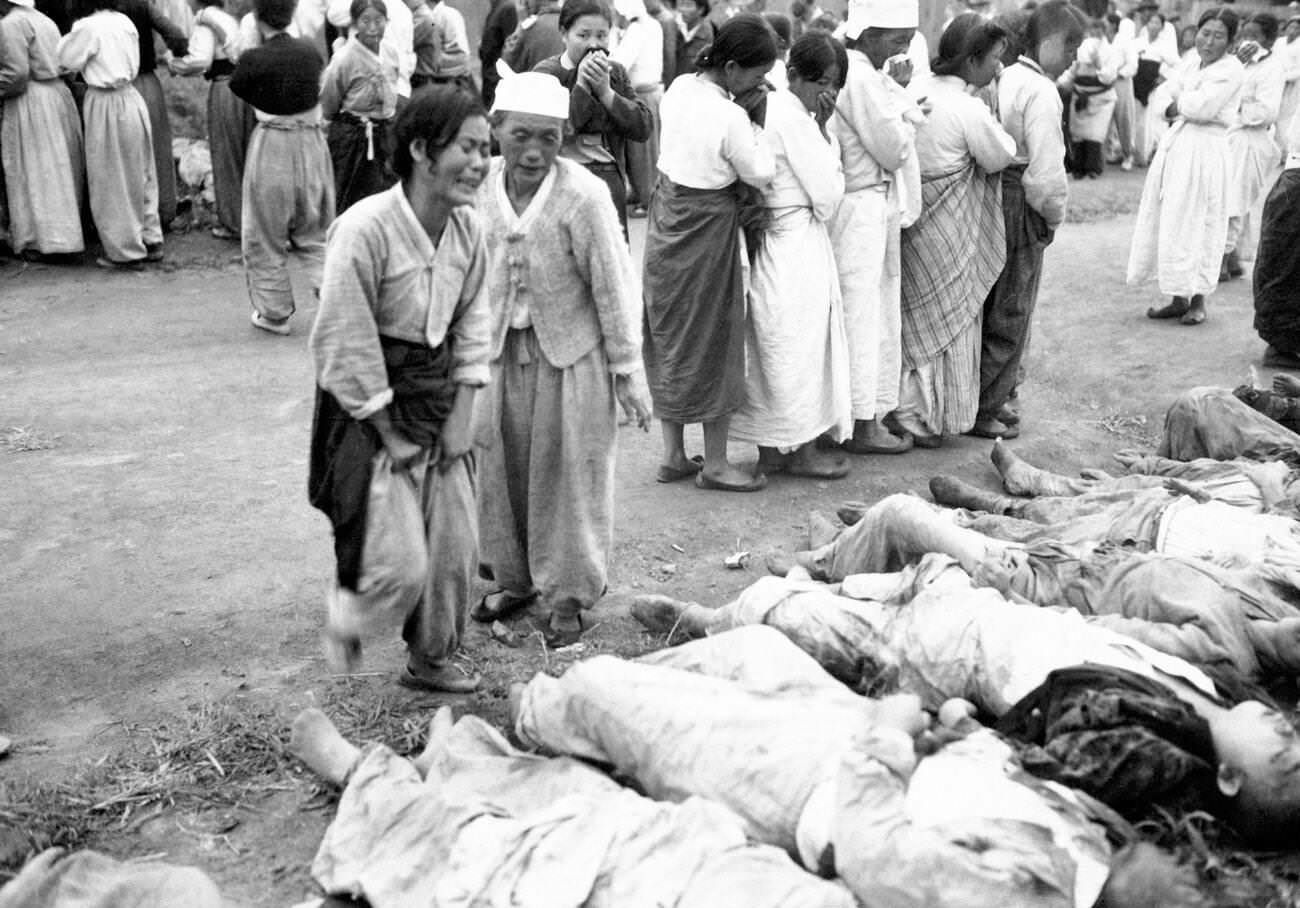
Grief and disbelief ripple through the crowd as civilians in traditional clothing gather in an open area, many with hands to their faces or bodies turned away. In the foreground, several bodies lie sprawled on the ground, their clothing dusty and rumpled, while onlookers cluster behind them in a tense, uneven line. The stark contrast between the stillness of the dead and the anxious movement of the living makes the scene difficult to forget.
War on the Korean Peninsula in the 1950s was fought by armies and alliances—South Korea backed by the United Nations, North Korea supported by the People’s Republic of China—but photographs like this insist on the human cost beyond the front lines. The framing draws the eye from the massed spectators to the casualties at their feet, suggesting a moment after sudden violence when communities were left to reckon with what had just happened. Faces are partly obscured, yet the posture of mourning speaks clearly, turning a historical conflict into a personal catastrophe.
For readers searching the history of the Korean War, this image offers more than a battlefield narrative; it reflects the disruption of everyday life and the civilian suffering that accompanied civil war conditions and shifting control. The clothing, the crowding, and the raw proximity to death evoke a society caught between forces far larger than any individual. As a historical photo for a WordPress post, it anchors discussion of the 1950s conflict in lived experience—loss, fear, and the fragile resilience of those who remained standing.