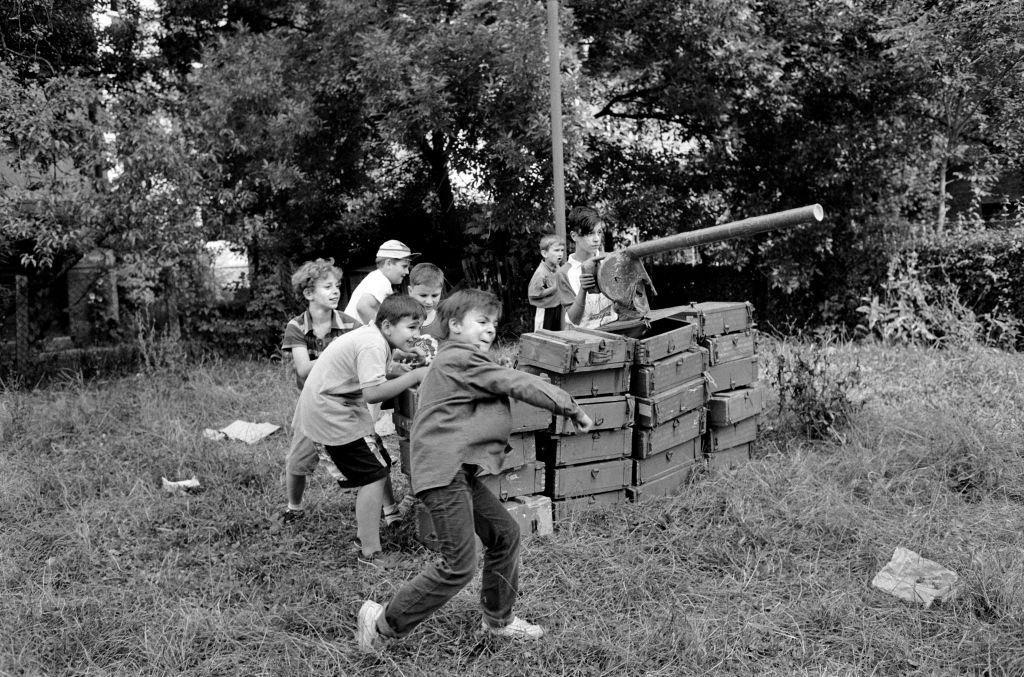
A cluster of boys crowd around a makeshift fort built from stacked ammunition boxes, their bodies angled in mid-action as if the next move matters more than anything else. One child braces himself behind the pile while another points forward, and a long metal tube protrudes over the top like an improvised cannon. The setting is a patch of grass at the edge of dense trees, a deceptively ordinary backdrop that heightens the unease of seeing war material repurposed as playground props.
The title places this moment during the shelling of Sarajevo in 1992, when pauses in real violence could still be filled by games shaped by what was closest at hand. Instead of toy soldiers, the children stage “Serb against Bosnians,” turning the language of the surrounding civil war into roles they can act out and control, however briefly. That uneasy blend—childhood energy meeting the physical leftovers of combat—makes the photograph a stark document of how conflict seeps into daily life.
Beyond its immediate scene, the image speaks to the psychological landscape of besieged cities, where normal routines are interrupted yet never fully disappear. It is a reminder that wartime photography is not only about front lines and ruins, but also about how civilians, especially children, adapt to danger and scarcity in ways that look like play from a distance. For readers searching the history of the Bosnian War, the Siege of Sarajevo, and the civilian experience of civil wars, this frame offers a chillingly intimate entry point.