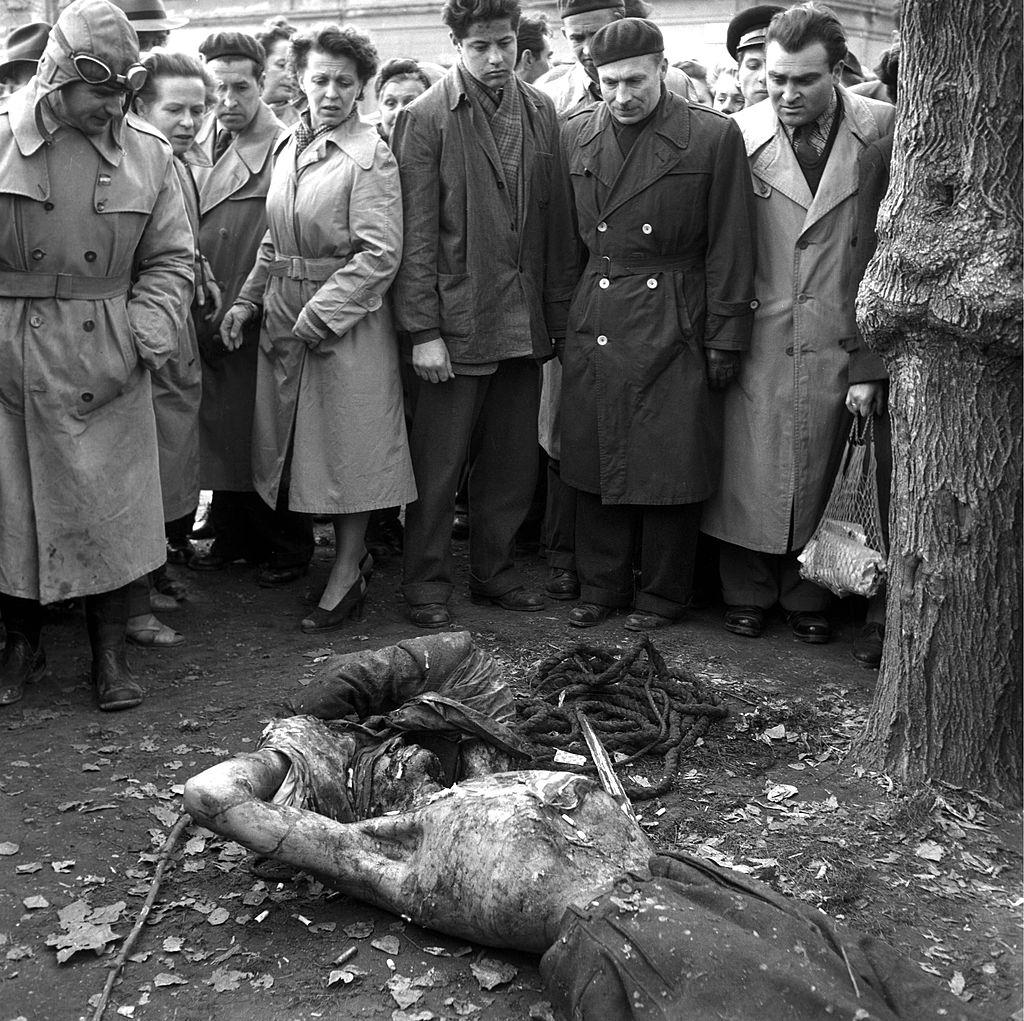
A tight ring of onlookers crowds the edge of an outdoor scene, their faces drawn and uneasy as they stare downward. Coats are buttoned against the chill, hats pulled low, and one man’s goggles and heavy trench hint at the working lives and practical gear of the era. The camera frames the group at close range, emphasizing not spectacle but the heavy silence of a public moment no one quite knows how to meet.
In the foreground lies a deceased body on bare ground scattered with leaves and debris, the figure partly clothed and marked by dirt and damage, suggesting violence or disaster. The crowd’s posture—hands in pockets, shoulders hunched, eyes fixed—reads as a mix of shock, curiosity, and grim recognition, the kind of spontaneous gathering that forms when death interrupts ordinary streets. With the post title pointing to 1956 and the broader context of “Civil Wars,” the photograph resonates as a document of communal trauma rather than a staged tableau.
For readers exploring mid-century conflict history, this image offers a stark look at how civilians encounter the realities of civil unrest: not through headlines, but at ground level, in shared space. It also reflects the ethics of witnessing—how people become a silent chorus around loss, and how a photographer’s lens turns that circle into historical evidence. Used carefully, the photo can anchor a WordPress post about 1950s civil war-era violence, public mourning, and the uneasy boundary between documentation and intrusion.