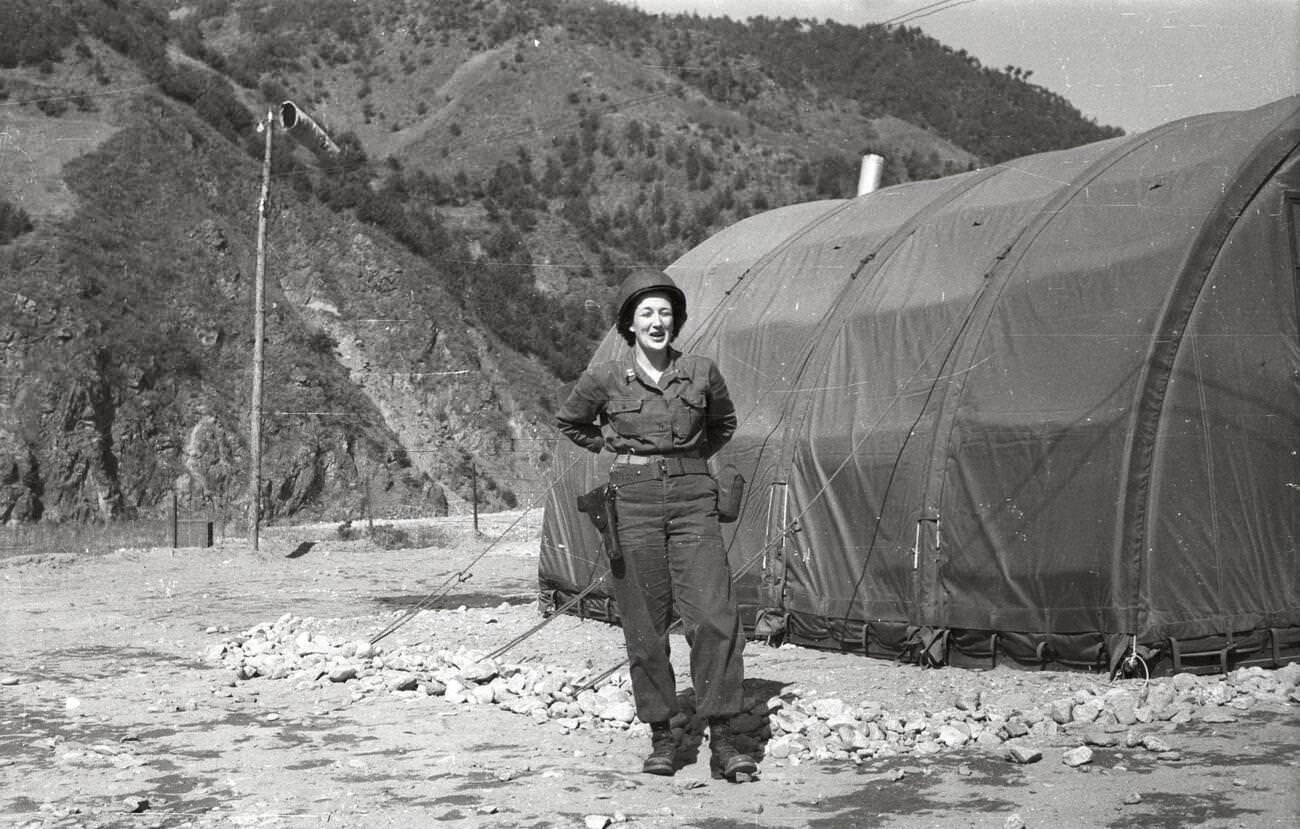
Framed by rugged hills and a line of canvas tents, a woman in U.S. Army uniform stands with the easy authority of an officer in the field. Her helmet, belted jacket, and practical boots speak to a working environment where rank mattered—but so did stamina—and the tent beside her hints at the constant movement and improvisation that defined Mobile Army Surgical Hospital (MASH) life in the 1950s.
MASH units were designed to bring surgical care close to the front, and the setting here—rocky ground, taut guy lines, and a windsock marking the breeze—captures that blend of medicine and military logistics. The photograph invites a closer look at how these temporary hospitals functioned as miniature cities: erected quickly, maintained under pressure, and staffed by professionals expected to make fast, high-stakes decisions with limited comfort and time.
Women in leadership roles within wartime medical services often appear only briefly in popular memory, yet images like this preserve their presence in clear, human terms. For readers interested in Korean War–era military medicine, women officers, and the everyday reality behind the term “MASH,” this scene offers a grounded glimpse of responsibility carried outdoors, between tents, under open sky.