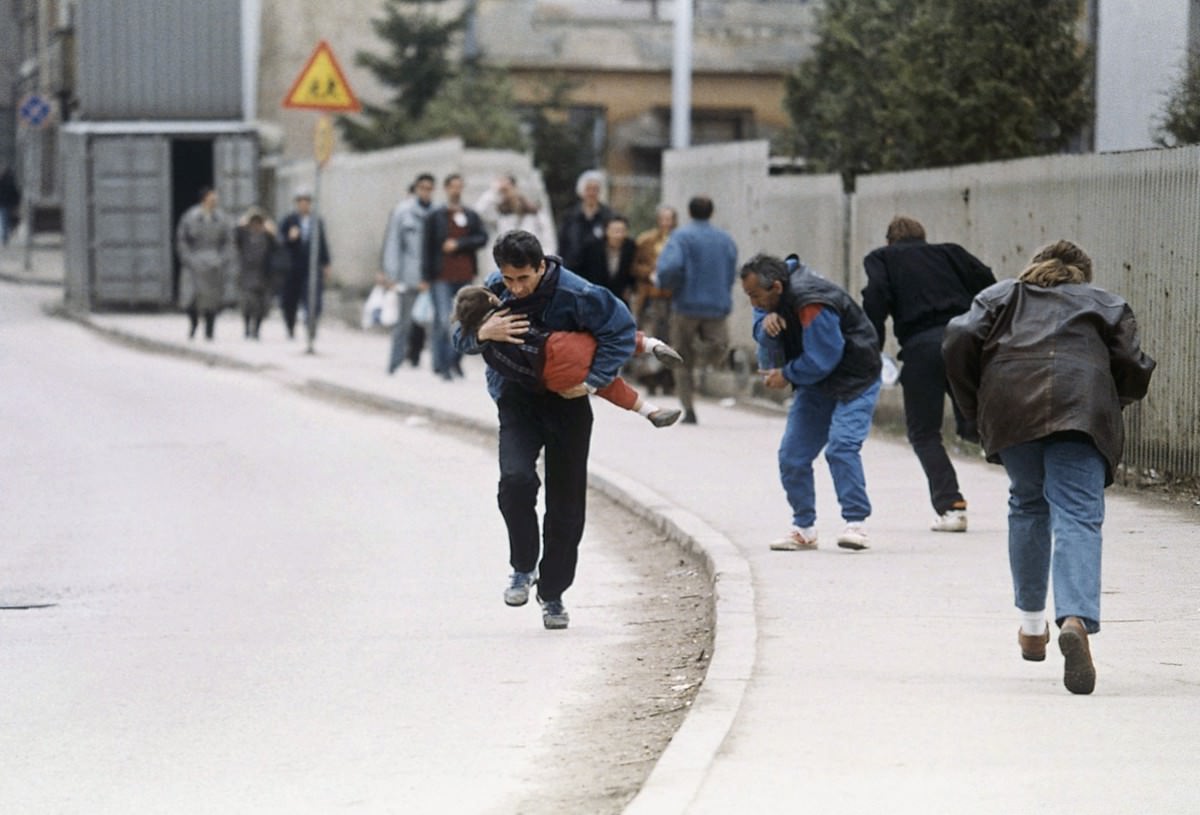
A man runs toward the camera with a small child clutched tight against his chest, the child’s legs bouncing with each hurried step. Around them, other pedestrians break into a sprint or hunch low along the curb, bodies angled as if trying to shrink beneath an invisible line of fire. The ordinary street—sidewalk, fencing, distant onlookers—turns into a corridor of danger, where speed and cover become the only protection.
Set in Sarajevo on April 11, 1993, the scene speaks to the daily mathematics of survival during the Bosnian War: when to move, how fast, and with whom. The title’s reference to one of the city’s worst sniper spots adds weight to every posture in the frame, especially the protective cradle of the child, held more like a shielded secret than a passenger. Even those farther back seem caught between waiting and running, illustrating how fear reorganizes public space.
For readers searching the history of the Siege of Sarajevo, images like this document more than battlefield headlines; they record the civilian experience of civil war in a single split second. It’s a photograph about parenting under pressure, about neighbors moving in the same direction without time for conversation, and about streets that no longer belong to pedestrians. In its quiet details, it preserves the human cost of snipers and street crossings, reminding us how conflict reshapes the simplest act of getting from one side to the other.