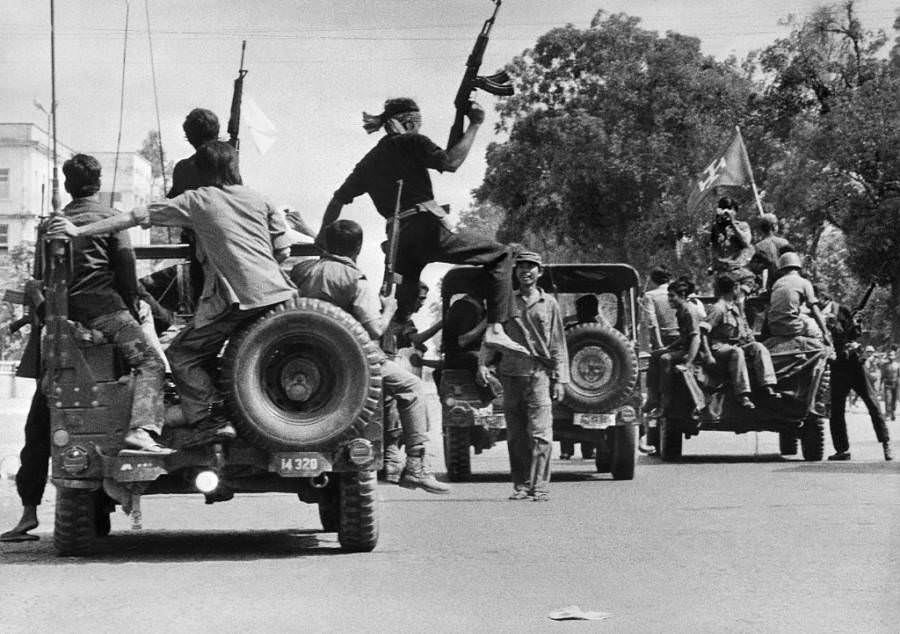
Dust and exhaust hang over a Phnom Penh street as open-backed vehicles roll forward, crowded with armed men and fluttering flags. The scene is busy and kinetic—rifles raised, bodies perched on tailgates and wheel housings, and the hard silhouettes of military jeeps cutting through the city’s everyday space. Even without hearing it, you can almost sense the engine noise and shouted directions that often accompany a capital in transition.
Taken in 1975, the photograph aligns with the moment the Khmer Rouge entered Phnom Penh at the end of Cambodia’s civil war. The casual stances and quick glances toward the roadside suggest a moving column rather than a posed portrait, capturing the uneasy mix of triumph and uncertainty that follows the collapse of one authority and the arrival of another. Trees and low buildings frame the roadway, reminding viewers that this is not a distant battlefield but an urban center where civilians would have been close by, watching events unfold in real time.
For readers searching the history of Cambodia, the Khmer Rouge, or Phnom Penh in 1975, images like this serve as stark visual evidence of power changing hands on city streets. Details—the improvised seating on jeeps, the visible weaponry, and the packed convoy—echo the broader story of civil wars, revolutions, and the rapid militarization of public life. As a historical photo, it invites reflection on how quickly a capital can be remade, and how a single day’s traffic can signal a nation’s turning point.