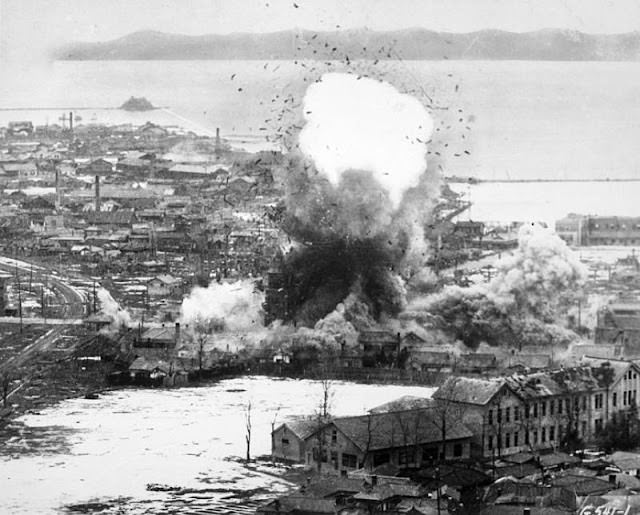
A towering blast plume rises over the port city of Wonsan, North Korea, throwing dark debris into the air while the shoreline and clustered rooftops sit in stark contrast beneath it. The harbor and surrounding hills frame the scene, underscoring how closely industry, transport, and civilian-built spaces could overlap in a wartime landscape. From this vantage point, the scale of the detonation reads as both immediate and distant—one violent moment frozen over a broad urban panorama.
In 1951, during the Korean War, B-26 Invaders were frequently tasked with striking the supply arteries that kept front-line forces moving: warehouses, rail spurs, fuel dumps, and other logistics depots. Targeting such nodes aimed to disrupt movement through ports and rail connections, and Wonsan’s coastal infrastructure made it a strategically significant objective. The photograph’s billowing smoke and expanding shock of dust suggest a concentrated hit consistent with attacks meant to cripple storage and distribution rather than merely harass.
Seen today, the image functions as more than combat documentation; it’s a visual record of airpower’s reach into the built environment and the way modern war mapped itself onto cities. The stillness of the water and the neat lines of buildings make the explosion feel even more jarring, inviting viewers to look past the spectacle to the systems being targeted—shipping, warehousing, and transport—along with the people living nearby. For readers searching Korean War history, B-26 Invader operations, or the bombing of Wonsan in 1951, this photograph offers a stark entry point into the conflict’s logistical and human dimensions.