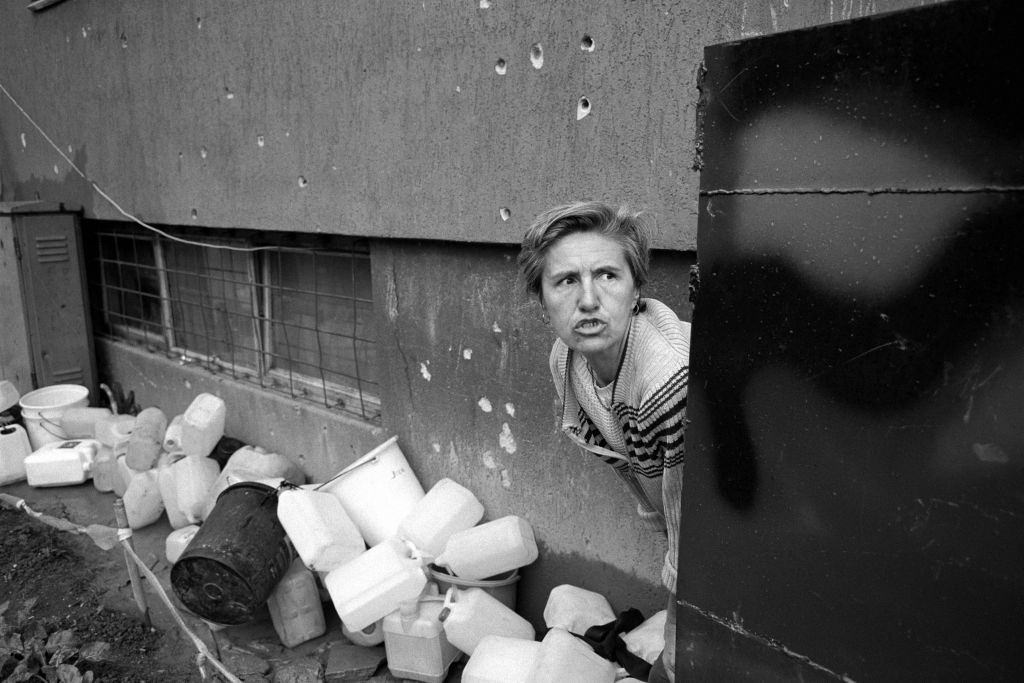
Pressed against a scarred wall, a woman leans out from cover with a look that mixes urgency and dread, as if listening for the next burst of gunfire. Around her feet, a jumble of plastic jerrycans and buckets crowds the ground, the everyday tools of survival in a city where the simple act of getting water has become a dangerous mission. Bullet marks pock the concrete above her, quiet evidence of how close violence has come to ordinary life.
July 1992 sits early in the Bosnian War, when neighborhoods were cut off, basic services failed, and civilians were forced into calculated dashes for essentials. A stand pipe—normally unremarkable—turns into a contested lifeline, drawing people into exposed spaces at precisely the moments they most want to remain unseen. The title’s mention of exchanges of gunfire between Bosnian and Serbian fighters frames the scene as part of a wider civil war, yet the photograph keeps the focus on the civilian cost measured in liters, containers, and seconds.
Details do the storytelling here: the harsh angle of her posture, the improvised queue of empty vessels, the barrier that offers only partial protection. For readers searching for historical photos of the Bosnian conflict, civilian life under siege, or the reality of water shortages during war, this image distills the era into a single tense errand. It reminds us that in civil wars, the front line often runs through the routines of daily living, where fear and necessity meet at a public tap.