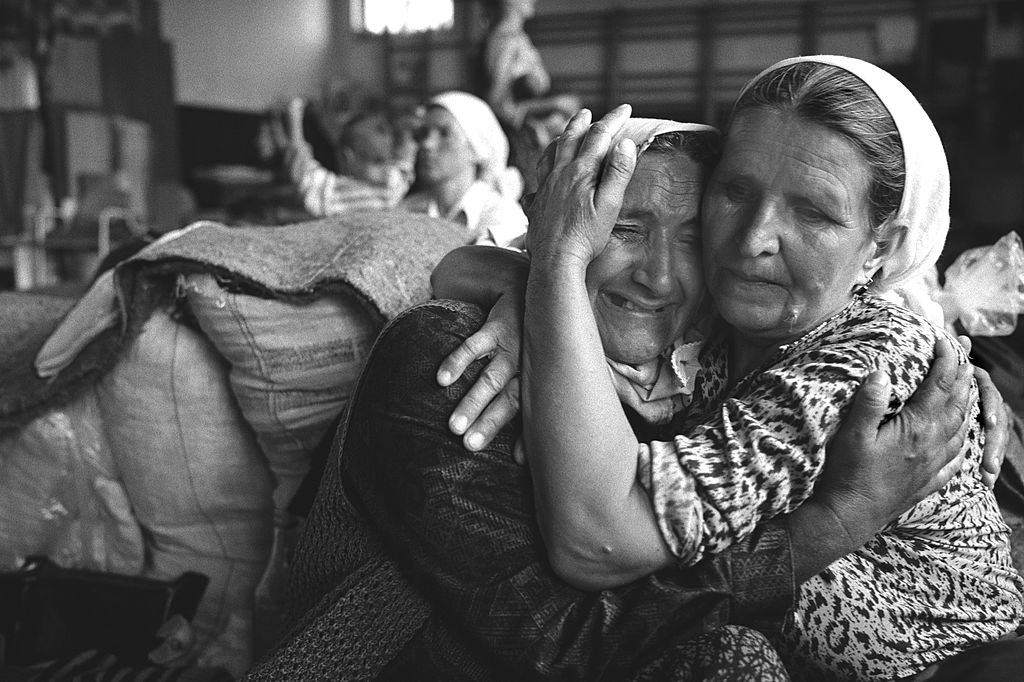
Pressed together in a tight embrace, two elderly Muslim women sit in the crowded refuge of a temporary shelter, their headscarves and lined faces drawing the eye to a grief that words cannot easily carry. One woman’s hand cups the other’s head as if to steady her, while tears and tension pull at their expressions. The closeness of their bodies speaks of consolation and endurance amid displacement after fleeing Srebrenica.
Around them, the refugee centre appears improvised and strained—blankets, bundled bedding, and people resting in the background suggest a space converted for survival rather than comfort. The shallow depth of field keeps the focus on the foreground sorrow, yet the blurred figures behind hint at a larger community of Muslim families navigating the same uncertainty. In this civil war setting, the ordinary details of shelter life become part of the story: shared floors, shared fatigue, and shared loss.
The photograph’s power lies in how it frames war not through weapons or front lines, but through the human aftermath inside a humanitarian sanctuary. It is a stark reminder of what forced flight looks like for the elderly, whose memories of home and family are carried into exile with no guarantee of return. For readers searching for historical images of Srebrenica refugees, Muslim women in wartime, and the civilian cost of civil wars, this scene offers an intimate, devastating witness.