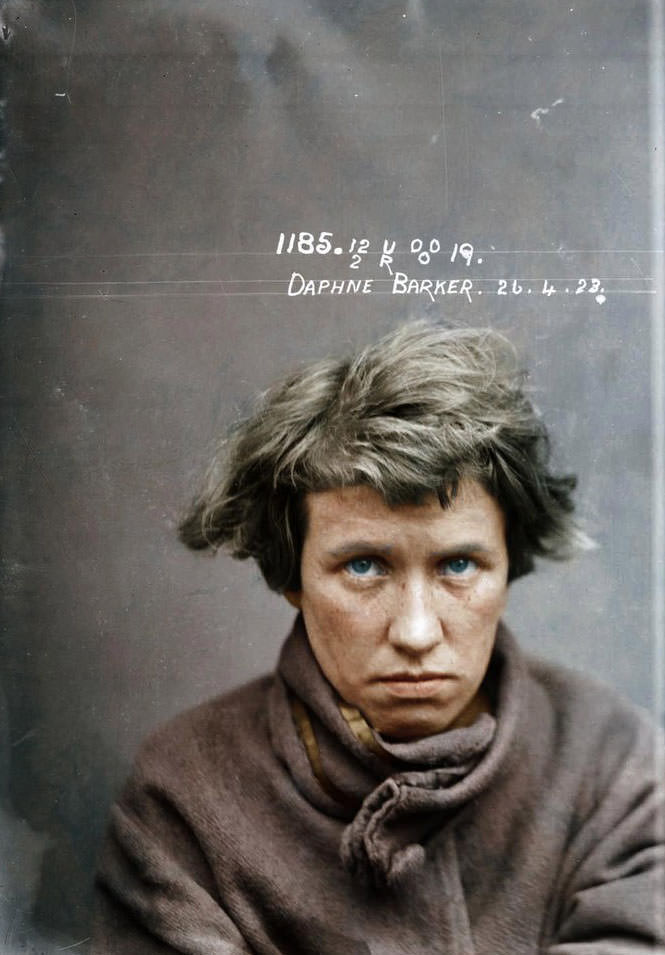
Daphne Barker’s face, set against a bare backdrop and framed by hastily written identification marks, meets the viewer with an unguarded intensity. The colorization brings forward the striking contrast of light eyes, wind-tossed hair, and a heavy coat fastened tight at the neck, suggesting a cool day and a life that hasn’t allowed much softness. Even without fuller context, the composition carries the unmistakable feel of an official record—functional, unsentimental, and meant to fix a person in time.
Noted on the image is the date 26 April 1923, along with her name, and the post title points to a probable connection with Sydney’s Central Police Station. That uncertainty matters, because it reminds us how often institutional photographs survive while the personal stories fade, leaving only clues: a number, a scribbled caption, a direct stare. If this was indeed a police station photograph, it sits within the broader history of early twentieth-century policing, documentation, and the ways authorities catalogued individuals in urban Australia.
Colorization adds a new layer of immediacy to what began as a stark archival artifact, inviting closer attention to texture, skin tone, and fabric rather than letting the subject recede into monochrome distance. For readers interested in Sydney history, Australian archival photography, or the human side of police records, this portrait is a powerful starting point—one that raises questions about circumstance, identity, and what it meant to be recorded by the state in 1923. Details remain unknown, yet the image still speaks, insisting on Daphne Barker’s presence nearly a century later.