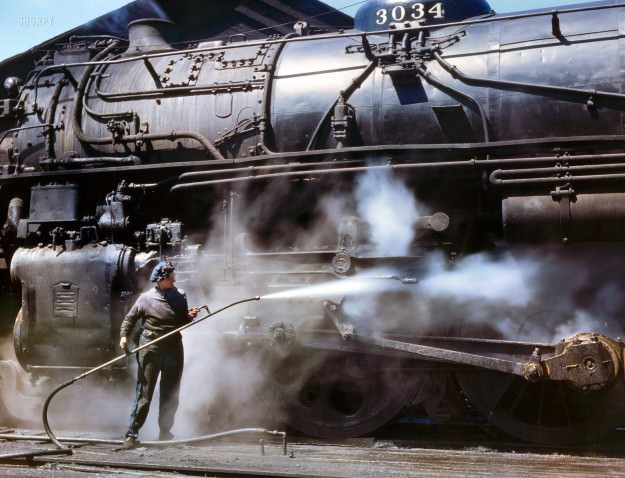
April 1943 places us inside the working rhythm of the Chicago & North Western roundhouse at Clinton, Iowa, where Viola Sievers stands beside a towering “H” class steam locomotive, hose in hand, as live steam billows around the running gear. The Kodachrome color renders the engine’s dark metal skin and riveted contours with startling immediacy, while the drifting white vapor turns the scene into something half-industrial, half-theatrical. Numbering on the locomotive’s front plate anchors the moment in the everyday specificity of railroad maintenance rather than the romance of the main line.
Viola’s job title—wiper—signals the essential, gritty labor that kept steam power moving: cleaning, servicing, and preparing locomotives for the next assignment. The “bath” of live steam suggests both efficiency and intensity, a practical method for loosening grime and grease in hard-to-reach places along rods, wheels, and pipes. Up close, the composition is all scale and texture, contrasting her small figure and steady stance with the massive machinery that dominates the frame.
Wartime context quietly sharpens the story, because the title notes that Mrs. Sievers is the sole support of her mother and has a son-in-law serving in the Army. That single sentence widens the image from shop-floor maintenance to the home front economy—women taking on demanding railroad roles while family members are away in uniform. Jack Delano’s transparency preserves not just a maintenance task, but a social record of American railroading, labor, and resilience during World War II, making it a compelling historical photo for anyone searching the era’s industrial life in authentic color.