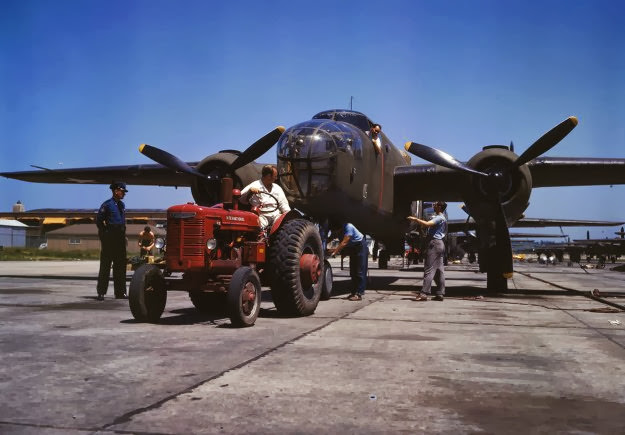
Under a wide Midwestern sky, a B-25 bomber inches forward on the outdoor assembly line at North American Aviation, Inc., hauled by a sturdy red tractor across sunlit concrete. The colorization brings a striking immediacy to the scene: dark twin engines and broad wings dominate the frame while the greenhouse nose canopy gleams, hinting at the aircraft’s complex interior. Every surface—metal skin, tires, and pavement—reads as workaday and real, a factory yard turned runway for wartime production.
Workers gather close to the aircraft as it moves, their postures practical and attentive, suggesting the careful coordination required to shepherd a bomber through final steps outside. The pairing of heavy farm-like equipment with advanced military aviation tells its own story about American industry in 1942—how familiar machines and skilled hands were repurposed to meet urgent demands. In the background, more aircraft and plant structures stretch the perspective, reinforcing the scale of manufacturing in Kansas City, Kansas during World War II.
Seen today, this moment at the North American Aviation facility is a reminder that victory was assembled as much as it was fought, one tow and inspection at a time. The outdoor line emphasizes throughput and pace, yet the men on the ground keep the focus on precision, safety, and craftsmanship. For readers searching for B-25 bomber history, Kansas City WWII industry, or North American Aviation production photos, this colorized view offers a vivid window into the logistics and labor behind the famous Mitchell.