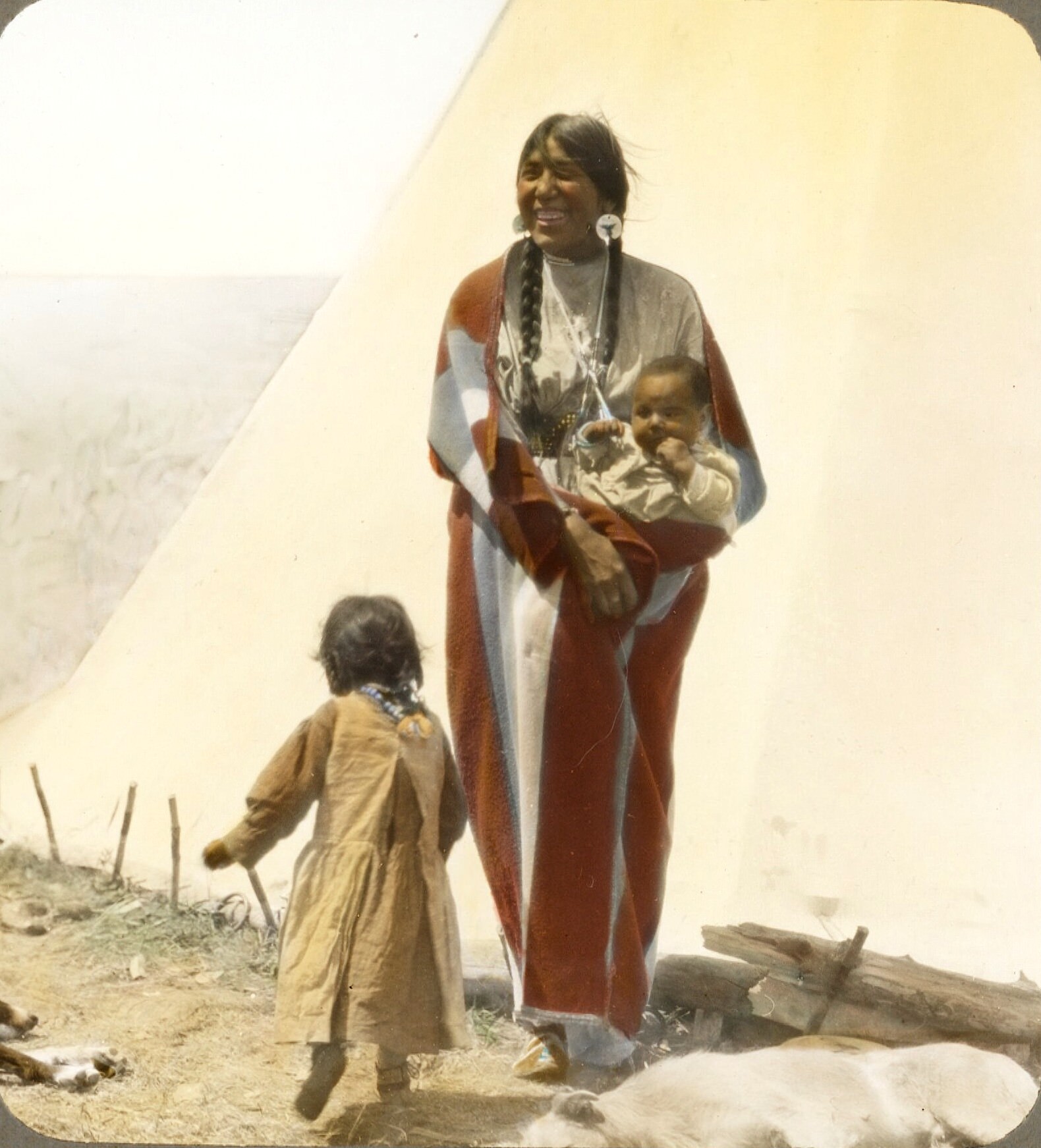
Joy breaks across the frame as a Blackfeet woman smiles into the light, her long braid and bright earrings catching the eye while she steadies a bundled baby in her arms. A small child, partly turned away, seems mid-step—perhaps the “coming running” hinted at in the title—adding a sense of movement to an otherwise quiet moment. Behind them, the pale plane of a tipi rises like a backdrop, placing this family scene firmly in Montana in the early 1900s.
Colorization lends warmth to the details: the red-and-white blanket draped around her shoulders, the soft tones of clothing, and the sunlit dust underfoot. The glass lantern slide format, associated here with Walter McClintock, was made for projection and storytelling, and the composition feels built for an audience—intimate, direct, and centered on everyday life rather than ceremony. Even with the simplicity of the setting, the photograph invites close looking at textiles, adornment, and the practical ways children were carried and kept close.
For readers searching Native American history photographs, Blackfeet family images, or Montana early 20th-century life, “Coming Running” offers a reminder that the past is made of ordinary days as much as monumental events. The mother’s expression—open, confident, and unguarded—counters the distance often imposed by archival images, pulling us into a shared human moment. As a colorized historical photo, it also prompts questions about how we see and interpret Indigenous life through lenses, captions, and the evolving choices of preservation.