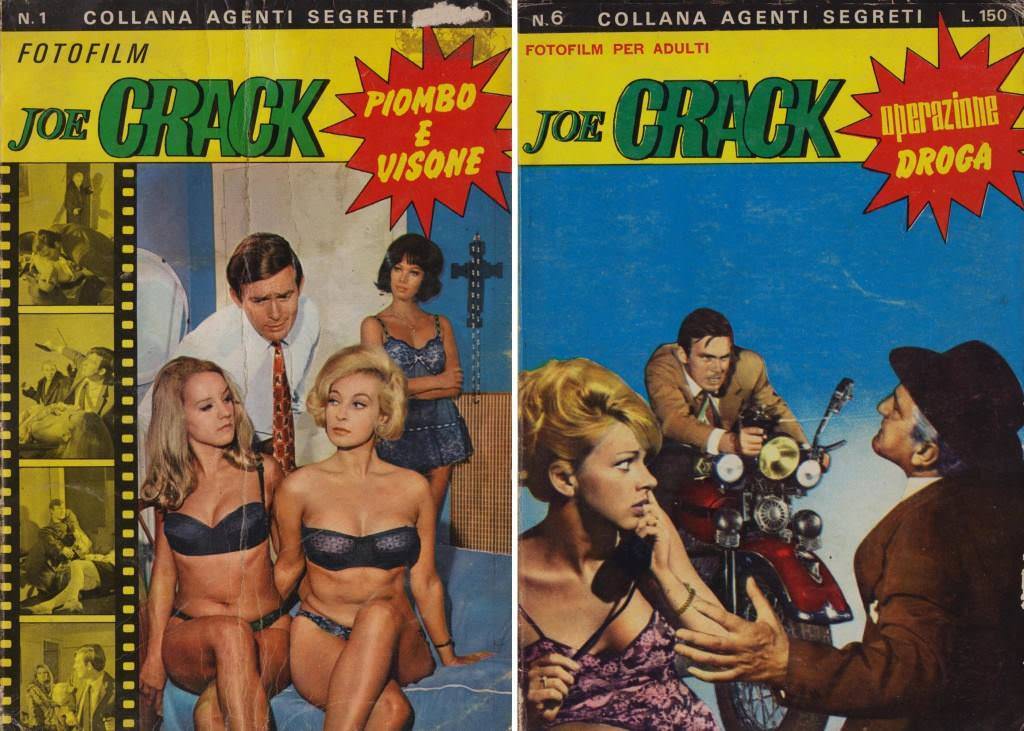
Bold Italian cover art bursts with tabloid energy: “Joe Crack” splashed across the top, starburst headlines shouting “Piombo e Visoni” and “Operazione Droga,” and a banner promising “Collana Agenti Segreti” and “Fotofilm per adulti.” The design leans hard into high-contrast color, oversized typography, and instant intrigue, the kind of kiosk-ready packaging that made crime fotonovelas irresistible to passersby in the 1960s–70s.
On the left, staged glamour and danger mingle in a single room—two women posed in lingerie, a suited man hovering between them, and another figure in the background as if the plot has just walked in unannounced. A strip of film frames the margin with tiny scenes, reminding readers that these were stories told through sequential photographs rather than drawings, borrowing the visual language of cinema to sell suspense, betrayal, and adult melodrama in a few quick glances.
The right-hand cover shifts to street-level action: a tense confrontation in the foreground, a motorbike and rider cutting in from behind, and a bright blue field that turns the scene into a billboard for noir thrills. Together these covers offer a compact lesson in Spanish and Italian crime comics (fotonovelas)—how publishers fused pulp detective themes, photographic storytelling, and sensational marketing to create a uniquely Mediterranean take on espionage, vice, and modern anxiety.