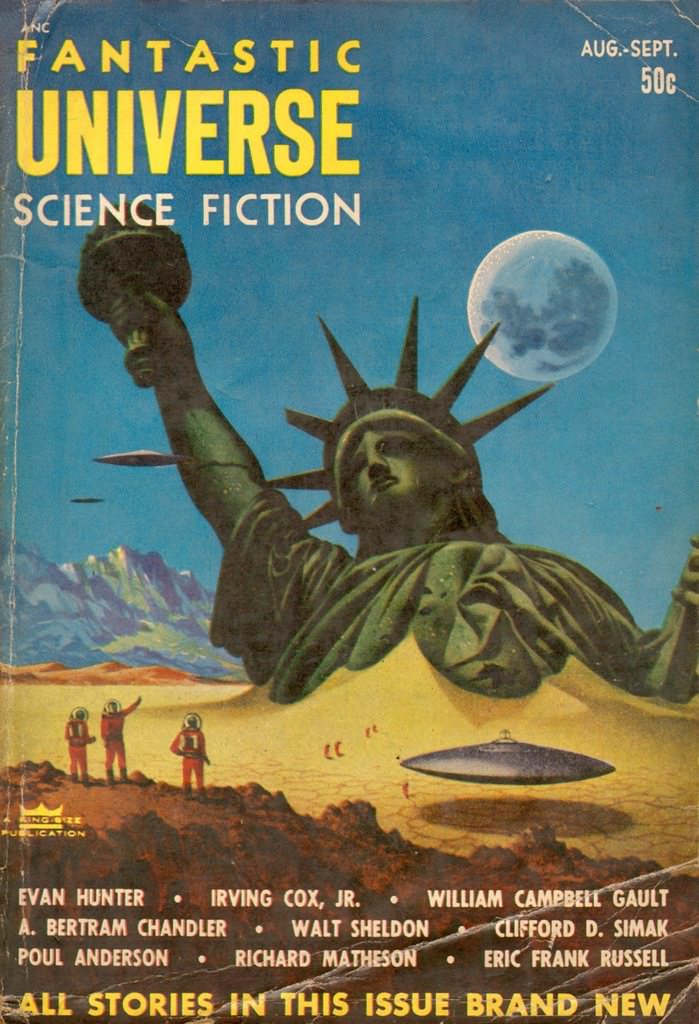
Bold yellow type shouts “Fantastic Universe” across a cool blue sky, selling science fiction as both spectacle and promise. In the corner, the cover marks an Aug.-Sept. issue priced at 50 cents, a small detail that instantly anchors the artwork in the mid-century magazine rack. Even before the scene below comes into focus, the design signals a 1950s pulp era when futurist imagination was packaged in striking, high-contrast color.
Half-buried in a vast desert lies a monumental Statue of Liberty, its crown spikes jutting into the open air like wreckage from a fallen age. A large moon hangs nearby, while tiny helmeted figures in red suits gather at the edge of the sand, dwarfed by the collapsed symbol of civilization. Off to the right, a sleek saucer-like craft hovers close to the ground, and distant mountains sharpen the horizon, turning the landscape into a stage for alien arrival, exploration, or the aftermath of catastrophe.
Along the bottom, a lineup of author names and the promise that “all stories in this issue” are brand new add to the authentic feel of a classic science fiction magazine cover. The composition leans on Cold War-era anxieties and awe—ruins, space travelers, and the question of what comes after an ending—while remaining pure adventure at a glance. For collectors and readers alike, “Fantastic Universe, 1953” stands as a vivid piece of vintage pulp cover art and a snapshot of how the genre pictured the future in bright, unsettling strokes.