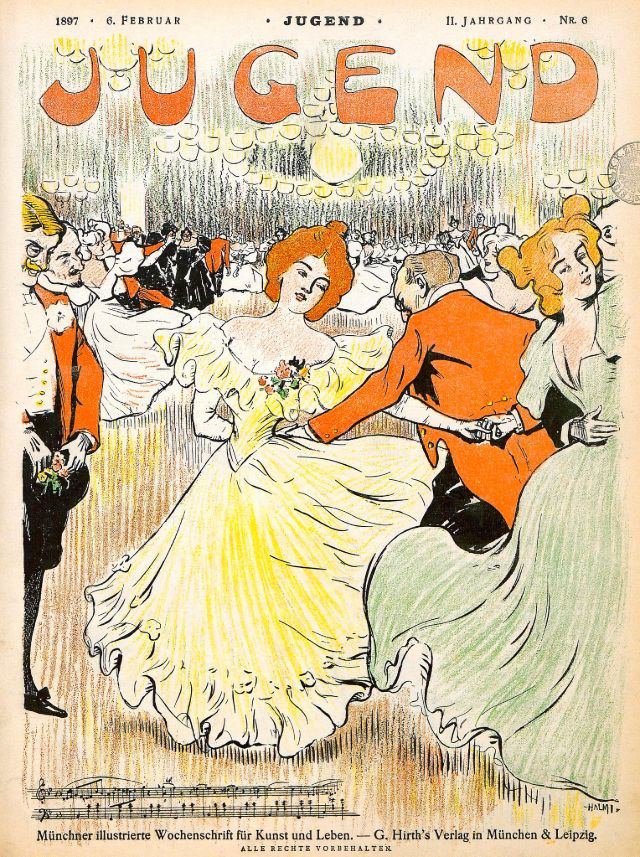
Across the top, the bold title “JUGEND” crowns a lively cover dated 6. Februar 1897 (II. Jahrgang, Nr. 6), pulling the viewer straight into a glittering ballroom scene. Couples swirl beneath a ceiling of bright, bubble-like lights, their movement suggested by sweeping lines and the blur of a crowd receding into the background. At the bottom, a short staff of printed music hints that the evening’s energy is as much heard as seen.
Center stage, a woman in a voluminous white gown turns mid-dance, her dress billowing in layered folds that catch the warm yellows and creams of the illustration. Men in formal attire—one in a striking red coat—lean and pivot with the rhythm, while a figure at the left holds a bouquet, adding a note of courtship and performance. The artist’s palette and confident contours give the scene a theatrical glamour, balancing elegance with a touch of caricature in faces and posture.
As cover art for Jugend, the Munich-based illustrated weekly devoted to art and life (“Münchner illustrierte Wochenschrift für Kunst und Leben”), this February 1897 issue showcases the magazine’s flair for modern design and social observation. The typography, color blocks, and flowing composition work together in a way that feels distinctly fin-de-siècle—fashionable, urbane, and keenly aware of spectacle. For collectors and researchers of Jugendstil, German magazine illustration, and late-19th-century visual culture, this cover offers a vivid window into the period’s taste for movement, music, and metropolitan nightlife.