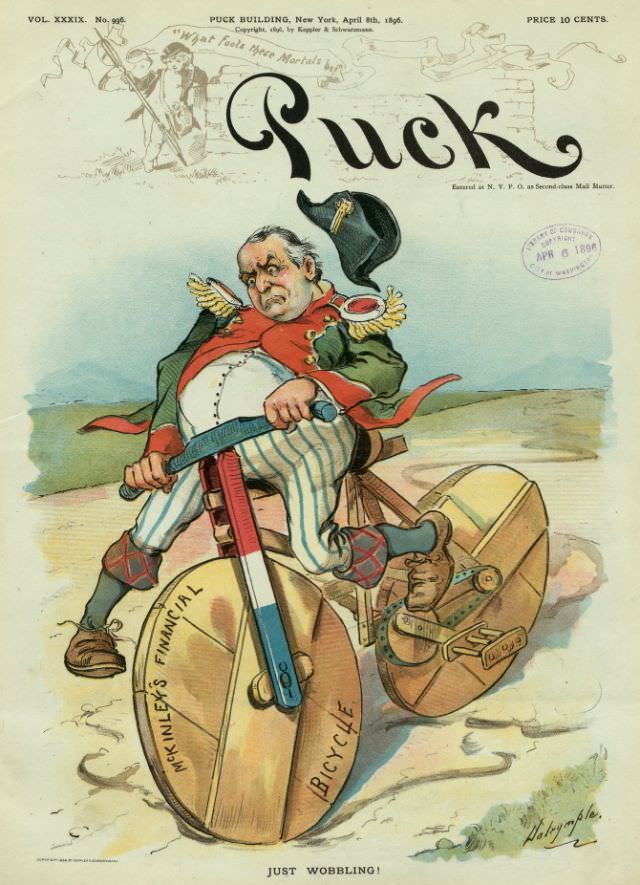
Bold lettering spells out “Puck” across the top of this April 8, 1896 magazine cover, setting the stage for a sharply colored political cartoon. At center, a weary-looking figure in a military-style coat slumps on an outsized bicycle, his posture suggesting strain and imbalance rather than speed. The illustration leans into exaggeration—oversized wheels, a sagging seat, and a rider whose expression telegraphs discomfort—to deliver satire at a glance.
The bicycle’s front wheel is labeled “McKinley’s Financial,” while the rear reads “Bicycle,” turning a popular 1890s symbol of modern motion into a metaphor for economic policy and political maneuvering. A wobble becomes the point: the rider grips the frame and sits tensely as if trying to stay upright, implying uncertainty, instability, or a ride that isn’t going as promised. The caption “Just Wobbling!” reinforces the joke, framing the scene as a public spectacle of shaky progress.
For collectors and history enthusiasts, this Puck cover offers a vivid snapshot of how late‑nineteenth‑century American satire packaged complex issues into memorable cover art. The crisp typography, hand-drawn linework, and carefully applied color wash are classic elements of magazine illustration from the era, designed to catch the eye at the newsstand. As a piece of political cartoon history, it’s a reminder that humor, symbolism, and graphic design have long shaped public conversation—sometimes with a single unsteady bicycle.