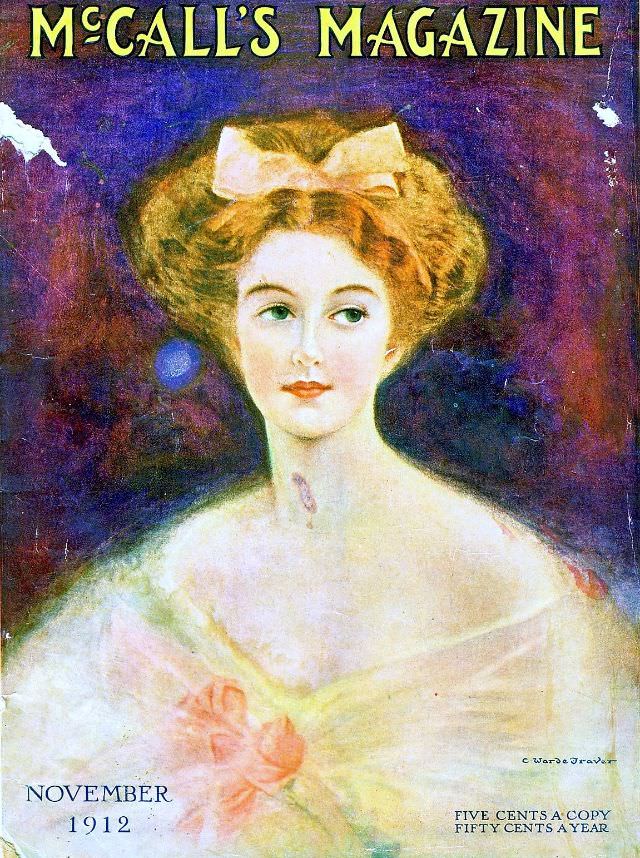
Across the top, the bold masthead “McCall’s Magazine” crowns a softly painted portrait that feels both intimate and theatrical. A young woman with auburn hair, piled high and tied with an oversized pale bow, turns her gaze slightly to the side as if caught in a private thought. The palette leans into deep purples and midnight blues behind her, setting off the luminous warmth of her skin and the delicate blush of her lips.
November 1912 appears at the lower left, anchoring the artwork in the early twentieth-century world of illustrated magazine covers and mass-market style culture. The sitter’s off-the-shoulder dress and gauzy, light-toned fabric are rendered with a painter’s touch, while a rose-like accent at the bodice adds a note of softness and romance. Even the small pricing text at the bottom right—“Five cents a copy, fifty cents a year”—quietly reminds modern readers how widely such imagery circulated.
Rather than relying on a busy scene, this McCall’s cover art uses restraint: a single figure, a rich background, and a carefully controlled play of light that draws the eye back to her expression. It’s a compelling artifact for anyone exploring 1912 magazine illustration, women’s fashion imagery, or the visual language of American print culture in the years before modern advertising took over. As a historical cover, it offers a vivid glimpse into how elegance, youth, and aspiration were packaged for readers at the newsstand.