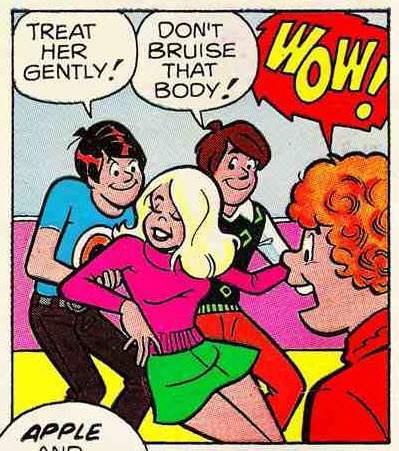
Bright pop-art colors and exaggerated teen expressions set the tone in this Archie-style panel, where a blonde girl in a tight pink top and short green skirt is caught mid-swoon as two boys crowd in with a little too much enthusiasm. The speech balloons—“TREAT HER GENTLY!” and “DON’T BRUISE THAT BODY!”—lean into suggestive banter, while a big “WOW!” from a red-haired onlooker punctuates the moment like a canned laugh turned flirtatious. Even without a full page of context, the composition telegraphs a shift from innocent hallway hijinks to something knowingly racy.
That wink-at-the-reader energy is exactly what made certain 1970s “funny” comics feel hotter than earlier decades, when the humor was typically safer and the romance more coy. Here, body language does the storytelling: hands hovering, faces close, and a heroine drawn as much for curves and attitude as for punchline potential. The gag still reads as slapstick, but it also signals how publishers tested the boundaries of mainstream youth comedy by dialing up sexuality in poses, dialogue, and reaction shots.
For collectors and comic historians, panels like this help map how Archie Comics and its contemporaries navigated changing tastes—keeping the familiar clean linework and bright palette while letting the jokes grow more adult. It’s a small snapshot of an era when the “lusty pages” weren’t explicit so much as loaded with innuendo, capturing the cultural crosscurrents that reshaped pop entertainment. If you’re exploring Archie Comics in the 1970s, this kind of art is a telling clue to how the series flirted with edgier humor while still passing as lighthearted fun.