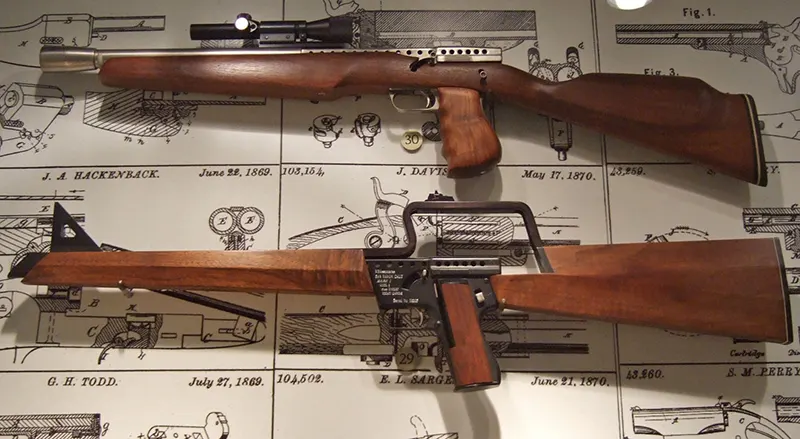
Few Cold War curiosities feel as boldly futuristic as the Gyrojet guns of the 1960s, a family of experimental firearms that tried to replace conventional bullets with tiny rocket projectiles. The photo highlights two examples laid out for inspection: long wooden stocks, compact metal assemblies, and an overall silhouette that reads more like a prototype than a mass-produced weapon. Even at a glance, the design suggests an era when “invention” meant rethinking fundamentals rather than polishing old patterns.
What makes the Gyrojet concept so searchable—and so debated among collectors and military-history readers—is the ammo itself: self-propelled rounds intended to accelerate after leaving the barrel. That idea promised reduced recoil and a different set of engineering tradeoffs, shifting attention from barrels and pressure to ignition, stability, and consistent thrust. The visible mix of simple wood furniture and intricate metal parts underscores how experimental technology often arrives wrapped in familiar forms.
Beneath the guns, technical drawings and patent-style diagrams create a fitting backdrop, situating these objects in the world of mid-century research labs, test ranges, and speculative procurement. For a WordPress post on 1960s inventions, this historical photo works as a visual anchor for discussions about prototype culture, unconventional small-arms development, and why some innovations—no matter how imaginative—struggle to move from concept to widespread adoption.