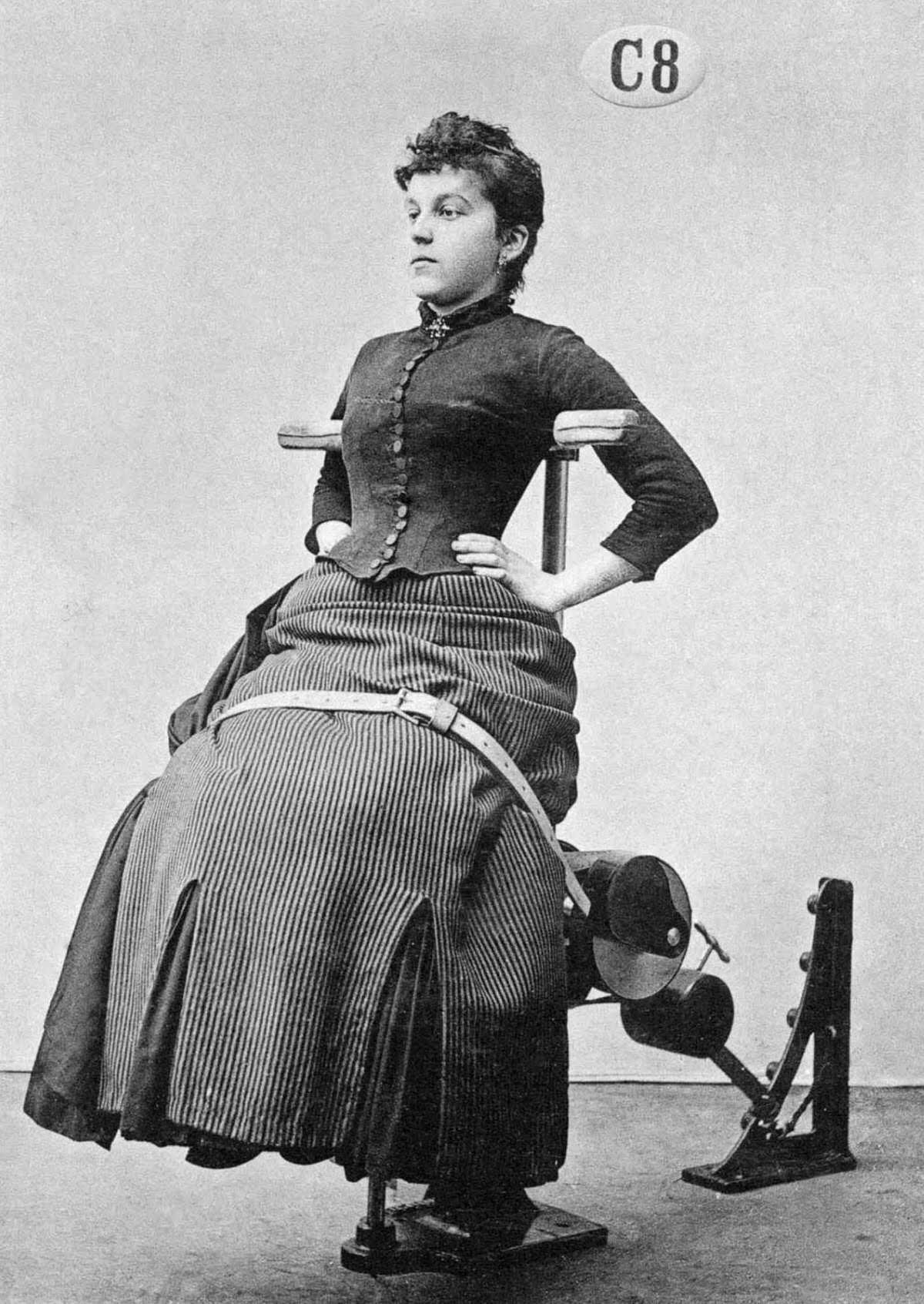
Rigid posture meets mechanical ingenuity in this striking scene of a woman seated on an early exercise or therapeutic contraption billed as a pelvis-twisting machine. A broad belt is fastened across her lap, anchoring the body while a system of levers and rotating parts sits to the side, suggesting controlled motion rather than free movement. Even the studio-like backdrop and the small “C8” marker add to the sense that this was documented as an invention meant to be studied, marketed, or demonstrated.
Devices like this belong to a moment when wellness, “corrective” exercise, and modern technology were being blended into fashionable promises of better health. The machine’s design implies a focus on the hips and core—an attempt to mechanize what today might be called stretching, mobilization, or targeted conditioning. Clothing and setting hint at an era when such equipment was presented with scientific confidence, even if the experience for the user likely felt awkward, restrictive, or both.
For readers interested in the history of fitness machines and medical inventions, the pelvis-twisting machine offers a vivid example of how bodies were shaped—literally and culturally—by the gadgets of their day. It raises questions about who these devices were built for, what claims surrounded them, and how ideas about women’s health were packaged in steel, straps, and swivels. As a piece of visual history, it’s both a curiosity and a reminder that the pursuit of “improvement” has long been big business.